women boyshot underwear

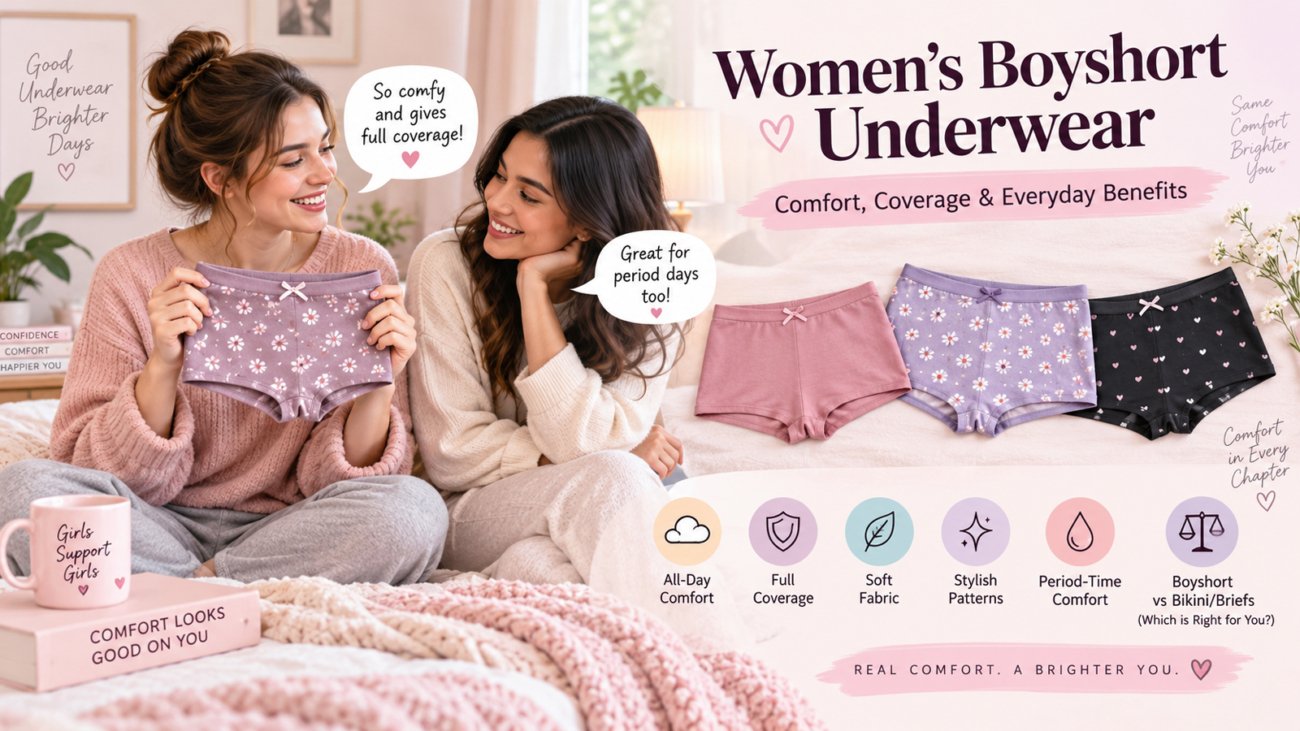
Women’s Boyshort Underwear: Comfort, Benefits, Period Use & Everything You Need to Know

Today women have plenty of choices when it comes to underwear. Briefs, bikini panties, hipsters, thongs, seamless panties and boyshorts all offer different levels of coverage and comfort.

Among these options, women’s boyshort underwear has become especially popular with younger women who want more coverage without giving up a modern and stylish look.

But what exactly is a boyshort? Is it comfortable during periods? Is it better than a regular brief or bikini panty?

Meet Riya and Neha, two friends discussing exactly these questions.


1. What Is Boyshort Underwear?

Riya: Neha, I keep seeing “boyshort panties” while shopping online. Why are they called boyshorts?

Neha: Because their shape is inspired by men’s short-style underwear. Instead of having a high-cut leg opening like bikini panties, women’s boyshorts usually extend slightly further down the upper thigh and provide more coverage around the hips and bottom.

Riya: So are they actually shorts?

Neha: Not exactly. They are still underwear, but their wider side panels and extended leg design give them a short-like appearance.

A typical women’s boyshort panty covers more of the hips and buttocks than a bikini panty. Depending on the design, it may sit at the low waist, mid waist or high waist.

For example, imagine a soft FLYBABY cotton-stretch boyshort with a comfortable waistband, full back coverage and slightly extended leg openings. It would provide the coverage of a fuller panty while maintaining a youthful, modern shape.

The major difference is therefore simple:

Bikini = less coverage and higher-cut legs.
Boyshort = broader sides, lower leg opening and greater coverage.


2. How Many Types of Patterns Are Available in Boyshort Underwear?

Riya: Are boyshorts always plain? Most of the ones I remember seeing were basic solid colours.

Neha: Not anymore. Boyshorts now come in many fabrics, prints and constructions.

There is no fixed number of boyshort patterns because brands keep introducing new collections. However, several styles are commonly found in the market.

Solid Boyshorts

Solid-colour boyshorts are one of the most common choices for everyday wear.

Colours such as black, nude, white, pink, maroon, navy blue, lavender and pastel shades work well for regular wardrobes.

For example, a black cotton boyshort can be an easy everyday option because it is simple, practical and easy to pair with different outfits.

Printed Boyshorts

You can also find boyshorts featuring floral prints, geometric designs, hearts, polka dots, stripes, abstract graphics and small repeat prints.

These designs are particularly popular among younger consumers looking for something more playful than basic underwear.

Seamless Boyshorts

Seamless boyshorts are designed with minimal or reduced visible seams.

They can work especially well underneath fitted dresses, leggings or trousers when reducing visible underwear lines is important.

Lace Boyshorts

Lace boyshorts combine the coverage of a boyshort silhouette with decorative lace.

They are generally chosen more for fashion and appearance, although comfort depends heavily on the softness and construction of the lace.

Ribbed Boyshorts

Ribbed fabrics give boyshort underwear a casual, modern appearance.

Soft ribbed cotton or stretch fabric is particularly suitable for lounging and everyday comfort.

High-Waist Boyshorts

These offer additional abdominal and waist coverage.

Some women prefer this shape during lounging, sleeping or days when they simply want a little more coverage.

Low-Rise Boyshorts

Low-rise boyshorts sit lower on the waist and can work with low- or mid-rise trousers.

Period Boyshorts

Period boyshorts are a separate functional category.

Unlike an ordinary boyshort, genuine period underwear contains absorbent and leak-resistant layers designed specifically for menstrual protection.

So although the basic boyshort shape stays similar, fabric, waistband, rise, leg length, print and functional construction can all be different.


3. Why Do Young Women Like Wearing Boyshort Underwear?

Riya: Why do you think boyshorts are so popular among younger women?

Neha: Probably because they combine comfort, coverage and a modern look.

Many young women want underwear that feels practical for college, work, travelling, relaxing at home and sleeping.

Boyshorts provide additional hip and back coverage compared with many bikini-style panties. This can create a more secure feeling for women who dislike underwear with very narrow sides.

Their shape may also reduce direct friction between certain garment seams and the upper-thigh area when the boyshort fits properly.

For example, imagine someone spending a long day travelling by train or flight. A soft cotton-stretch boyshort with a smooth waistband may feel more comfortable than a very narrow panty because it distributes fabric coverage over a wider area.

Riya: So it is basically fashion plus practical comfort?

Neha: Exactly. That balance is probably one of its biggest attractions.


4. Is Boyshort Underwear Comfortable During Periods?

Riya: This is actually what I wanted to know. Are boyshorts good during periods?

Neha: They can be very comfortable, but you need to choose the correct type.

A well-fitting boyshort provides more coverage around the hips and back, which can make some women feel more secure during menstruation.

Soft cotton-rich or breathable stretch fabrics can also feel comfortable during long periods of sitting, sleeping or travelling.

However, an ordinary boyshort should not be confused with period underwear.

Regular boyshort panties do not automatically absorb menstrual flow or prevent leakage.

If someone uses sanitary pads, the boyshort needs to fit securely enough to keep the pad properly positioned. The gusset design and leg opening also matter. If the underwear is too loose, the pad may shift.

For heavier flow or overnight use, specially designed period boyshort underwear with absorbent and leak-resistant layers may be a more appropriate choice.

Riya: So just because something has a boyshort shape doesn’t mean it is period-proof?

Neha: Correct. “Boyshort” describes the underwear shape. “Period underwear” describes its menstrual-protection function.

For example, a regular cotton FLYBABY-style boyshort could be comfortable when worn with suitable menstrual protection, while a dedicated period boyshort would require additional absorbent construction specifically designed for menstrual flow.


5. What Are the Benefits of Boyshort Underwear?

Riya: Apart from coverage, what makes boyshort underwear worth buying?

Neha: Quite a few things, provided you select the right size and fabric.

One of the biggest advantages is greater coverage. Boyshorts generally cover more of the hips and bottom than bikini panties.

Another advantage is a secure feeling. Some women feel more comfortable in underwear with wider side coverage, especially while sleeping, travelling or moving throughout the day.

The broader construction can also make boyshorts suitable for lounging and nightwear. Some women even pair boyshort-style underwear with an oversized T-shirt while relaxing at home.

Boyshorts made from breathable cotton-rich fabrics can work well for daily wear, while stretch fabrics help the underwear follow natural body movement.

A well-designed boyshort can also provide comfortable coverage underneath skirts and loose dresses.

And aesthetically, boyshorts have a distinctive sporty, youthful and modern appearance that separates them from traditional briefs.


6. What Are the Disadvantages of Boyshort Underwear?

Riya: Okay, they sound pretty good. But there must be some disadvantages too.

Neha: Definitely. No underwear style is perfect for every person, body shape or outfit.

One common issue is riding up. If the leg opening or size is incorrect, boyshort fabric may move upward when walking or sitting.

Another possible problem is visible panty lines. Boyshorts with thick seams can sometimes show underneath very tight trousers, leggings or bodycon dresses.

Because they contain more fabric than bikini panties, some designs may also feel warmer in hot weather, particularly if they are made from poorly breathable synthetic material.

Fit is especially important. A boyshort that is too small can feel tight around the thighs, while a boyshort that is too large may move around and lose support.

Some boyshort constructions may also be less convenient with certain sanitary pads if the gusset shape or fit does not hold the pad securely.

That is why the best choice is usually a boyshort made with a soft, breathable fabric, appropriate stretch and the correct size.


7. Is Boyshort Underwear Better Than Brief or Bikini Panties?

Riya: Now the big question. Boyshort, brief or bikini—which one is actually the best?

Neha: There isn’t one universal winner. It depends on what you are wearing and what feels comfortable to you.

Riya: So if I want maximum everyday coverage, boyshorts could make sense.

Neha: Yes.

If you want something classic and supportive, briefs are excellent.

If you prefer narrower sides and higher-cut legs, bikinis may suit you better.

And if you want fuller hip coverage with a youthful, sporty feel, boyshorts are worth trying.

Body shape also matters. Two women wearing the same size can still prefer completely different cuts because everyone’s hips, thighs and waist proportions are different.


8. Final Conclusion: Should Women Try Boyshort Underwear?

Riya: Okay, after this conversation I think I finally understand why boyshorts are becoming popular.

Neha: They are definitely worth trying, especially if you like fuller coverage.

Women’s boyshort underwear offers an interesting middle ground between traditional full-coverage panties and fashion-oriented underwear.

It provides broader coverage around the hips and bottom, comes in everything from simple cotton solids to prints, seamless constructions and period-specific versions, and can work particularly well for everyday wear, travelling, relaxing and sleeping.

However, the experience depends heavily on fabric, fit, leg opening, waistband and size.

A poorly fitted boyshort can ride up or feel tight, while a well-designed boyshort made from soft, breathable stretch fabric can become one of the most comfortable pieces in an underwear wardrobe.

During periods, boyshorts may offer a secure and comfortable feeling, but remember that ordinary boyshort underwear is not automatically leakproof. Proper menstrual protection or dedicated period boyshort underwear is still necessary.

Anti-Rash Underwear

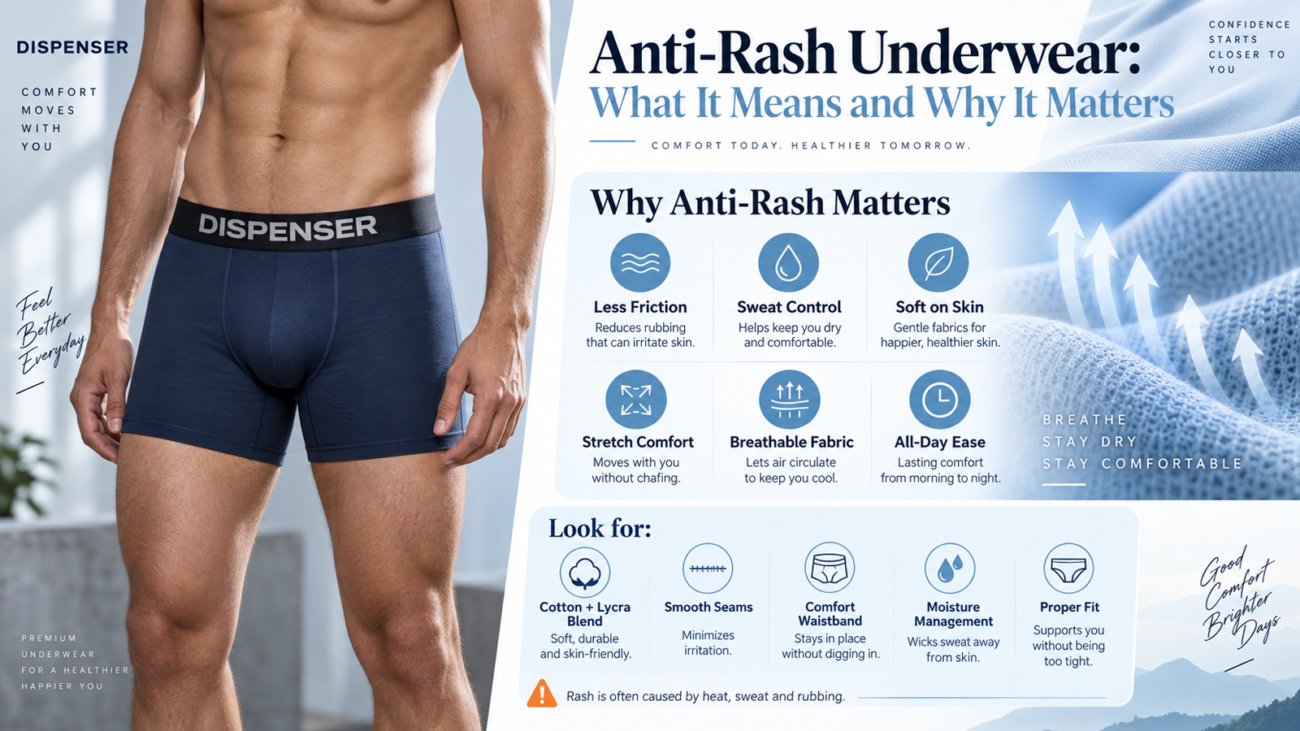
Anti-Rash Underwear: What It Means and Why It Matters

Underwear stays in direct contact with some of the most sensitive areas of our skin for many hours every day. During walking, travelling, exercising, sitting at work, or simply dealing with hot weather, the combination of sweat, heat, moisture and repeated rubbing can make the skin uncomfortable.

This is why the term “anti-rash underwear” has become important in modern innerwear.

But what does anti-rash actually mean? Is it a special chemical treatment? Does it mean the fabric can prevent every type of rash? And what role do fabric, dyes, seams, moisture and fit play?

Let’s understand it in detail with practical examples using DISPENSER underwear.

1. What Is “Anti-Rash”?

“Anti-rash” is commonly used in apparel to describe underwear designed to reduce the conditions that can lead to skin irritation, particularly friction, trapped sweat, excessive moisture, rough fabric contact and uncomfortable seams.

It is important to understand that anti-rash is not one single medical treatment or universally defined textile process. A rash can have many causes, including friction, heat, moisture, allergy, infection or an existing skin condition.

One common example is chafing. When skin or fabric repeatedly rubs against the body, particularly in a warm and sweaty environment, irritation can develop. Medical sources note that friction combined with heat and moisture can contribute to inflammatory conditions such as intertrigo.

Therefore, good anti-rash underwear focuses on creating a better environment between the skin and the garment.

For example, imagine wearing a DISPENSER Cotton Lycra trunk during a long working day. A soft fabric surface, comfortable stretch, breathable construction and smooth seams can help reduce unnecessary rubbing compared with underwear that is rough, poorly fitted or remains heavily damp with sweat.

So, in simple words:

Anti-rash underwear = underwear designed to reduce friction, moisture accumulation and other fabric-related sources of irritation.

It should not be interpreted as a guarantee that a person will never develop a skin rash.


2. What Are the Different Types of Rash Problems Related to Underwear?

When we talk about “anti-rash” underwear, it helps to understand that irritation can come from different sources.

Friction or Chafing

This is one of the most common problems associated with innerwear.

The inner thighs, groin, waistband and leg openings move continuously when we walk, run or exercise. If fabric repeatedly rubs against damp skin, irritation may develop.

Research on skin-textile interaction shows that excessive friction between fabric and the skin can contribute to discomfort, chafing and other forms of irritation.

DISPENSER example:
A properly fitted DISPENSER stretch trunk can move more naturally with the body. Soft fabric, suitable stretch and smoother construction can help minimise excessive fabric-to-skin rubbing during daily movement.

Sweat and Moisture-Related Irritation

Sweat itself does not automatically create a rash. The bigger problem occurs when moisture remains trapped around the skin while heat and friction continue.

Warm and moist environments can increase friction and may also create conditions in which microorganisms can multiply more easily.

DISPENSER example:
A breathable DISPENSER innerwear fabric designed to manage everyday perspiration can provide a more comfortable skin environment than thick, poorly ventilated underwear that stays wet for a long time.

Irritant Contact Dermatitis

Some materials or substances can directly irritate sensitive skin. The problem does not necessarily involve an allergy.

Rough fibres, chemicals, detergents, sweat and repeated physical contact may all contribute to irritation in susceptible people.

Allergic Contact Dermatitis

This is different from normal chafing.

A person may be sensitive or allergic to a substance used in a garment. According to DermNet, textile contact dermatitis is more commonly related to chemical additives used during textile processing than to the fibre itself.

Potential textile allergens may include certain:

  • Textile dyes
  • Finishing chemicals
  • Formaldehyde-based resins
  • Rubber or elastic components
  • Glues
  • Metal accessories
  • Other chemical additives

Formaldehyde-containing textile finishes and certain dyes have historically been associated with allergic or irritant textile dermatitis.

This is an important reason why “anti-rash” cannot depend only on softness. Responsible dyeing, finishing and chemical control also matter.


3. What Type of Chemical Allergy Can Come From Fabric?

Modern fabric passes through several manufacturing stages before becoming underwear.

Depending on the textile, processes may include:

Fibre → Yarn → Knitting → Dyeing → Washing → Finishing → Cutting → Stitching → Finished Underwear

Chemicals may be introduced during some of these stages to provide colour, softness, wrinkle resistance, easy-care properties or other performance characteristics.

Most people wear modern textiles without developing a problem. However, sensitive individuals may react to particular substances.

Textile Dyes

Certain textile dyes have been associated with allergic contact dermatitis. Sweat can sometimes encourage loosely bound dye molecules to move from the fabric onto the skin.

The problem may become more noticeable around areas with greater rubbing and perspiration, including the:

  • Waist
  • Groin
  • Buttocks
  • Upper thighs

Formaldehyde-Based Finishing Resins

Formaldehyde-based resins have historically been used in some textiles for properties such as wrinkle resistance.

Formaldehyde can act as both an irritant and a sensitiser in susceptible individuals. Clothing-related reactions are more likely around areas where there is considerable friction and sweating.

Rubber and Elastic Components

Waistbands and elastic materials can contain substances that may cause contact reactions in certain people.

This makes waistband quality particularly important in underwear because the waistband remains in direct contact with the skin for many hours.

Finishing Agents

Textile finishing can add useful functionality, but adding more chemicals does not automatically make a fabric better for sensitive skin.

Even antimicrobial textile technologies have to be assessed for skin safety, sensitisation and biocompatibility. Scientific reviews point out that antimicrobial treatments should be evaluated carefully because some textile treatments may themselves cause irritation in susceptible users.

This means an effective anti-rash approach should focus not simply on adding a chemical, but on designing the entire fabric and garment responsibly.


4. How Can the Rash Problem Be Reduced Through Fabric Design?

There is no single fabric treatment that can solve every cause of skin rash. Instead, underwear manufacturers can work on several factors together.

Choose Soft, Skin-Friendly Fabric

A smoother textile surface can help reduce unnecessary mechanical rubbing. there are many fabric are design by pass out anti rush problem like bamboo, and micro modal.

For example, DISPENSER Micro Modal and bamboo based underwear can be designed to combine softness with stretch, allowing the garment to move more naturally with the wearer.

Maintain Good Stretch and Recovery

Underwear that is too tight can create pressure and friction. Underwear that becomes too loose can bunch or move excessively, which may also cause rubbing.

A stretch blend such as Cotton Lycra can help underwear maintain a comfortable body-following fit when properly designed.

Best Combination of 95% cotton, you retain the natural cotton feel, breathability and moisture absorption. The 5% Lycra is usually enough to give 4-way stretch, better recovery and a body-following fit without making the garment feel overly synthetic.
Following table are explain best combination of fabric good stretch and recovery

BlendBest for
95% Cotton + 5% LycraDaily underwear, trunks, briefs
92% Nylon + 8% LycraStretch-fit / active underwear
90% Poly + 10% LycraCompression-style underwear
95% Micro Modal + 5% LycraLoose/basic underwear
100% CottonLoose underwear

For example, a DISPENSER 95% Cotton + 5% Lycra trunk can stretch when the customer walks, sits, travels or exercises and then recover toward its original shape instead of becoming loose around the thighs or seat.

For a premium trunk, I would target roughly 170–190 GSM if you want a substantial, durable feel. Around 160–175 GSM can work well if you want a lighter, more breathable summer product.

One important point for your anti-rash positioning: 95/5 alone does not make underwear anti-rash. The final comfort also depends on combed cotton quality, smooth knitting, dyeing/finishing, seam construction, waistband softness, moisture handling and correct sizing.

So for a DISPENSER premium daily-wear product, my preferred specification would be: 95% Combed Cotton + 5% Elastane/Lycra | 170–190 GSM | 4-way stretch | soft finish | smooth/flat seams | soft waistband

Control Moisture

Good breathability and moisture management can help keep the skin environment more comfortable.

This becomes especially important in India’s hot and humid conditions or during gym, travel and outdoor activity.

For example, someone wearing underwear during a full working day may benefit from a fabric construction designed to handle perspiration more comfortably rather than allowing excessive moisture to remain trapped around the skin.

Reduce Rough Seams

A high-quality fabric can still feel irritating if the garment has bulky seams. Smooth or flat-seam construction can reduce prominent edges that continuously rub against the skin. In a trunk Underwear, special attention can be given to high-movement areas such as the thighs, pouch and side seams.

Improve Waistband Comfort

The waistband is one of the most important areas of underwear. A rough, overly tight or badly finished waistband can cause repeated rubbing around the waist. A comfortable waistband should provide enough support to keep the underwear in place without creating unnecessary pressure or harsh skin contact.


5. What Is the “Anti-Rash Process” in Fabric?

Instead of thinking about one chemical called an “anti-rash chemical,” it is more accurate to think about an anti-rash design process.

A responsible process can include several stages.

Step 1: Fibre Selection

The process begins with selecting an appropriate fibre or fibre blend.

For example:

Cotton Lycra:
Cotton provides a familiar soft textile base while elastane/Lycra provides stretch.

Micro Modal Blend:
Modal can provide a smooth, soft hand feel when engineered appropriately.

The exact comfort of the finished garment, however, depends on much more than the fibre name alone.

Step 2: Smooth Fabric Construction

Knitting structure, yarn quality, GSM and finishing influence how the fabric feels against the skin. A smoother surface can help reduce abrasive contact.

Step 3: Controlled Dyeing

Colour should be applied through a properly controlled dyeing process followed by appropriate washing and rinsing. Removing excess unfixed dyes and processing residues is particularly important for garments worn directly against the skin. Textile dye allergy is a recognised cause of allergic contact dermatitis in susceptible people.

Step 4: Washing and Neutralisation

After dyeing and finishing, appropriate washing helps remove residual processing chemicals and unbound material. This stage should be controlled carefully for a direct-skin-contact product such.

Step 5: Appropriate Fabric Finishing

Fabric may be finished to improve its:

  • Softness
  • Moisture management
  • Surface feel
  • Dimensional stability
  • Hygiene performance

But any finish intended for a skin-contact garment should be selected and controlled appropriately. More chemical treatment does not automatically mean better anti-rash performance.


6. What Are the Benefits of Anti-Rash Fabric?

Well-designed skin-comfort underwear can provide several practical advantages.

Reduced Friction

Smooth fabric and suitable stretch can reduce excessive rubbing between the garment and skin.

Better Comfort in Hot Weather

Breathability and moisture management become especially valuable during summer and humid conditions.

Better Comfort During Movement

Walking, travelling, working and exercising involve thousands of repeated body movements.

Stretchable underwear such as a properly fitted DISPENSER Cotton Lycra trunk can move with the body instead of constantly resisting movement.

More Comfortable Waistband and Seams

Carefully designed construction reduces unnecessary hard contact points.

Suitable for Long Wearing Hours

Many people wear underwear for 8, 10 or even 12 hours before changing.

For such long skin contact, fabric softness, moisture management, fit and seam quality become particularly important.

Better Everyday Confidence

Comfort may not always be visible from the outside, but uncomfortable underwear can distract a person throughout the day.

An anti-rash-focused design aims to make innerwear less noticeable while wearing it—which is exactly what comfortable underwear should do.


7. Why Should We Wear Anti-Rash Underwear?

Think about the situations in which underwear has to perform:

A businessman may sit at a desk for eight hours.

A traveller may spend an entire day in a car, train or aeroplane.

A gym user may continuously sweat and move.

A delivery professional may spend hours walking or riding.

Someone living in a hot and humid city may perspire heavily even during normal daily activity.

In all these situations, heat + sweat + movement + friction can increase discomfort.

That is where underwear designed with skin comfort in mind becomes valuable.

Example

Imagine two men travelling for ten hours.

One is wearing poorly fitted underwear with rough seams and fabric that becomes uncomfortable when damp.

The second is wearing a properly fitted stretch underwear design with soft fabric, comfortable seams, breathable construction and a supportive waistband.

The second garment cannot guarantee that the wearer will never develop a rash, but its design can help reduce several common mechanical and moisture-related causes of discomfort.

That is the practical meaning of anti-rash underwear.


Chemical Safety Matters Too

Because underwear has prolonged direct contact with the skin, responsible chemical management should be an important part of manufacturing.

Independent standards can also provide useful verification. For example, OEKO-TEX® STANDARD 100 tests textile articles for harmful substances, with stricter requirements applying as skin contact becomes more intensive. Underwear falls within its direct-skin-contact product category.

A brand should only claim such certification when the specific product actually holds a valid certification.


Final Thoughts: Better Underwear Starts With Better Skin Comfort

“Anti-rash” should not simply be treated as another label printed on underwear packaging.

True everyday comfort depends on several factors working together:

Soft Fabric + Breathability + Moisture Management + Stretch + Smooth Seams + Comfortable Waistband + Proper Fit + Responsible Textile Processing

For a brand such as DISPENSER, the objective of anti-rash-focused underwear is simple: create an inner layer that remains comfortable when customers are working, travelling, exercising, relaxing or moving through everyday life.

A good pair of underwear should not constantly remind you that you are wearing it.

why men should wear vest

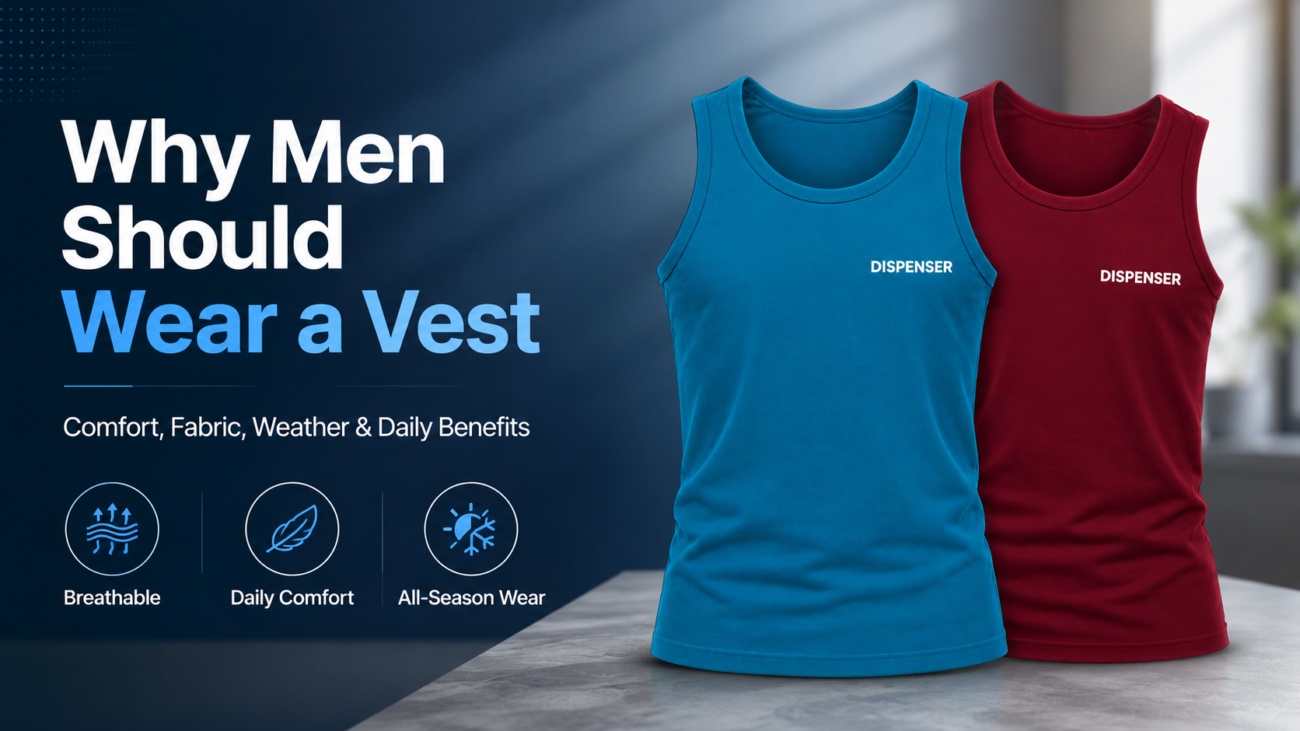
Why Should Men Wear a Vest? Complete Guide for Everyday Comfort

Why Should Men Wear a Vest? Complete Guide for Everyday Comfort

A vest is one of the simplest pieces of men’s clothing, but its role is much bigger than many people realise. For generations, men have worn vests underneath shirts, T-shirts, kurtas and formal clothing. Today, modern fabrics such as cotton, cotton Lycra, modal and bamboo blends have made men’s vests softer, lighter and more comfortable.

But do men actually have to wear a vest?

The answer is no. Wearing a vest is a personal choice. However, a good-quality vest can improve comfort, help manage perspiration, provide an additional layer between the skin and outer clothing, and make everyday dressing more convenient.

For example, imagine a man travelling to work during an Indian summer. Without an inner layer, perspiration may reach his formal shirt quickly. A lightweight, breathable vest can absorb some moisture and reduce the feeling of the shirt sticking directly to the body.

That is why a vest remains an important everyday innerwear option for many men.


1. Why Do Men Wear a Vest?

The primary purpose of a men’s vest is to create a comfortable layer between the body and outer clothing.

A vest can help with:

  • Managing perspiration and reducing direct sweat transfer to shirts.
  • Preventing certain rough fabrics or seams from rubbing directly against the skin.
  • Giving additional coverage underneath thin or light-coloured shirts.
  • Keeping outer garments fresher for longer.
  • Providing light insulation during cooler weather.
  • Creating a smoother base underneath formal or fitted clothing.

Example

Suppose Rahul works in an office and wears a formal light-blue shirt every day.

During summer, perspiration may become visible around his chest and back. Wearing a breathable cotton or modal vest underneath can absorb some of that moisture before it reaches his shirt.

For someone travelling by public transport or working for long hours, the additional comfort can make a noticeable difference.


2. Which Fabrics and Patterns Are Used in Men’s Vests?

Modern men’s vests are available in many fabrics. The best choice depends on weather, activity level, budget and personal preference.

FabricCharacteristics & Best For
CottonSoft, breathable and familiar – Everyday wear
Combed CottonSmoother and softer than regular cotton – Premium daily wear
Cotton LycraCotton comfort with added stretch – Active everyday use
ModalVery soft, lightweight and smooth – Premium comfort
Bamboo-based fabric/blendsSoft, breathable and moisture-friendly – Hot weather and premium innerwear
Cotton-Modal BlendBalance of softness, breathability and durability – Daily premium use
Polyester BlendQuick drying and durable – Gym and sports
MicrofiberLightweight and quick drying – Travel and active use
Wool/Merino BlendProvides greater warmth – Cold winter conditions

Cotton Vest

Cotton is perhaps the most commonly recognised fabric for men’s vests. It is breathable and comfortable for regular use.

Example: A basic white cotton vest worn underneath an office shirt.

Cotton Lycra Vest

Adding Lycra or elastane gives the vest stretch and helps it follow body movement.

Example: A man who rides a bike, works out or moves frequently during his workday may prefer a stretch cotton vest.

Modal Vest

Modal has a smooth and soft hand feel. It is commonly used in premium innerwear because the fabric can feel lighter and softer against the skin.

Example: Someone wearing a vest for 10–12 hours may prefer modal because of its smooth feel.

Bamboo-Based Vest

Bamboo-derived viscose or bamboo blends are increasingly used in innerwear because they can feel soft and breathable.

Example: A lightweight bamboo-blend vest can be comfortable during warm weather or long working days.


Popular Vest Patterns and Constructions

Men’s vests do not need to be limited to plain white designs.

Pattern / ConstructionDescription
SolidSingle-colour vest; most common style
RibbedVertical knitted texture with stretch
Mesh / PerforatedDesigned to improve airflow
StripedHorizontal or vertical stripe designs
PrintedFashion-oriented graphics or patterns
MelangeMixed-yarn appearance, commonly grey
Contrast BindingDifferent colour around neck or armholes
Logo VestSmall chest branding for a premium look

For innerwear, solid white, black, grey and skin-friendly neutral colours remain very popular, while modern vests are increasingly available in navy, teal, maroon and other fashion colours.


3. Which Vest Is Best for Summer, Winter and Monsoon?

The best vest should be selected according to weather rather than using the same heavy or light fabric throughout the year.

Best Vest for Summer

Indian summers can be hot and humid. During this season, breathability and lightweight construction become important.

Recommended fabrics include:

Cotton, combed cotton, modal, bamboo blends and lightweight cotton-modal fabrics.

The vest should ideally feel: Breathable, lightweight, soft and comfortable during perspiration.

Summer Example

A person travelling from home to office in 38°C weather may choose a lightweight modal or cotton vest underneath a formal shirt.

A thick or heavy fabric may feel uncomfortable in such conditions, while a lighter material can provide better everyday comfort.


Best Vest for Monsoon

During monsoon, clothes may take longer to dry because of high humidity. Therefore, a vest that dries relatively quickly can be useful.

Suitable options include: Light Nylon blends, modal blends, microfiber and performance polyester blends.

Monsoon Example

Imagine travelling to work on a rainy morning. Your clothes become slightly damp because of humidity or rain.

A very heavy cotton garment may remain wet longer. A nylon blend or quick-drying fabric can be more practical.


Best Vest for Winter

During winter, the purpose of the vest changes slightly. Instead of focusing only on sweat management, it can become part of a layering system.

Suitable options include: Medium or high weight cotton, cotton blends, thermal fabrics and wool/merino blends for colder climates.

Winter Example

A man living in Delhi during December may wear : Vest → Shirt → Sweater/Jacket

The vest adds another layer without requiring a bulky garment directly against the skin.


Weather-Wise Vest Guide

SeasonRecommended Fabric & Important Feature
SummerCotton, Modal, Bamboo Blend – Breathability
Humid SummerModal, Lightweight Cotton Blend – Moisture comfort
MonsoonCotton Blend, Microfiber – Faster drying
Mild WinterMedium-weight Cotton – Light insulation
Cold WinterThermal / Wool Blend – Warmth
Gym / Active UsePolyester Blend, Cotton Lycra – Stretch + quick drying

4. What Are the Benefits of Wearing a Vest Every Day?

A vest can offer several practical advantages when worn as part of daily clothing.

Sweat Management

One of the biggest reasons men wear vests is to create an absorbent layer underneath their shirts.

For example, during an office commute, the vest may absorb perspiration around the back and chest before it reaches the outer shirt.

Better Comfort

A soft vest keeps a layer of fabric between your skin and your shirt. This can be helpful when wearing uniforms, formal shirts or fabrics that feel less comfortable directly against the skin.

Helps Protect Outer Clothing

Perspiration, body oils and deodorant can affect shirts over time. A vest creates an additional barrier, potentially reducing how much direct contact the outer garment has with the body.

Additional Coverage

A vest underneath a light-coloured shirt can provide more coverage.

For example, under a thin white office shirt, a well-fitted vest can make the overall outfit feel more comfortable and appropriate.

Useful for Layering

During winter, a vest can form the first layer of clothing without adding significant bulk.


5. Why Wear a Vest at Night?

It is not necessary for everyone to wear a vest while sleeping. The choice depends on weather, room temperature and personal comfort. During warmer months, some people may prefer sleeping without a vest because fewer layers can feel cooler. However, a lightweight, loose and breathable vest can also work as comfortable sleepwear, especially when someone wants more upper-body coverage.

Example: Summer Night

If your bedroom is warm and humid, a lightweight cotton or modal vest with loose shorts may provide comfortable sleepwear.

Example: Air-Conditioned Room

When sleeping in a strongly air-conditioned room, a soft vest provides a light extra layer without requiring a full T-shirt.

Example: Winter Night

During winter, a vest can become the first layer underneath a T-shirt, night suit or thermal garment. The important point is that a night vest should be comfortable, breathable and not excessively tight.


6. Which Colours Are Most Popular in Men’s Vests?

White remains one of the most traditional men’s vest colours because it works underneath many shirts. But men’s innerwear has evolved significantly, and modern consumers increasingly choose coloured vests as well.

Vest ColourBest Usage
WhiteTraditional daily and formal wear
BlackModern, versatile styling
GreyCasual and neutral
Navy BluePremium everyday look
Teal / Airforce BlueContemporary fashion
Maroon / WinePremium and stylish appearance
Skin / BeigeUseful under some light-coloured clothing
Orange / Bright ColoursCasual and fashion-focused wear

Example

A white vest may work well under a business shirt. A black, teal or maroon premium vest can also be worn as relaxed homewear or styled as an outer layer in appropriate casual settings. That means today’s vest is no longer only an invisible piece of innerwear.


7. Can Wearing a Vest Make Your Lifestyle Look Rich?

A vest does not make someone wealthy, and clothing alone cannot create a “rich lifestyle.” However, premium innerwear can make everyday dressing feel more refined, comfortable and well considered. There is an important difference between looking expensive and living comfortably. A high-quality vest made from soft fabric, with clean stitching, good fitting, subtle branding and premium colours can contribute to a polished personal style.

Example : Modern Lifestyle Vest

A basic white cotton vest underneath a shirt serves a purely functional purpose.

Imagine a well-fitted teal modal vest with subtle DISPENSER branding, paired with lounge trousers while relaxing at home. The same product may offer both comfort and a modern premium appearance.

A man travelling may wear a soft stretch vest underneath an overshirt. When he reaches the hotel or home, the vest can also work as comfortable lounge clothing. This kind of versatility is what makes modern premium innerwear feel more lifestyle-oriented.


Conclusion: Is a Vest Worth Wearing Every Day?

For many men, yes.

A vest is a simple garment, but it can improve everyday comfort by adding a breathable layer between the body and outer clothing, helping manage perspiration, providing additional coverage and supporting seasonal layering.

From classic cotton vests to premium modal and bamboo-blend styles, modern men’s vests are designed for far more than basic innerwear.

Whether you’re heading to the office, travelling, relaxing at home, working out or layering clothes during winter, choosing the right vest can make everyday dressing more comfortable.

And today’s vest does not always have to remain hidden underneath a shirt.

With modern colours, premium fabrics and clean designs, it can become part of a man’s everyday comfort lifestyle.

Suggested DISPENSER closing line

DISPENSER Men’s Vests — Made for Everyday Comfort, Modern Style and Every Season.

Gen-z-Think

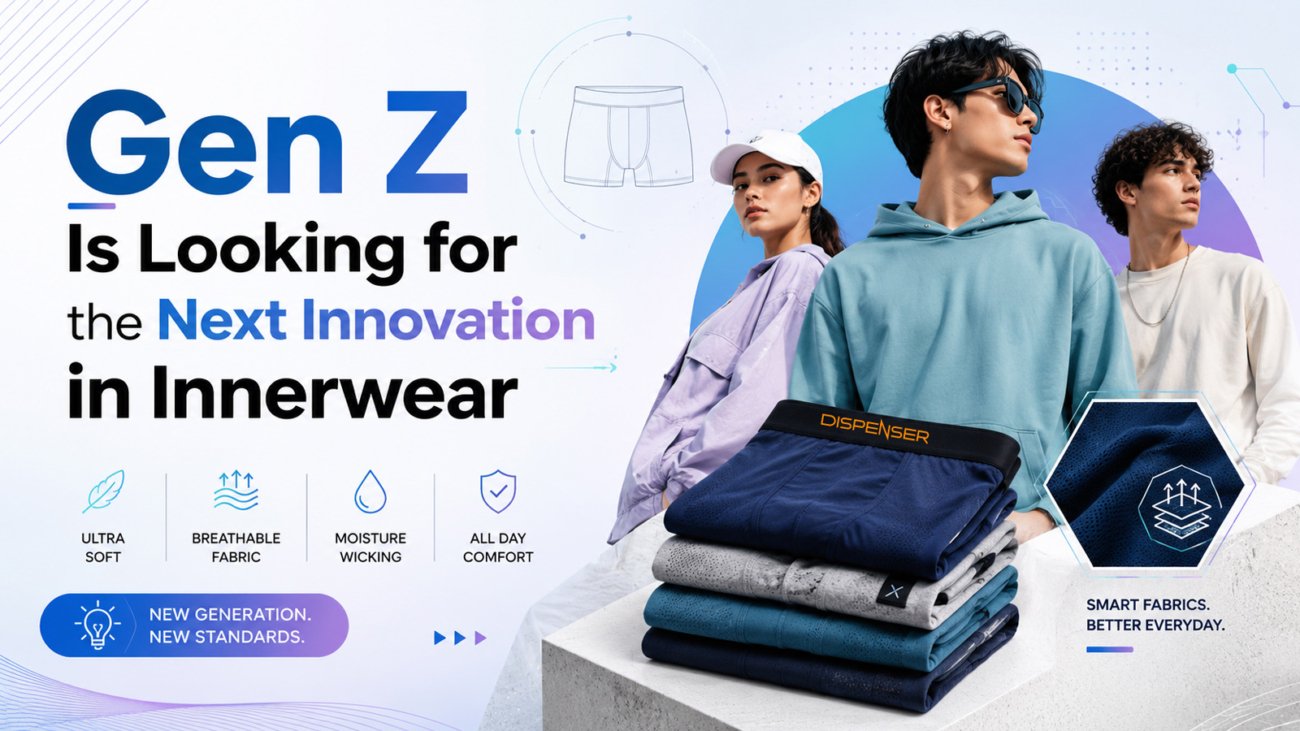
Gen Z Is Looking for the Next Innovation in Innerwear

Underwear is no longer only a hidden basic. Gen Z increasingly sees it as part of comfort, confidence, personal style and self-expression. Indian-market reporting also points to younger consumers expecting better fabrics, fit, design and brand identity—not just low price.

For Gen Z, intimate-area comfort is usually the first priority even when they want something romantic or special. They are more aware of softness, breathability, sweat control, irritation, waistband pressure, fabric feel, and how innerwear behaves during long wear. For men, this means soft stretch fabric, supportive but non-restrictive fit, smooth seams, and a waistband that does not dig into the skin. For women, the preference is often toward soft-touch fabrics, breathable panties, comfortable waist and leg openings, bras without excessive pressure, and designs that feel attractive without becoming uncomfortable after a short time.

In design, many Gen Z do not want innerwear that looks too traditional, overly dramatic, or “special occasion only.” They usually prefer clean, premium, modern and slightly playful designs that can still be worn normally after marriage. Deep colours like wine, black, navy, plum and burgundy can give a romantic feel, while softer shades such as lavender, blush, cream, sage and dusty blue create a more intimate and relaxed mood. Minimal lace, contrast piping, subtle prints, small symbols, tonal patterns and premium waistbands generally feel more modern than very loud romantic graphics.

Gen Z think about Men – Underwear, Boxer & Vest

“I wear this all day. It should feel great, make me look good and match my personality.”

Dispenser India’s own Gen-Z-oriented content describes men’s innerwear as a mix of comfort, function and individual taste, while broader Indian innerwear reporting points to breathable fabrics, modal/microfiber-type softness, moisture management and seamless construction becoming more important.

For men’s underwear, I would rank Gen Z needs:

Comfort → Fit → Freshness → Style → Confidence → Brand image.

They are likely to appreciate soft cotton blends/modal, 4-way stretch, a soft but visually strong waistband, anti-ride-up construction and moisture management.

But colour shouldn’t be limited to black, navy and grey. Keep those essentials and add wine, olive, sage, sky blue, electric blue, orange, lavender, burgundy and earthy tones.

Pattern direction should be more “Instagram/streetwear cool” than traditional: abstract loops, geometric shapes, micro prints, graffiti-inspired graphics, check patterns, topographic lines and minimal typography.

Over All Basic Parameters of Gen-Z Men’s think

Comfort thinking : Underwear and boxer are soft, breathable, stretchable, sweat-control, no riding-up, comfortable waistband and vest should be lightweight, breathable, sweat absorbing, invisible under shirts

Style / design thinking : Wants underwear to look modern, not like an old-fashioned basic and vest want clean athletic fit; something that can sometimes double as home/lounge wear, Gen Z men have more interest in premium, coordinated and occasion-based innerwear

Emotional feeling : Fresh, confident, active, attractive

Romantic element : On dates, wants to feel well-groomed and confident without looking like he tried too hard, Mostly Genz men are depend her partner choice in underwear. they preferred matching undergarment with their partner.

Patterns / colours : Mostly underwear choice in print like Geometric, abstract, minimal graphics, checks, stripes, typography, dark solids + bold accents, Now days they want’s printed trunk and boxer which look morden and vest are Clean, cool, energetic. GenZ men also interested in Matching/coordinated colours, subtle hearts, initials, playful messages, premium solids, tasteful prints

Gen Z think about Women – Bra, Panties, Boy-shot

For many Gen Z women, “sexy” does not automatically mean lace + push-up + uncomfortable fit. A recent Cosmopolitan India piece specifically describes Gen Z moving toward soft underwear, playful prints, boy briefs and comfort-led sensuality. It frames intimacy increasingly around how the wearer herself feels.

Current lingerie commentary similarly describes Gen Z’s priorities as identity, self-expression, confidence and comfort rather than performing a traditional idea of sexiness.

So the mindset becomes: “I want my lingerie to make me feel pretty and confident—but I don’t want to suffer for it.”

For bras, think wireless, seamless, lightly padded, T-shirt bras, bralettes, supportive everyday bras and stylish sports-inspired designs. Wacoal India’s recent Gen-Z discussion likewise emphasizes comfort, softness, support and ease of movement.

For panties, consider hipster + boyshort + seamless + comfortable briefs, not only traditionally seductive cuts.

And don’t make everything pink/red/black. Gen Z gives you permission to experiment with sage, lilac, peach, butter yellow, powder blue, mocha, burgundy, black, cream and colour-block combinations.

Over All Basic Parameters of Gen-Z Women’s think

Comfort thinking : Bra want Strong preference toward comfort: soft support, wireless/seamless options, no digging straps, correct fit and Panties/Boy shot want Soft elastic, breathable fabric, no wedgie/riding-up, seamless options

Style / design thinking : Wants bras that can be beautiful without being uncomfortable, Panties look like Brief, hipster, boyshort and comfortable silhouettes can all feel stylish. Genz women have more interest in premium, coordinated and occasion-based innerwear

Emotional feeling : The feel Confidence, self-love, body positivity in Bra and Freedom, security, confidence feel in panties

Romantic element : Bra should be given look her body attractive for herself first, not only for a partner and panties look playful and comfortable is increasingly more appealing than stereotypical “sexy only” lingerie and intimacy that feels natural rather than overly dramatic

Patterns / colours : Mostly Pastels, neutrals, black, ribbed texture, subtle lace, florals, colour blocking are more choice in bra and Panties are cute prints, small florals, cherries/hearts, abstract graphics, solids, contrast trims. GenZ women also interested in Matching/coordinated colours, subtle hearts, initials, playful messages, premium solids, tasteful prints

Gen Z Parents think about their kids undergarments

This needs a completely different emotional strategy.

The parent is thinking: “My child wears this directly on the skin for many hours. Is it soft, safe and comfortable?” & The child is thinking: “Is it comfortable—and does it look fun?”

For Indian kidswear overall, cotton led material preference in 2025, with breathability and suitability for sensitive skin cited as important drivers. Guidance aimed at kids’ innerwear similarly stresses comfortable fit, breathable cotton and bright/fun patterns. Soft cotton/combed cotton, flat or comfortable seams, fabric-covered/soft waistband, tag-free construction, breathable construction and no scratchy decorative parts.

For boys: dinosaurs, rockets, football, cars, robots, sharks, planets over the design.

For girls: stars, fruits, flowers, butterflies, clouds, cute animals, abstract doodles over the design.

And increasingly you can offer gender-neutral themes such as space, ocean, jungle, smileys, food, nature and cartoons; contemporary Indian kidswear coverage notes growing interest in sustainable and less rigidly gender-coded design

Over All Basic Parameters of Gen-Z Parents’s think

Comfort thinking : Parents mostly care about their kids so they must have to think about natural fabric like bamboo, cotton and micro modal which help to given best comfort of their kids.

Style / design thinking : Parents want practical; child wants fun so they mostly take care about product print like cartoon characters.

Emotional feeling : care, protection, trust. Child are happy and independent

Patterns / colours : Animals, space, sports, fruits, dinosaurs, vehicles, nature, cheerful graphics

Gen Z Couple think about Innerwear

GenZ Couple want Matching in innerwear and also becoming more about coordination rather than wearing exactly the same design. For example, the woman may wear a burgundy bra-and-panty set while the man wears a black trunk with a burgundy waistband or burgundy print accents. A navy floral set for her can be matched with a navy geometric trunk for him. This gives the couple a private feeling of connection without making the products look childish or overly obvious. Matching colours, similar print themes, shared initials, subtle symbols, or coordinated packaging can make the product feel more personal and romantic.

Emotionally, Gen Z newlyweds are likely to value comfort, confidence, closeness and playfulness together. They want to feel attractive in front of their partner, but they also want the product to feel natural on the body. A strong product idea for this audience is therefore not simply “sexy innerwear,” but “comfortable couple innerwear with chemistry.” The best collection would combine soft fabric, attractive fit, coordinated colours, tasteful patterns and His & Her packaging so the couple feels that the product belongs to both of them.

Why Gen Z want’s Branded Innerwear

Gen Z generally expects an innerwear brand to understand their lifestyle, not just sell underwear. They look for a brand that feels young, modern, relatable and authentic. Comfort is the entry point—soft fabric, good fit, breathability, stretch and irritation-free construction—but once those basics are satisfied, brand personality matters a lot. Recent Gen Z-focused innerwear commentary consistently emphasizes comfort, individuality, confidence and long-term value.

They also judge the brand by design and identity. Gen Z is more open to bold colours, playful prints, minimal graphics, gender-neutral ideas, coordinated collections and innerwear that expresses personality. They don’t necessarily want a brand that communicates only “sexy” or only “basic.” A stronger position is: comfortable enough for everyday life, stylish enough to make you feel good about yourself. Younger consumers are also moving away from forced or highly stereotyped ideas of sensuality toward more natural, comfortable self-expression.

Trust is very important. Gen Z tends to respond better when a brand shows real product benefits, real-looking bodies, clear sizing, genuine reviews and transparent communication instead of exaggerated advertising. Social media, creators and customer-generated content can strongly influence Gen Z purchase intention, so Instagram/Reels/TikTok-style storytelling and community participation are particularly useful.

So the brand thought you should aim to create is: “This brand understands me.” Not just “they make underwear.” Your Gen Z innerwear brand should represent Comfort + Confidence + Style + Self-expression + Inclusivity + Trust. For DISPENSER, for example, the opportunity would be to move from simply “men’s innerwear brand” toward a more emotional position such as “Innerwear for the way the new generation lives, moves and feels.”

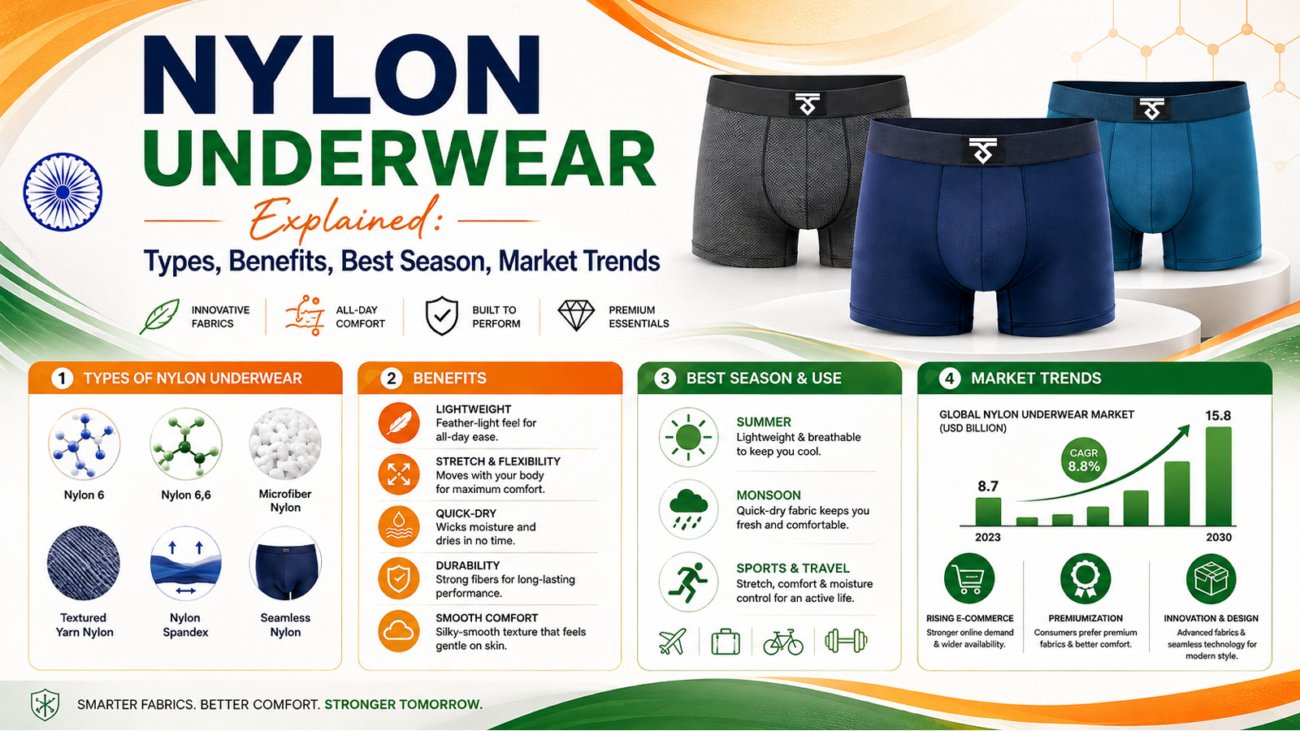
NYLON UNDERWEAR

TYPE, BENIFITS & MARKET TREND OF NYLON UNDERWEAR

Nylon yarn plays an important role in underwear because it provides strength, flexibility, smoothness, and durability to the fabric. Nylon is a synthetic fibre known for being lightweight yet very strong. When blended with cotton, modal, bamboo, polyester, or elastane, it helps the underwear maintain its structure while still feeling soft and comfortable against the skin. This makes nylon especially useful in products designed for daily wear, sports, travel, and active lifestyles.

One of the main purposes of nylon yarn in underwear is to improve stretch and shape retention. Underwear needs to move with the body throughout the day without becoming loose or losing its original fitting. Nylon fibres have good elasticity and recovery, so they help the garment return to its original shape after stretching. When nylon is combined with spandex or elastane, it can provide even better flexibility and a comfortable body-hugging fit.

Nylon yarn also improves the durability and life of the garment. Underwear goes through frequent washing, stretching, rubbing, and everyday movement. Nylon has excellent resistance to abrasion, which means the fabric is less likely to wear out quickly in high-friction areas. It can also be used in waistbands, leg openings, seams, and stretch fabrics to provide additional strength without making the garment heavy or uncomfortable.

Another benefit of nylon is its ability to support moisture management and quick drying. Nylon itself absorbs relatively little moisture compared with fibres such as cotton, so moisture can evaporate more quickly from properly engineered nylon-blend fabrics. This is especially useful in performance underwear, gym wear, travel underwear, and hot-weather products. However, moisture-wicking performance depends on the complete fabric construction and finishing, not only on the presence of nylon yarn.

TYPE OF YARN USED IN NYLON UNDERWEAR

1. Nylon 6

Nylon 6 is one of the most commonly used nylon fibres in the textile and innerwear industry. It is produced from caprolactam and is known for its good balance of softness, strength, flexibility, and affordability. Because underwear is worn directly against the skin for long hours, the fabric needs to be lightweight and comfortable. Nylon 6 can be produced in very fine yarn counts, allowing manufacturers to make smooth and soft knitted fabrics suitable for everyday innerwear.

A major advantage of Nylon 6 is its good stretch and recovery characteristics, especially when blended with elastane or spandex. The fabric can follow body movement without feeling excessively stiff. It also has good abrasion resistance, which helps underwear withstand repeated movement, washing, and friction. This makes it suitable for men’s trunks, women’s panties, briefs, sports underwear, and seamless products.

Nylon 6 also dyes relatively well, allowing manufacturers to produce bright, deep, and fashionable colours. It can be used in solid-colour underwear as well as jacquard, rib, mesh, or textured constructions. Depending on yarn type and knitting construction, Nylon 6 fabric can be made shiny, semi-dull, or matte.

Common applications: seamless panties, men’s trunks, briefs, active innerwear, stretch waist panels and lightweight performance underwear.


2. Nylon 6,6

Nylon 6,6 is another important nylon fibre used in textiles. Compared with Nylon 6, Nylon 6,6 generally offers higher strength, better heat resistance, dimensional stability, and abrasion resistance. Because of these properties, it is especially useful in areas of underwear that experience repeated stretching or friction.

For example, Nylon 6,6 may be used in elastic waistbands, leg openings, support zones, reinforcement areas, or technical innerwear fabrics. It helps the garment maintain its shape even after repeated wearing and washing. This can be important for premium underwear where long-term durability is a major selling point.

Nylon 6,6 can also be manufactured into very fine filament yarns, so increased strength does not necessarily mean the fabric must feel heavy. With the correct yarn denier and knitting structure, it can provide a smooth and comfortable surface while increasing the garment’s durability.

However, Nylon 6,6 may cost more than basic Nylon 6 in some applications. Therefore, manufacturers normally select it when performance, durability, heat stability, or abrasion resistance is especially important.

Common applications: premium underwear, performance innerwear, durable waistbands, technical stretch fabrics, leg openings and reinforcement zones.


3. Microfiber Nylon

Microfiber nylon refers to nylon made from extremely fine individual filaments. Because the fibres are much finer than conventional yarn, microfiber nylon fabric can feel exceptionally smooth, soft, lightweight, and silky against the skin. This is why it is widely used in premium underwear.

The fine filaments create a fabric surface with very little roughness. This helps reduce bulky or coarse sensations and allows the garment to sit smoothly underneath trousers, dresses, leggings, or fitted clothing. Microfiber nylon is particularly useful when the desired product positioning is soft touch, premium feel, invisible appearance, or second-skin comfort.

Microfiber nylon also gives manufacturers good flexibility in fabric engineering. It can be knitted into smooth jersey, mesh, rib, jacquard, seamless structures, or high-stretch fabrics. When blended with spandex, the fabric becomes highly flexible and can closely follow body contours.

Another advantage is its relatively quick-drying nature compared with fabrics containing large amounts of cotton. However, actual moisture-wicking performance depends on the fabric structure and finishing treatment.

Microfiber nylon is commonly used for women’s panties, men’s premium trunks, seamless underwear, shapewear, activewear, bras and lightweight innerwear.


4. Textured Nylon Yarn

Textured nylon is created by processing smooth filament yarn so that the filaments develop crimp, loops, coils, or increased bulk. The purpose of texturing is to improve properties such as softness, stretch, volume, flexibility, and covering ability.

A very common form is DTY — Draw Textured Yarn. Textured nylon can provide natural-looking stretch even before adding elastane. When it is combined with spandex, manufacturers can produce fabrics with excellent body movement and recovery.

Another benefit is better fabric coverage. Because textured yarn has more bulk than flat filament yarn, it can create a fuller fabric while maintaining relatively low weight. It can also make the material feel warmer and softer compared with completely flat nylon filament.

In underwear, textured nylon yarn can be particularly useful in seamless knitting machines, where different zones of compression, ventilation, ribbing, support, and stretch can be created within the same garment.

Manufacturers may use textured nylon in body fabric, waist areas, leg openings, jacquard designs, mesh zones, and stretch panels.

Key benefits: elasticity, bulk, softness, flexibility, good coverage, shape recovery and seamless-machine compatibility.


5. Nylon-Spandex / Nylon-Elastane Blend

A Nylon-Spandex blend is one of the most important fabric combinations in modern stretch underwear. In this combination, the two fibres perform different jobs. Nylon provides strength, smoothness, durability and lightweight performance, while spandex provides high stretch and recovery.

For example, a fabric composition such as 90% Nylon + 10% Spandex can provide excellent flexibility for everyday underwear. A composition containing a higher percentage of elastane may be selected when additional stretch, compression, body contouring, or support is required.

This type of fabric can stretch with walking, sitting, exercising, bending, and other daily movement while returning toward its original dimensions afterward. Good recovery is particularly important because poor-quality underwear can become loose around the waist, seat, or leg openings after repeated use.

Nylon-spandex fabrics can also be made very lightweight. This helps manufacturers create underwear that fits close to the body without using thick or heavy fabrics.

The exact percentage should always be selected according to the product. Everyday underwear, shapewear, sports underwear, compression garments, and seamless panties may all require different constructions.

Common examples include:
95% Nylon + 5% Spandex – light stretch
90% Nylon + 10% Spandex – good everyday stretch
85% Nylon + 15% Spandex – higher stretch and recovery
80% Nylon + 20% Spandex – strong stretch/compression applications

These percentages are examples rather than universal standards.


6. Seamless Nylon Fabric

Seamless nylon underwear is technically more of a garment construction or knitting category than a completely separate type of nylon. It is commonly produced using circular seamless knitting machines with nylon, textured nylon, microfiber nylon and elastane yarns.

The biggest advantage is that large sections of the garment can be knitted without traditional side seams. This can reduce seam bulk and create a smoother appearance under clothing. Seamless technology can also allow manufacturers to engineer different structures directly into the same garment.

For example, one section can have higher stretch, another can have mesh ventilation, and another can provide additional support or coverage. This zonal construction is one of the major reasons seamless technology is popular in modern underwear and activewear.

Nylon is particularly suitable for seamless manufacturing because fine nylon yarns have good strength and can run efficiently through high-speed knitting machines. When nylon is combined with elastane, the final garment can provide close fitting, stretch, recovery, and a smooth body-contouring appearance.

Seamless nylon fabrics are widely used in women’s hipsters, briefs, men’s trunks, sports underwear, shapewear, bras, camisoles and performance innerwear.

Simple comparison

TypeMain Purpose in UnderwearMain Advantage
Nylon 6General underwear fabricSoft + durable
Nylon 6,6Higher-performance areasHigher strength
Microfiber NylonPremium soft underwearSmooth second-skin feel
Textured NylonStretch/seamless knittingBulk + flexibility
Nylon + SpandexStretch underwearExcellent stretch & recovery
Seamless NylonSeam-free garment constructionSmooth fit + engineered zones

For modern premium underwear manufacturing, Microfiber Nylon + Spandex or Textured Nylon + Spandex in seamless construction is usually a particularly useful combination because it can deliver softness, stretch, shape recovery and a clean premium appearance.

From these 6 types, the most commonly used in modern underwear is Nylon + Spandex/Elastane blend.

A very common construction is around 85–95% nylon with 5–15% spandex, depending on how much stretch, support, and compression the product needs. Nylon gives the fabric strength, smoothness, lightweight feel, durability, and quick-drying performance, while spandex gives stretch and shape recovery.

For premium and seamless underwear, manufacturers often use microfiber nylon or textured nylon together with spandex. So practically, the most common combinations are:

  • Nylon + Spandex — most widely used overall
  • Microfiber Nylon + Spandex — premium soft underwear
  • Textured Nylon + Spandex — very common in seamless underwear
  • Nylon 6 — commonly used as the base nylon fibre
  • Nylon 6,6 — used more selectively where extra strength is needed
  • Seamless Nylon — a construction method, usually made using textured/microfiber nylon + spandex

So if you are developing men’s trunks, women’s panties, or seamless underwear, I would mainly consider Nylon 6 / microfiber or textured nylon + spandex, rather than using 100% nylon alone.

BENIFITS OF NYLON UNDERWEAR

Nylon underwear has several practical benefits. It is lightweight, smooth, strong, and durable, so it can feel comfortable while also handling repeated washing and daily movement. Nylon also has good abrasion resistance, which helps the fabric last longer in high-friction areas. When combined with spandex, it gives excellent stretch and shape recovery, so the underwear can fit close to the body without becoming loose quickly.

Another major benefit is quick drying. Nylon absorbs much less water than cotton, so nylon underwear can dry faster after sweating or washing. This makes it especially useful for people who travel, exercise, or live in humid areas. Nylon fabrics can also be made very fine and smooth, which gives underwear a premium, second-skin feel and makes it easier to wear under fitted clothing.

Nylon underwear is also suitable for sports and active use because it is lightweight and flexible. With the right fabric construction and moisture-management finish, it can help move sweat away from the skin and dry faster. Nylon-spandex blends are especially good for gym wear, running, travel, and everyday movement because they provide stretch without adding much weight.

Best season for nylon underwear

The best season is summer and humid weather, especially when the fabric is lightweight, breathable, and designed for moisture management. Quick-drying nylon can be very useful during hot weather because sweat does not stay trapped in the fabric as long as it can in heavier cotton garments.

It is also very good during the monsoon season because clothes often take longer to dry in humid conditions. Nylon underwear generally dries faster, making it convenient for daily use and travel.

For winter, nylon underwear can still be comfortable, but it is not necessarily the best choice purely for warmth. Cotton blends, modal, or thermal fabrics may feel warmer depending on the product.

So, in simple terms: Summer + Monsoon + Sports + Travel are the strongest use cases for nylon underwear, especially when using a good-quality nylon + spandex fabric with breathable construction.

TOP 5 COUNTRY OF NYLON UNDERWEAR SUPPLIER

1. China — Best Overall Nylon Underwear Supply Base

China is probably the strongest country for nylon underwear manufacturing because it has the complete supply chain—from nylon chips and yarn to knitting, dyeing, seamless machines, elastic, garment manufacturing and packaging. China is especially strong in Nylon 6, microfiber nylon, textured nylon DTY, nylon-spandex fabrics and seamless underwear.

For men’s and boys’ knitted underpants made from man-made fibres, World Bank/WITS trade data shows China as by far the largest exporter in the available dataset, at about US$934 million in 2022.

Best for: Seamless underwear, nylon-spandex trunks, women’s panties, microfiber underwear, sports innerwear and high-volume private-label manufacturing.

2. Vietnam — Strong Export-Quality Manufacturer

Vietnam has become a major global apparel manufacturing centre and is particularly strong in synthetic-fibre garments and performance clothing. It is attractive to international brands because of good factory quality, export infrastructure and experience handling technical fabrics.

World Bank/WITS data lists Vietnam as the second-largest exporter of men’s/boys’ knitted underpants made from man-made fibres in its 2022 dataset, with exports of approximately US$229 million.

Best for: Premium nylon underwear, sports underwear, branded OEM production, nylon-elastane products and performance innerwear.

3. India — Strong and Growing Opportunity

India already has a huge cotton and knitwear industry, but its use of man-made fibres such as nylon and polyester is expanding. Tiruppur, one of India’s biggest knitwear manufacturing centres, is actively increasing its man-made-fibre capabilities. Industry reporting says thousands of Tiruppur units have begun working with MMF products as the cluster tries to expand beyond its traditional cotton base.

India was also among the significant exporters of men’s/boys’ man-made-fibre underpants in WITS data, with approximately US$56 million of exports in 2022.

Best for: Men’s trunks, briefs, panties, private labels, nylon blends and companies wanting to develop a China-alternative supply chain.

For an Indian underwear manufacturer, nylon + spandex and seamless underwear could be an especially interesting area to develop, because India’s MMF manufacturing capability is currently expanding.

4. Bangladesh — Best for Large-Volume Garment Production

Bangladesh is one of the world’s major apparel manufacturing countries. Its biggest strength is large-volume production at competitive costs. Large international retailers source significant garment volumes from Bangladesh, particularly basic and mass-market products. Recent sourcing discussions continue to compare Bangladesh with China, Vietnam and India as major Asian apparel manufacturing locations.

Bangladesh is traditionally particularly strong in cotton garments, so for very specialized nylon yarn, microfiber or seamless technology, China or parts of East Asia may have a stronger upstream supply chain. But Bangladesh remains important for cut-and-sew underwear manufacturing at scale.

Best for: High-volume underwear, basic briefs/trunks, large retailer orders and cost-sensitive production.

5. Turkey — Strong for Premium & European Markets

Turkey has a mature textile and apparel industry and is particularly attractive when supplying Europe because of its geographic proximity. It has experience in lingerie, hosiery, stretch fabrics, seamless products and premium garment manufacturing.

Turkey may not match China’s enormous synthetic-material supply chain, but it can be attractive for higher-value products, faster European deliveries and smaller premium collections.

Best for: Premium underwear, women’s lingerie, seamless products, fashion collections and European brands.

PRICE OF NYLON UNDERWEAR FOR INDIA MARKET

For the Indian retail market, nylon underwear ranges from very low-cost marketplace products to premium branded microfiber/nylon-elastane underwear. Current listings show nylon men’s briefs/trunks starting around ₹87–₹117 per piece on the low end, while premium branded nylon underwear can go above ₹1,000 per piece.

LevelApprox. Retail Price / PieceTypical Product
Very Low₹80–₹150Basic nylon brief/trunk, local or marketplace brands
Budget₹150–₹250Basic Nylon 6 / simple nylon stretch underwear
Economy Plus₹250–₹400Better nylon-spandex, improved waistband & stitching
Mid Range₹400–₹600Nylon-elastane / Tactel / better microfiber
Premium₹600–₹900Microfiber nylon + spandex, performance underwear
High Premium₹900–₹1,500Premium seamless/performance/branded underwear
Luxury₹1,500–₹3,000+International premium/luxury brands

For a DISPENSER-type mass-premium range, I would particularly study the ₹299–₹599 segment. It gives enough room to communicate softness + quick dry + 4-way stretch + lightweight + shape recovery without entering expensive international-brand territory.

On Indian e-commerce, the strongest-selling nylon-underwear segment appears to be men’s trunks made from microfiber/Tactel nylon + elastane, especially in the ₹400–₹700 range. Exact unit sales are usually not public, so the best signals are marketplace “Bestseller” tags, review volumes, ratings, and how prominently products rank in nylon/trunk searches.

Jockey IC28 Tactel Microfiber Elastane Trunk is probably the most important product for you to study. Amazon search results identify Jockey IC28 as a bestseller, while Myntra currently lists the Tactel Microfiber Stretch Solid Trunk at around ₹649. The product-search data also shows roughly 4.5/5 from 1,100 reviews, which is a strong demand signal.

Tactel is another strong online positioning. XYXX currently has a Solid Tactel Trunk around ₹499, while Myntra’s nylon-trunk category also surfaces it prominently.

At the premium seamless end, Jockey’s Tactouch Microfiber Seamfree Bonded Tech and Texcelight Microfiber Bonded Tech trunks are currently around ₹899.

The important finding is that plain nylon itself is not the strongest proposition. The marketplace leaders usually combine nylon/microfiber with elastane, moisture management, quick-dry performance, mesh, seamless construction, or premium soft-touch positioning.

conclusion:

If you are planning to develop a nylon underwear range, the best direction is Microfiber or Tactel Nylon + Spandex, with a focus on quick dry, 4-way stretch, lightweight comfort, smooth premium feel, shape recovery, and moisture management. This gives the product a much stronger market position than selling it only as “nylon underwear.

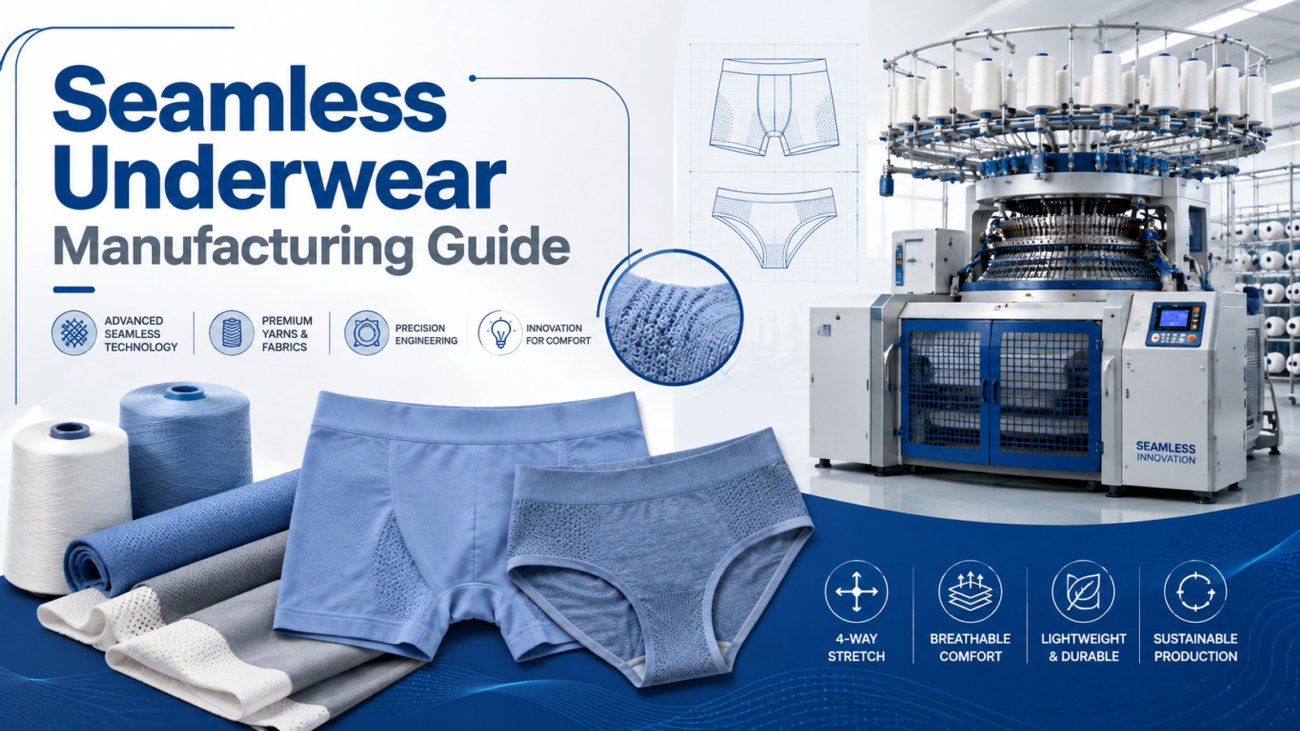
seamless underwear manufacturing guide

Seamless Underwear Manufacturing Guide

Detail of Seamless Underwear: Fabrics, Machines, Elastic Types, Manufacturing Process, Advantages and Future Business Potential

The underwear industry is continuously evolving with new fabrics, advanced knitting machines, improved fitting technology, and changing consumer preferences. One of the most important developments in modern innerwear manufacturing is seamless underwear.

Consumers increasingly prefer underwear that feels soft, remains invisible under clothing, stretches comfortably with the body, and causes less irritation. Seamless technology helps manufacturers meet these requirements by producing garments with fewer stitched joints than traditional cut-and-sew underwear.

However, “seamless” does not always mean that the garment contains absolutely no stitching. In many products, the main body is knitted as a tube without side seams, while limited cutting, bonding or stitching may still be required at the gusset, waistband, leg opening or finishing points.


What Is Seamless Underwear?

Seamless underwear is an undergarment manufactured with minimal seams, fewer stitched joints or no side seams.

Instead of cutting several fabric panels and stitching them together, the main body of seamless underwear is generally knitted in a tubular form on an electronic circular knitting machine. The machine controls individual needles to create different zones for stretch, support, ventilation, shaping and coverage.

Seamless technology developed from circular hosiery knitting technology. It was initially used mainly for hosiery and underwear but later expanded into sportswear, shapewear, activewear, swimwear, medical garments and outerwear.

A seamless knitting machine can create:

  • The main tubular body
  • Different knit structures
  • Waist support zones
  • Ribbed areas
  • Ventilation zones
  • Compression zones
  • Decorative patterns
  • Different levels of fabric thickness
  • Body-contouring shapes

Santoni, one of the major seamless knitting-machine manufacturers, describes its seamless machine range as suitable for underwear, lingerie, activewear, sportswear, shapewear, swimwear, nightwear and medical garments.


Does Seamless Mean Completely Stitch-Free?

Not always.

The term “seamless underwear” is used for several constructions but it’s depend on garment’s pattern and machine.

1. Seamless-knitted underwear

The garment body is knitted as a tube without conventional side seams. Some stitching may remain at the gusset or crotch. Electronic Circular Seamless Knitting Machine is the main machine used to manufacture seamless-knitted underwear.

  • Knit the garment in tubular form
  • Remove conventional side seams
  • Create rib, mesh and plain knit zones
  • Add compression zonesForm ventilation structures
  • Create decorative patterns
  • Change yarn within the garment
  • Integrate a knitted waistband
  • Control garment stretch and support
  • Produce different sizes through machine diameter and programming

Examples include electronic single-jersey and double-jersey circular seamless machines.

Santoni’s SM8-TOP2V is an electronic single-jersey circular machine designed to manufacture seamless garments for underwear, sportswear, outerwear, beachwear and sanitary applications. It uses needle-by-needle electronic selection to create different structures within the garment.

Seamless garments can be produced as individual tubular pieces instead of continuous fabric rolls. Some manufacturers use different cylinder diameters to cover different garment sizes. In this category, two type of machine are used 1. Single-jersey seamless machine and 2. Double-jersey seamless machine that’s depend on underwear pattern.

2. Bonded seamless underwear

Bonded seamless underwear is underwear in which some or most fabric parts are joined with heat-activated adhesive film or bonding tape instead of conventional needle-and-thread stitching.

The fabric pieces are normally cut into the required shape, overlapped or folded, and then bonded using controlled:

  • Heat
  • Pressure
  • Dwell time
  • Cooling

The result is a thin, smooth and low-profile joint that creates fewer visible lines under clothing. Bonded underwear is commonly used for: No-show panties , Women’s seamless briefs, Men’s low-profile trunks, Shapewear Sports underwear, Bonded bras, Laser-cut underwear, and Maternity underwear Swimwear.

The bonding material is normally supplied as a thin thermoplastic adhesive film, web, net or tape. It is placed between two fabric surfaces.

The machine applies heat, causing the adhesive to soften or melt. Pressure forces the activated adhesive into the surface of the fabric, and sufficient dwell time allows the bond to form. Cooling then stabilises the joint. there are many type of machine are used for this underwear manufacture but mostly require Die-cutting or hydraulic press-cutting machine

3. Laser-cut underwear

The fabric edges are cut with laser technology to create thin, clean leg openings that remain less visible under clothing.

Laser-cut underwear is a type of no-show innerwear in which the fabric panels and leg openings are cut using a computer-controlled laser instead of conventional scissors or blade cutting. The laser produces highly accurate, smooth and thin edges, helping the underwear remain almost invisible under fitted trousers, leggings, dresses or sportswear. Laser-cut underwear is commonly made from lightweight stretch fabrics such as nylon-elastane, polyester-spandex, microfiber, tricot or other specially developed raw-cut fabrics that resist fraying and curling.

The main machine used is a CO₂ laser-cutting machine for textiles. The garment pattern is first prepared in CAD software and transferred to the laser machine. The laser beam then follows the digital pattern to cut the front panel, back panel, gusset, waist area and leg openings. Important machine controls include laser power, cutting speed, focus distance, exhaust pressure and fabric-feed tension. Incorrect settings may burn the fabric, harden the edge, create yellow marks or damage the elastane, so every fabric quality requires separate testing.

Laser-cutting alone does not complete the underwear. The cut panels are generally joined using a heat-bonding press, hot-air seam-bonding machine or continuous belt-fusing machine. A thin polyurethane adhesive film or bonding tape is placed between the fabric layers and activated through controlled heat, pressure and time. An adhesive-slitting machine may also be used to cut bonding film into narrow tapes, while a cooling press helps stabilise the bonded seam. A heat-transfer machine is normally used to apply the brand logo, size and wash-care information without adding an uncomfortable stitched label.

The main advantages of laser-cut underwear are smooth leg openings, reduced visible underwear lines, less seam bulk, accurate sizing and a modern premium appearance. However, the product requires compatible fabric, precise laser settings, good-quality bonding adhesive and strict washing tests. Poor-quality production can cause edge curling, adhesive separation, hard cut edges, fabric discolouration or loss of stretch. Therefore, the complete production setup normally includes CAD software, a textile CO₂ laser cutter, bonding equipment, cooling equipment and bond-strength testing facilities.

4. Raw-cut underwear

Special stretch fabric is cut without folding or sewing the leg edge. The fabric must resist curling and fraying.

Raw-cut underwear is a type of no-show innerwear in which the fabric edges, especially around the leg openings and waist, are left without folding, hemming or conventional stitching. The fabric is specially selected and finished so that it does not fray, unravel or curl excessively after cutting. This construction creates an ultra-thin edge that stays smooth under fitted trousers, dresses, leggings and sportswear. Raw-cut underwear is commonly made from lightweight nylon-elastane, microfiber, polyester-spandex, fine tricot or specially engineered stretch fabrics with strong edge stability.

The main machine used is an automatic fabric-cutting machine, die-cutting press or CO₂ laser-cutting machine. For heat-sensitive fabrics, an automatic knife cutter is preferred because it cuts without melting or hardening the edge. A hydraulic die-cutting press is suitable for repetitive bulk production, where sharp metal dies cut identical front, back and gusset panels. A laser cutter may also be used when precise, clean edges are required, but incorrect laser power can damage elastane, create a hard edge or cause yellowing.

Raw-cut panels are usually assembled using a heat-bonding press, hot-air bonding machine or ultrasonic welding machine because conventional stitching can create visible seam lines. Thin polyurethane adhesive tape or film may be used at the side seams, gusset and waistband. A pneumatic heat press applies controlled temperature, pressure and time, while a hot-air bonding machine is useful for curved seams and continuous tape application. A cooling press or flat cooling table helps stabilise the bonded joint after heating.

The main advantages of raw-cut underwear are minimal visible lines, lightweight comfort, smooth leg openings and a premium modern appearance. However, the fabric must have excellent edge stability, stretch recovery and wash durability. Poor-quality fabric may curl, fray, lose shape or become loose after washing. Manufacturers should therefore test edge curling, stretch recovery, wash shrinkage, bond strength and wearer comfort before starting bulk production.

5. Hybrid seamless underwear

Hybrid seamless underwear combines two or more manufacturing technologies in one garment, such as circular seamless knitting, laser cutting, raw-cut edges, heat bonding and limited stitching. For example, the main body may be knitted in tubular form without side seams, while the gusset, waistband, support panel or leg opening is attached using bonding or flatlock stitching. This method allows manufacturers to retain the comfort and stretch of seamless knitting while adding better support, shaping, durability or design flexibility.

The main machine used is an electronic circular seamless knitting machine, which produces the tubular body and creates different zones for stretch, ventilation, ribbing and compression. After knitting and finishing, a CO₂ laser-cutting machine or automatic knife cutter may be used to create accurate leg openings, waist shapes, gussets or reinforcement panels. Laser cutting is suitable for clean no-show edges, while knife cutting is preferred for fabrics that may harden or discolour under laser heat.

For joining the additional components, manufacturers use a pneumatic heat-bonding press, hot-air seam-bonding machine or continuous belt-fusing machine. These machines activate thin polyurethane adhesive tape using controlled heat, pressure and time. A flatlock or overlock sewing machine may also be used only in high-stress areas such as the crotch or gusset, where extra security is required. A heat-transfer press is commonly used for applying the brand logo, size and wash-care details without adding a bulky sewn label.

The main advantage of hybrid seamless underwear is that it offers a balance of comfort, support, durability and design freedom. It can provide a smooth body fit with fewer seams while allowing stronger construction in areas that receive more pressure. However, production is more complex because the knitted body, cut panels, adhesive, stitching and finishing must all work together. Manufacturers must carefully test bond strength, seam stretch, waistband recovery, wash durability, edge curling and wearer comfort before bulk production.

Therefore, brands should clearly understand whether their product is:

  • Side-seam-free
  • Seamless-knitted
  • Bonded
  • Laser-cut
  • Stitch-free at the leg opening
  • Fully seamless
  • Nearly seamless

How Many Fabrics Are Used in Seamless Underwear?

There is no fixed number of fabrics used in seamless underwear.

Seamless underwear can be manufactured from many yarn combinations. Most products use two or more fibres because one fibre provides softness while another provides elasticity, strength, moisture control or durability.

The most common materials are listed below.


1. Polyamide or Nylon

Polyamide, commonly called nylon, is one of the most widely used fibres in seamless underwear.

It is popular because it offers:

  • Smooth texture
  • High strength
  • Good elasticity
  • Lightweight construction
  • Abrasion resistance
  • Quick drying
  • Good body conformity
  • Suitability for fine-gauge knitting machines

Polyamide 6.6 is especially suitable for underwear, activewear and seamless garments because of its soft and smooth feel.

Textured polyamide yarn can provide additional softness, volume, stretch recovery and fabric coverage while maintaining a lightweight feel.

Common composition example

  • 85% polyamide
  • 15% elastane

This combination is common in premium seamless briefs, panties, bras and shapewear.


2. Polyester

Polyester may be used in performance-oriented seamless underwear.

Its benefits include:

  • Fast drying
  • High durability
  • Good colour retention
  • Lower moisture absorption
  • Easy care
  • Suitability for sports innerwear
  • Cost efficiency

Polyester is often used for:

  • Sports underwear
  • Gym innerwear
  • Quick-dry trunks
  • Performance briefs
  • Base layers

However, standard polyester may not feel as silky as fine polyamide unless microfilament or specialised yarn is used.

Common composition example

  • 90% polyester
  • 10% elastane

3. Elastane, Spandex or Lycra

Elastane is not normally used alone. It is blended with nylon, polyester, cotton, modal or other fibres.

Its purpose is to provide:

  • Four-way stretch
  • Shape recovery
  • Body-hugging fit
  • Compression
  • Flexibility
  • Size adaptability
  • Waist and leg stability

Modern soft-stretch elastane varieties can provide gentle support, four-way stretch and a second-skin feel in underwear and bodywear.

Typical elastane percentage

Seamless underwear may contain approximately:

  • 3% to 8% for light stretch
  • 8% to 15% for regular body fit
  • 15% to 25% for shapewear or compression products

The correct percentage depends on yarn type, knit structure, fabric weight and required compression.


4. Cotton

Cotton is valued for:

  • Natural softness
  • Breathability
  • Familiar skin feel
  • Moisture absorption
  • Everyday comfort
  • Consumer trust

However, 100% cotton is generally not ideal for highly stretchable seamless underwear because it has limited stretch recovery.

Cotton is therefore commonly blended with:

  • Polyamide
  • Polyester
  • Elastane
  • Modal

Common composition example

  • 60% cotton
  • 32% polyamide
  • 8% elastane

Cotton-blend seamless underwear can be suitable for daily-use trunks, briefs, panties and vests.


5. Modal and Micro Modal

Modal is a regenerated cellulosic fibre generally produced from wood-based cellulose.

It is used for premium underwear because it can provide:

  • Soft hand feel
  • Smooth surface
  • Good moisture absorption
  • Comfortable drape
  • Breathability
  • Premium appearance

Micro modal uses finer fibres and can provide an even softer, more luxurious feel.

Common composition example

  • 70% modal
  • 23% polyamide
  • 7% elastane

Modal blends are suitable for:

  • Premium men’s trunks
  • Women’s briefs
  • Lounge underwear
  • Soft everyday innerwear

6. Viscose

Viscose may be used as a cost-effective cellulosic option.

It can provide:

  • Softness
  • Moisture absorption
  • Smooth drape
  • Comfortable skin feel

However, its wet strength and dimensional stability must be carefully controlled through yarn selection, knitting construction and finishing.


7. Bamboo-Viscose Blends

Products described as bamboo underwear usually use regenerated cellulose fibre made from bamboo pulp rather than untreated natural bamboo fibre.

Bamboo-viscose blends can offer:

  • Soft texture
  • Moisture absorption
  • Smooth feel
  • Breathability
  • Premium marketing appeal

They are commonly blended with elastane and sometimes polyamide.


8. Recycled Nylon and Recycled Polyester

Sustainable seamless underwear may use:

  • Recycled polyamide
  • Recycled polyester
  • Recycled elastane blends
  • Bio-based yarn components

Recycled nylon 6.6 is already being developed for seamless apparel, sportswear and lingerie applications.

These materials can help brands build environmentally responsible product ranges, although certification, traceability, shade consistency and performance testing remain important.


9. Functional and Technical Yarns

Advanced seamless underwear may also use yarns designed for:

  • Odour control
  • Moisture management
  • Cooling effect
  • Thermal insulation
  • Antistatic performance
  • Bacteriostatic performance
  • Compression
  • Sports recovery
  • UV protection

These products are more common in premium sportswear, medical wear, shapewear and performance underwear.


Best Fabric Combinations for Seamless Underwear

Daily-wear underwear

  • Cotton + polyamide + elastane
  • Modal + polyamide + elastane
  • Micro modal + elastane

Sports underwear

  • Polyamide + elastane
  • Polyester + elastane
  • Moisture-management yarn + elastane

Shapewear

  • High-denier polyamide + higher elastane percentage

Invisible underwear

  • Fine-gauge polyamide microfiber + elastane

Sustainable underwear

  • Recycled polyamide + recycled or bio-based elastane
  • Modal + elastane
  • Recycled polyester + elastane

There is no single “best” fabric for every seamless underwear product. The ideal composition depends on target price, customer use, climate, fit, wash performance and product positioning.


Which Types of Elastic Are Used in Seamless Underwear?

Seamless underwear may use a separate elastic waistband, knitted-in elastic yarn or a combination of both.


1. Knitted-In Elastane Waistband

In many seamless garments, the waistband is directly knitted into the garment.

The machine changes:

  • Stitch density
  • Elastane feed
  • Yarn tension
  • Rib structure
  • Knit construction

Advantages

  • No separate waistband seam
  • Smooth appearance
  • Lower bulk
  • Integrated design
  • Comfortable body fit

Limitations

  • Difficult to replace
  • Recovery depends heavily on yarn quality
  • Programming and tension must be accurate
  • May roll if the structure is poorly designed

2. Exposed Jacquard Elastic

This is a separate waistband with the brand name or logo woven or knitted into it.

It is commonly used in men’s trunks and briefs.

Benefits

  • Strong branding
  • Good waist support
  • Premium appearance
  • High durability
  • Easy identification

Common materials include:

  • Nylon
  • Polyester
  • Elastane
  • Rubber thread

3. Plush-Back Elastic

Plush elastic has a soft inner surface that touches the skin.

It is suitable for:

  • Briefs
  • Panties
  • Bras
  • Kids’ underwear
  • Sensitive-skin products

Its main benefit is improved comfort and reduced roughness.


4. Knitted Elastic

Knitted elastic is soft, flexible and generally lightweight.

It can be used in:

  • Waistbands
  • Leg openings
  • Light underwear
  • Women’s panties
  • Children’s garments

It normally remains flexible when stitched but may provide less firm support than woven elastic.


5. Woven Elastic

Woven elastic is more structured and stable.

It is suitable for:

  • Men’s trunks
  • Sports underwear
  • Firm waistbands
  • Premium exposed waistband products

It can provide better strength and recovery but may feel thicker than knitted elastic.


6. Fold-Over Elastic

Fold-over elastic folds around the fabric edge.

It is used for:

  • Leg openings
  • Waist edges
  • Bras
  • Panties
  • Lightweight underwear

It provides both elasticity and edge finishing.


7. Clear Elastic

Clear elastic is usually a transparent polyurethane-based elastic.

It can be used for:

  • Stabilising edges
  • Supporting leg openings
  • Maintaining shape
  • Lightweight invisible constructions

It is generally hidden inside the garment.


8. Silicone-Grip Elastic

Silicone lines, dots or strips are added to elastic to reduce slipping.

It is useful in:

  • Strapless garments
  • Shapewear
  • Sportswear
  • Cycling garments
  • Selected briefs and bras

Silicone-backed elastic can improve grip, although poor silicone quality may cause discomfort or lose grip after repeated washing. Silicone gripper materials can be applied to textile elastic through bonding or roll-to-roll processes.


9. Latex-Free Elastic

Latex-free elastic uses synthetic alternatives instead of natural rubber latex.

It is suitable for:

  • Sensitive-skin products
  • Medical garments
  • Premium underwear
  • Products marketed for latex-sensitive consumers

The factory should obtain proper material declarations rather than making unsupported allergy-free claims.


10. Bonded Elastic Film

Thin elastic film may be bonded inside waist or leg areas.

Its benefits include:

  • Low thickness
  • Smooth appearance
  • Reduced visible lines
  • Clean bonded construction

However, bond strength and washing durability must be carefully tested.


Which Countries Are Major Manufacturers and Suppliers of Seamless Underwear?

There is no single customs classification covering only seamless underwear, so exact country rankings can be difficult to establish. Seamless garments are usually included within broader underwear, knitted-apparel and intimate-apparel trade categories.

However, several countries are important in seamless technology, manufacturing or sourcing.


1. China

China is one of the largest manufacturing and sourcing centres for:

  • Seamless underwear
  • Activewear
  • Shapewear
  • Seamless bras
  • Bonded underwear
  • Laser-cut underwear
  • Knitting machinery components
  • Elastic and trims
  • Synthetic yarns

Its advantages include:

  • Large production scale
  • Strong yarn and accessory supply chain
  • Access to seamless knitting machines
  • Competitive OEM and private-label manufacturing
  • Advanced bonding and laser-cutting facilities

China is particularly strong for high-volume orders and complete supply-chain availability.


2. India

India is growing in seamless underwear and activewear manufacturing.

Its strengths include:

  • Large domestic underwear market
  • Strong cotton and synthetic textile base
  • Availability of skilled garment labour
  • Increasing installation of electronic circular knitting machines
  • Competitive manufacturing cost
  • Strong private-label opportunity
  • Growing demand for sportswear, shapewear and comfort innerwear

India also has the opportunity to develop seamless products suitable for hot climates, plus-size customers and value-conscious consumers.


3. Turkey

Turkey is an important textile and garment manufacturing centre serving Europe and surrounding markets.

Its strengths include:

  • Fast delivery to Europe
  • Strong circular knitting experience
  • Quality finishing
  • Fashion-oriented production
  • Smaller and flexible order quantities
  • Advanced underwear and activewear manufacturing

Turkey can be suitable for mid-to-premium brands that need faster European supply.


4. Italy

Italy is especially important for seamless technology, machine innovation, premium yarns and high-quality product development.

Santoni, a major seamless circular knitting-machine manufacturer, is based in Italy. Italian companies have played a significant role in the development of seamless knitting technology and technical yarns.

Italy is stronger in:

  • Machinery
  • Product development
  • Premium fibres
  • Fashion innovation
  • Technical seamless garments
  • High-value manufacturing

5. Portugal Vietnam and Cambodia

Portugal is known for premium European textile manufacturing, underwear, knitwear and technical products.

Portuguese suppliers are active in:

  • Underwear
  • Loungewear
  • Circular knits
  • Sustainable fabrics
  • Premium private-label production
  • Seamless bodywear

Portugal has manufacturers with vertically integrated expertise in underwear, technical products and seamless garments.

Vietnam and Cambodia

Vietnam and Cambodia are increasingly important for scalable apparel production.

Major international seamless manufacturers operate production networks across countries including Vietnam, Cambodia, China, India, Romania, Jordan and El Salvador. Tefron, for example, reports production operations across seven countries and substantial monthly garment capacity.

These countries can offer:

  • Large-scale production
  • Competitive labour cost
  • Export-oriented manufacturing
  • International brand experience

Major Advantages of Seamless Underwear

1. Better comfort

The reduction of bulky seams can reduce pressure and rubbing against the skin.

This is especially useful for:

  • Daily wear
  • Gym activities
  • Running
  • Cycling
  • Travel
  • Tight-fitting clothing

2. Reduced chafing

Traditional side seams can create friction during repeated movement.

Seamless construction reduces potential friction points, although chafing can still occur if the garment is too tight, poorly fitted or made from unsuitable yarn.


3. Second-skin fit

The tubular knit structure can stretch with the body and provide a close, flexible fit.


4. Better freedom of movement

Seamless knitting allows different stretch levels to be placed in different body areas.

This is valuable in sportswear and active underwear.


5. Body-mapped construction

Manufacturers can create:

  • Ventilation zones
  • Support zones
  • Compression areas
  • Ribbed structures
  • Mesh sections
  • Flexible movement areas

without stitching separate fabric panels.


6. Reduced fabric cutting waste

Because the garment body is knitted closer to its final shape, there can be less cutting waste than in traditional panel cutting.

The actual reduction depends on garment construction, rejected pieces, yarn waste and finishing requirements.


7. Fewer sewing operations

The process can reduce:

  • Side-seam sewing
  • Panel joining
  • Edge finishing
  • Labour-intensive assembly

Fulgar identifies fewer seams, reduced finishing requirements and faster sampling among the potential advantages of seamless technology.


8. Faster design variation

A manufacturer can modify knit structures, patterns and body zones through machine programming without creating an entirely new cut-and-sew pattern set.


9. Premium visual appearance

Seamless products often look:

  • Cleaner
  • More modern
  • More technical
  • More body-contoured
  • More premium

10. Better invisibility under clothing

Laser-cut, raw-cut and bonded underwear can reduce visible panty lines or seam impressions.


11. Product differentiation

Seamless technology helps brands develop unique selling points such as:

  • No side seams
  • Second-skin comfort
  • 360-degree stretch
  • Body-mapped ventilation
  • Smooth fit
  • Invisible finish

Disadvantages of Seamless Underwear

1. High machine investment

Electronic seamless knitting machines, design software and supporting equipment require substantial investment.

Additional cost may include:

  • Machine installation
  • Technician training
  • Spare parts
  • Software
  • Air compressor
  • Power stabilisation
  • Yarn inventory
  • Dyeing and finishing development

2. Requirement for specialised technicians

Traditional sewing knowledge alone is not enough.

A seamless factory requires technicians who understand:

  • Circular knitting
  • Needle selection
  • Yarn tension
  • Programming
  • Knit structure
  • Elastane behaviour
  • Machine maintenance
  • Size development

3. Machine-diameter limitations

The tubular garment size depends partly on machine-cylinder diameter.

Once a machine diameter is selected, the manufacturer has limited freedom to create significantly larger widths. Diameter is one of the recognised limitations of circular seamless technology.

Factories may therefore need different machine diameters for different size groups.


4. Size-development challenges

A single machine program cannot always be stretched across every size.

Problems may include:

  • Excess compression in larger sizes
  • Loose fit in smaller sizes
  • Incorrect rise
  • Leg-opening pressure
  • Waist rolling
  • Inconsistent garment length

Plus-size seamless underwear requires dedicated development rather than simply increasing finishing stretch.


5. Limited fabric flexibility

Traditional underwear can combine multiple fabrics and panels easily.

Circular seamless products are more dependent on yarn selection and knit programming. Adding non-knitted panels can reduce the seamless advantage.


6. Difficult fitting corrections

In cut-and-sew underwear, the pattern can be adjusted panel by panel.

In seamless knitting, fit corrections may require:

  • Program changes
  • Yarn changes
  • Stitch-density changes
  • Machine-tension changes
  • New sampling
  • New dyeing and finishing trials

7. Risk of waistband or leg rolling

Poor structure, incorrect elastane percentage or wrong heat setting may cause:

  • Waistband rolling
  • Leg curling
  • Garment riding up
  • Loss of shape

8. Yarn-quality dependency

A small difference in elastane quality, yarn denier or tension can significantly affect:

  • Garment width
  • Compression
  • Stretch recovery
  • Shade
  • Shrinkage
  • Surface appearance

9. Higher development cost

Sampling may be quick after the program is perfected, but the initial development process can be expensive.

The factory may need several trials to finalise:

  • Fit
  • Yarn combination
  • Machine program
  • Dyeing recipe
  • Finishing method
  • Size grading

10. Repair and alteration difficulty

Seamless products are generally difficult to alter or repair because their structure is knitted as one integrated body.


11. Bonding durability concerns

Bonded underwear can experience:

  • Edge lifting
  • Adhesive failure
  • Delamination
  • Hardening after washing
  • Reduced stretch

if the adhesive, fabric or process is unsuitable.


12. Not automatically more breathable

“Seamless” describes construction, not breathability.

A poorly designed polyester garment may feel less breathable than a well-designed cotton cut-and-sew garment. Breathability depends on:

  • Fibre type
  • Yarn construction
  • Knit density
  • Fabric thickness
  • Mesh zones
  • Moisture treatment
  • Garment fit

13. Synthetic-fibre dependence

Many seamless garments use nylon, polyester and elastane because these fibres perform well on fine-gauge machines.

This creates challenges related to:

  • Microfibre shedding
  • Fossil-based raw materials
  • Recycling blended fabrics
  • End-of-life disposal

The industry is responding with recycled, bio-based and lower-impact yarn options, but large-scale circular recycling remains difficult for multi-fibre elastic blends.


Is Seamless Underwear the Future of the Undergarment Business?

Seamless underwear is an important part of the future, but it will not completely replace traditional underwear.

The most realistic future is a combination of:

  • Seamless knitting
  • Traditional cut-and-sew manufacturing
  • Laser cutting
  • Heat bonding
  • Automated sewing
  • Digital body mapping
  • Sustainable yarns
  • Functional finishes

Why Traditional Underwear Will Continue

Traditional cut-and-sew underwear will remain important because it provides:

  • Greater fabric choice
  • Easy panel modification
  • Lower initial machinery investment
  • Easier small-batch production
  • More flexible size grading
  • Easier print placement
  • Strong suitability for cotton products
  • Easier repair and alteration
  • More design options using multiple fabrics

Therefore, seamless and traditional underwear will likely grow together, serving different price points and customer needs.


Conclusion

Seamless underwear is manufactured using specialised circular knitting, bonding, laser-cutting or hybrid technology to reduce conventional seams and create smooth, stretchable and body-contoured garments.

The most commonly used materials include:

  • Polyamide
  • Polyester
  • Cotton
  • Modal
  • Micro modal
  • Viscose
  • Recycled fibres
  • Elastane

The main production equipment is an electronic circular seamless knitting machine supported by design software, yarn-covering equipment, dyeing machines, dryers, heat-setting equipment, laser cutters, bonding machines and limited sewing machinery.

Seamless underwear offers major advantages in comfort, appearance, stretch, body mapping and production efficiency. However, it also involves high machinery investment, specialised technical knowledge, size limitations and strong dependence on yarn and process control.

Seamless technology is therefore not the only future of the undergarment business, but it will be one of its most important growth areas. Brands that combine seamless construction with good fabric, accurate fitting, functional performance, sustainable materials and honest product communication can build a strong position in the next generation of innerwear.

The winning product will not be the one that is called “seamless.” It will be the product that delivers measurable comfort, reliable fit, wash durability and value to the customer.

how to make micro modal fabric with complate guide

Micro Modal Fabric Guide: Origin, Quality, Benefits & Uses in Men’s Underwear

Men’s underwear remains in direct contact with the skin for many hours every day. Therefore, the fabric used in underwear must offer more than an attractive appearance. It should feel soft, manage perspiration, allow easy movement, retain its shape and remain comfortable after repeated washing.

Micro Modal has become a popular premium material for men’s underwear because it combines exceptional softness with breathability, flexibility and moisture-management properties. For a comfort-focused innerwear brand such as DISPENSER, Micro Modal can help create underwear designed for long working hours, travel, daily use and relaxed weekend wear.

Which Company and Country Developed Micro Modal?

Micro Modal is most strongly associated with Lenzing AG, a speciality fibre company headquartered in Austria. Lenzing manufactures regenerated cellulosic fibres derived from wood and is internationally known for its modal and lyocell technologies.

Lenzing has produced modal fibres from beech wood at its Austrian headquarters since 1965.

Micro Modal should not be confused with the original invention of modal rayon. Modal fibre technology developed gradually from earlier viscose-rayon processes. Micro Modal represents a finer and more specialised version of modal fibre rather than an entirely separate natural fibre.

Therefore, the most accurate explanation is:

Micro Modal was commercially developed and popularised as a fine modal-fibre technology by Lenzing AG in Austria.

Who Was the Founder of Micro Modal Yarn?

There is no reliable public record identifying one individual as the “founder of Micro Modal yarn.”

Micro Modal was developed through industrial fibre research, production improvements and textile-engineering innovations within companies such as Lenzing. It should therefore be credited to the company’s research and technical development rather than to one individual inventor.

Lenzing began producing modal fibres in Austria in 1965, while finer Micro Modal products were developed commercially later as fibre-spinning technology advanced.

Businesses should avoid publishing an unsupported personal name or invention year. A factually safer statement is:

“Micro Modal is a fine modal-fibre technology developed and commercialised by Lenzing AG of Austria, building on the company’s modal-fibre production experience since 1965.”

HOW TO DEVELOP MICRO MODAL FABRIC FROM ROW OF CELLULOSE PULP

Micro Modal does not come directly from a cotton plant like cotton yarn. It begins with cellulose-rich wood.

Lenzing states that wood and dissolving wood pulp are the main raw materials used for its cellulosic fibre production. The company sources wood and pulp from certified or controlled sources.

The process can be understood through the following example.

Step 1: Wood Is Collected

Wood, commonly including beech wood for modal production, is obtained from managed forest sources.

Think of the tree as the original natural source of cellulose. Cellulose is the structural material that gives plants and trees their strength.

Step 2: Wood Is Converted into Pulp

The wood is broken down and processed to separate cellulose from other components.

The resulting material is called dissolving wood pulp. It looks somewhat like thick, clean sheets of paper or compressed white pulp.

Step 3: Cellulose Is Purified

The pulp is further purified to obtain the quality of cellulose required for textile-fibre production.

Impurities are removed so that the cellulose can be dissolved and regenerated into an even, consistent fibre.

Step 4: Cellulose Is Made into a Spinning Solution

The purified cellulose is treated and converted into a liquid spinning solution.

This stage does not mean that the final fabric becomes plastic. The cellulose is chemically processed and regenerated into fibre while maintaining its cellulosic origin.

Step 5: The Solution Is Extruded into Fine Fibres

The spinning solution is pushed through extremely small openings called spinnerets.

A simple example is pressing soft dough through a very fine perforated plate. The material emerges as many thin, continuous strands. In Micro Modal production, these openings and spinning conditions are controlled to create exceptionally fine fibres.

Step 6: Fibres Are Washed and Finished

The newly formed fibres are washed, purified, dried and prepared for textile production.

The fibres may then be cut into staple lengths, depending on the required yarn and fabric construction.

Step 7: Fibres Are Spun into Yarn

The fine Micro Modal fibres are aligned, twisted and spun into yarn.

The yarn can be produced in different counts. A finer yarn usually creates a lighter, smoother fabric, while a slightly thicker yarn may be selected for better coverage or durability.

Step 8: Yarn Is Knitted into Fabric

For men’s underwear, Micro Modal yarn is generally knitted rather than woven.

Knitting creates loops that help the fabric stretch naturally. Elastane or spandex is often added to improve shape retention, body movement and recovery.

For example, a premium underwear fabric may combine:

  • Micro Modal for softness and moisture management
  • Elastane for stretch and shape recovery
  • A knitted structure for flexibility and breathability

The finished fabric is dyed, washed, heat-set, tested and then cut and stitched into garments.

Micro Modal is an exceptionally fine form of modal fibre. Modal belongs to the family of regenerated cellulosic fibres, meaning that its basic raw material is natural cellulose obtained from wood, which is then processed into textile fibre.

The word “micro” refers to the finer diameter of the fibre. Because Micro Modal fibres are finer than standard modal fibres, they can be used to produce lightweight fabrics with a smoother, softer and more luxurious surface.

Lenzing describes modal fibres made with its Micro technology as some of the finest fibres in its textile portfolio, resulting in greater softness and comfort. commanly micro modal fabric used in undergarment, premium t-shirt, activewear and sleepwear. Its soft hand feel makes it especially suitable for products that remain in direct contact with sensitive areas of the body.

How Many Types of Fabric Can Be Made from Micro Modal Yarn?

There is no universal system that divides Micro Modal into a fixed number of quality levels. Fabric quality depends on several technical factors rather than simply being labelled “Quality 1,” “Quality 2” or “Quality 3.”

The main quality differences include the following.

1. Fibre Authenticity and Source

Fabric made from traceable, branded modal fibre generally offers better consistency than material sold only under a generic “modal” description.

Lenzing uses identification and traceability technology for its branded modal fibres.

Manufacturers should ask suppliers for:

  • Fibre-source documentation
  • Blend composition
  • Test reports
  • Yarn specifications
  • Colour-fastness results
  • Shrinkage and pilling results

2. Standard Modal and Micro Modal

Standard modal is already soft and comfortable. Micro Modal uses finer fibres and normally creates an even softer, smoother and more refined fabric.

For premium underwear, Micro Modal is generally preferable where the objective is a lightweight, silky and luxurious skin feel.

3. Pure Micro Modal Fabric

Fabric may be made using a very high percentage of Micro Modal.

This offers excellent softness and drape, but underwear also requires stretch and shape recovery. Therefore, completely pure Micro Modal may not always provide the most practical performance for fitted trunks or briefs.

4. Micro Modal-Elastane Blend

A Micro Modal and elastane blend is often the best choice for premium men’s underwear.

Micro Modal provides softness, breathability and moisture handling, while elastane allows the garment to stretch and return to its original form.

A suitable composition may be selected after wear, wash and recovery testing. The exact ratio should be decided according to the underwear pattern, knitting structure, required stretch and target price.

5. Micro Modal-Cotton Blend

Micro Modal can also be blended with cotton.

This can provide a balance between cotton’s familiar feel and modal’s smoothness. However, the fabric may not feel as light or silky as a high-Micro-Modal composition.

6. Micro Modal Single Jersey

Single jersey is lightweight, flexible and widely used in underwear and T-shirts.

It can be a good option for everyday men’s briefs and trunks, provided the fabric offers sufficient opacity, recovery and dimensional stability.

7. Micro Modal Rib Fabric

Rib-knitted fabric offers greater natural stretch and can fit closely to the body.

It may be useful for vests, briefs, waist panels or garments requiring a flexible body-hugging structure.

8. Compact or High-Gauge Micro Modal Fabric

A high-gauge knitted fabric uses a finer, denser knitting structure. It can create a smoother surface and a more premium appearance.

For luxury men’s underwear, a fine-gauge Micro Modal-elastane fabric with proper GSM, good opacity and controlled recovery is generally one of the strongest options. A fine-gauge Micro Modal-elastane knitted fabric is generally an excellent choice for premium men’s trunks and briefs.

FOR EXAMPLE :
A premium DISPENSER Micro Modal men’s underwear range can use a fine Micro Modal-elastane fabric to offer a smoother and more comfortable everyday experience.

In this type of product, the Micro Modal component can provide:

  • A soft, skin-friendly surface
  • A lightweight and premium hand feel
  • Better moisture absorption and release
  • Comfortable wear in warm conditions
  • Smooth drape under trousers
  • Long-lasting softness with proper care

The elastane component can support:

  • Four-way movement
  • A close but comfortable fit
  • Improved shape retention
  • Reduced looseness after repeated wear
  • Better support during daily activities

The final performance also depends on garment design. DISPENSER can combine premium fabric with flat seams, a soft waistband, appropriate leg opening, sufficient front support and a correctly developed size chart.

Why Should Micro Modal Be Used in Men’s Underwear?

Superior Softness

Underwear is worn against the skin throughout the day. A rough or rigid fabric may create discomfort, especially during movement.

Micro Modal’s fine fibres create a smooth surface that can feel softer and more luxurious than many conventional fabrics. Lenzing specifically promotes modal fibres for intimate apparel because of their natural and long-lasting softness.

A DISPENSER Micro Modal trunk can therefore offer a soft-touch experience from the waistband to the leg opening.

Better Moisture Management

Cellulosic fibres can absorb and release moisture. This helps support a more comfortable microclimate next to the skin.

For a DISPENSER wearer travelling, working long hours or moving through warm Indian weather, this can help the underwear feel more comfortable than fabric that holds perspiration on its surface.

Micro Modal should not automatically be advertised as “quick-dry” unless the final tested fabric supports that claim. Moisture absorption and rapid drying are related but different performance characteristics.

Breathable Everyday Comfort

A lightweight knitted Micro Modal fabric allows comfortable airflow, particularly when the GSM and knitting construction are properly selected.

This makes it suitable for office use, daily commuting, travel and relaxed home wear.

Smooth Fit Under Clothing

Micro Modal fabric drapes smoothly and can create a streamlined fit beneath trousers, jeans or formal clothing.

A well-designed DISPENSER Micro Modal trunk can reduce bulky fabric folds and provide a cleaner appearance under slim-fit garments.

Comfortable Stretch

When blended with elastane, Micro Modal fabric can stretch with the wearer while walking, sitting, driving or exercising lightly.

The garment should move with the body instead of feeling stiff or restrictive.

Long-Lasting Softness

Lenzing states that the fibre structure and strength of its modal fibres support softness that remains through repeated washing and drying cycles.

This makes the material valuable for underwear, which is washed more frequently than many other garments.

Lightweight Luxury

Micro Modal creates a smooth, refined and lightweight fabric. This gives brands an opportunity to offer premium comfort without making the underwear feel heavy.

For DISPENSER, this can support a product position such as:

“Lightweight luxury engineered for everyday comfort.”

Good Colour Appearance

Micro Modal fabrics can achieve rich and attractive colours when dyed and finished correctly.

The smooth surface also helps the garment look refined. However, actual colour fastness must always be confirmed through laboratory testing.

Suitable for Sensitive Skin Comfort

The smooth surface of Micro Modal may reduce the rough sensation caused by coarse fibres.

However, brands should avoid making medical claims such as “prevents rashes” or “cures skin irritation” without clinical evidence. A safer product statement is:

“Soft and smooth fabric designed for comfortable skin contact.”

Responsible Wood-Based Origin

Modal is a regenerated cellulosic fibre derived from wood. Lenzing states that its modal fibres use certified or controlled wood sources and that selected products carry environmental certifications.

Any sustainability claim on a DISPENSER product should depend on the actual fibre supplier, certification and production documents. Generic modal fabric should not automatically be presented as certified Lenzing Micro Modal.

The final care instructions should always match the fabric supplier’s recommendations and garment test results.

Conclusion

Micro Modal is a fine regenerated cellulosic fibre made from wood-derived cellulose. It is closely associated with Lenzing AG of Austria, which has produced modal fibres from beech wood since 1965 and later developed finer Micro fibre technologies.

Its softness, lightweight feel, moisture-management capability, smooth drape and long-lasting comfort make it highly suitable for premium men’s underwear. A fine-gauge Micro Modal-elastane knitted fabric is generally one of the best constructions for fitted trunks and briefs because it combines softness with stretch and shape recovery.

By using authenticated fibre, tested fabric, comfortable seams, a soft waistband and an accurate fit, DISPENSER Micro Modal Men’s Underwear can be positioned as a premium everyday essential for men who expect softness, flexibility and dependable all-day comfort

what is purpose of men vest

Men’s Vest : Purpose, Types, Best Fabrics and Latest Trends

Parts of a man’s everyday wardrobe. Traditionally worn under a shirt or T-shirt, a vest creates a comfortable layer between the skin and outer clothing. Today, men’s vests are no longer limited to basic white cotton designs. They are available in modern fabrics, fashionable colours, improved fits and styles suitable for work, travel, exercise and home wear.

Choosing the right vest can make a noticeable difference in how comfortable and confident a man feels throughout the day.

What Is the Purpose of a Men’s Vest?

The main purpose of a men’s vest is to provide a soft and comfortable base layer under outer clothing. It protects the shirt from direct contact with the body and can help manage everyday perspiration.

1. Helps Manage Sweat

In India’s warm and humid climate, sweating is common during office hours, travelling, outdoor work and daily activities. A breathable vest absorbs or manages moisture before it reaches the outer shirt, helping the wearer feel more comfortable.

2. Protects Outer Clothing

Direct contact with sweat, body oils and deodorant can affect the appearance and freshness of shirts. Wearing a vest creates an additional protective layer and may help keep the outer garment presentable for longer.

3. Reduces Shirt Transparency

Light-coloured and thin formal shirts can sometimes appear transparent. A well-fitted white, beige or skin-tone vest provides extra coverage and creates a cleaner appearance under the shirt.

4. Improves Everyday Comfort

The fabric of a shirt may sometimes feel rough against the skin. A soft vest provides a smoother inner layer, especially under formal shirts, uniforms, kurtas and workwear.

5. Makes the Outfit Look Smoother

A properly fitted vest can create a cleaner base underneath the shirt. Modern invisible and seamless vests are specifically designed to reduce visible lines around the neck and armholes.

A vest is especially useful for men who:

  • Spend long hours at the office.
  • Travel regularly.
  • Work in warm or humid conditions.
  • Wear formal shirts or uniforms.
  • Experience frequent sweating.
  • Prefer an additional layer of coverage.
  • Want softer clothing against their skin.

The vest should not feel extremely tight or loose. A good regular-wear vest should sit close to the body while allowing free movement around the shoulders and arms.

Different Types of Men’s Vests

Men’s vests are available in several designs. Each type is created for a different wearing purpose.

1. Classic Sleeveless Vest

This is the most common type of inner vest. It has a deep neckline, broad shoulder straps and comfortable armholes.

It is suitable for:

  • Formal shirts
  • Uniforms
  • Kurtas
  • Everyday T-shirts
  • Regular office wear

A classic sleeveless vest is generally the most practical option for daily use.

2. Round-Neck Vest

A round-neck vest offers slightly more upper-body coverage. It can be worn as innerwear, loungewear or casual home wear.

It works well under:

  • Casual shirts
  • Sweatshirts
  • Jackets
  • Round-neck T-shirts

Current Indian vest collections include round-neck, sleeveless and extended-length options for different daily-wear requirements.

A racerback vest has narrower fabric coverage around the upper back and shoulders. It gives the arms greater freedom of movement and usually has a more athletic appearance.

It is suitable for:

  • Gym sessions
  • Sports activities
  • Walking
  • Casual summer wear
  • Home wear

3. Gym or Muscle Vest

A gym vest normally features larger armholes, a stretchable construction and a body-following fit. Cotton-elastane and performance fabrics are commonly used because they allow better movement during exercise.

A half-sleeve vest provides additional coverage around the shoulders and underarms. It is useful during cooler weather or under formal clothing when the wearer prefers more coverage.

4. Invisible or Seamless Vest

An invisible vest is designed with smooth or seamless edges around the neckline and armholes. It stays less visible under fitted formal shirts and creates a cleaner professional appearance.

Seamless and no-show constructions are becoming an important innovation in men’s innerwear.

For everyday wear, the best option is usually a soft, breathable sleeveless vest with a comfortable fit and sufficient length for easy tuck-in.

It should have:

  • Soft and breathable fabric
  • Smooth neckline and armholes
  • Comfortable stretch
  • Sufficient body length
  • Good shape retention
  • Lightweight construction
  • Easy wash care

Example: DISPENSER Men’s Vest

The DISPENSER men’s bamboo-modal vest can be presented as a modern regular-wear option for men who value softness and lightweight comfort.

A DISPENSER vest can be worn:

  • Under a formal shirt at the office
  • Under a kurta during functions
  • While travelling
  • With shorts as home wear
  • Under casual clothing during hot weather

Its clean design, stretchable fit and soft fabric make it suitable for long working days as well as relaxed home use. DISPENSER vest colour options such as white, black and orange also allow customers to choose between classic innerwear and modern casual styling.

Fabrics Commonly Used in Men’s Vests

The fabric determines how soft, breathable, stretchable and durable a vest feels.

1. Cotton

Cotton is the traditional choice for men’s vests. It is familiar, breathable, absorbent and suitable for regular use. Cotton vests are particularly popular for office wear and daily innerwear.

2. Combed Cotton

Combed cotton is processed to remove shorter fibres and impurities. This generally produces smoother, finer and stronger yarn than basic cotton.

Combed-cotton rib vests are widely available because they offer a familiar feel with improved softness and structure.

Cotton-elastane combines the comfort of cotton with added stretch. It allows the vest to move with the body and maintain a closer fit.

This fabric is commonly used for:

  • Gym vests
  • Muscle vests
  • Athletic innerwear
  • Fitted daily-wear vests

4. Modal and Micro-Modal

Modal is a regenerated cellulosic fibre made from wood-based raw material. It is known for softness and effective moisture regulation. According to TENCEL™, modal fibres can absorb and release moisture while supporting a drier microclimate near the skin. They are also designed to retain softness after repeated washing.

  • A smoother fabric feel
  • Lightweight comfort
  • Better moisture regulation
  • Premium everyday innerwear

5. Bamboo-Derived Fabric

Many bamboo garments use bamboo-derived rayon or viscose, sometimes blended with modal, cotton or elastane. These blends are increasingly used in premium vests because they can provide a soft, smooth and flexible feel.

The actual comfort and performance depend on the final fabric composition, knitting method and garment construction.

6. Polyester and Performance Blends

Polyester-based fabrics are mainly used in sports and gym vests. They can be lightweight, quick-drying and durable, but their feel is different from cotton or modal.

These fabrics are generally better suited to workouts than traditional office innerwear.

Which Fabric Is Best for Regular Daily Wear?

There is no single fabric that is perfect for everyone.

  • Cotton is best for customers who prefer traditional, breathable and easy-care innerwear.
  • Cotton-elastane is suitable for men who want additional stretch.
  • Modal or cotton-modal is suitable for customers who prefer a softer and more premium feel.
  • Bamboo-modal blends are suitable for long hours, warm weather and lightweight everyday comfort.
  • Polyester performance fabric is more appropriate for workouts and sports.

For long working days and regular Indian weather, a soft cotton-modal or bamboo-modal vest offers a useful balance of softness, moisture management, stretch and comfort.

This is where the DISPENSER bamboo-modal men’s vest can be positioned as a premium daily-wear alternative to an ordinary cotton vest.

What Are the Latest Trends in Men’s Vests in 2026?

Men’s vest designs are becoming more functional, fashionable and versatile.

1. Invisible and Seamless Construction

Customers increasingly prefer vests that do not create visible lines under fitted shirts. Seamless necklines, smoother armholes and second-skin fits are becoming important product features.

Modal, micro-modal, bamboo-derived fibres and cotton-modal blends are becoming more visible in premium innerwear collections. Current products from major innerwear brands include TENCEL micro-modal cotton and modal-cotton rib vests.

Basic flat fabrics are being joined by ribbed, pinstripe and subtly textured designs. These styles make a vest suitable for both innerwear and casual standalone use.

2. Neutral and Earthy Colours

White and black remain essential, but beige, olive, brown, grey and muted colours are becoming more popular. The wider 2026 menswear trend is also moving toward earthy greens and browns, natural-looking fabrics and personalised everyday styling.

Modern customers want products that can serve more than one purpose. A good-looking vest can be worn under a shirt, with shorts at home, during travel or as casual summer wear.

3. Extended-Length Vests

Longer vests that remain tucked inside trousers are gaining attention among office-going customers. Extended length helps reduce frequent readjustment during movement.

4. Tag-Free and Irritation-Free Designs

Printed labels, smoother seams and soft armhole finishes are replacing uncomfortable tags and bulky stitching. Comfort is now being improved not only through fabric but also through garment construction.

5. Better Size Inclusivity

Customers expect brands to provide more size options and clearer size charts. A vest should fit different body types without feeling excessively tight around the stomach, chest or shoulders.

Conclusion

A men’s vest is not just an additional piece of innerwear. It can help manage everyday sweat, protect outer clothing, improve coverage and provide a softer layer under shirts and T-shirts.

For regular daily wear, men should look for a sleeveless vest with breathable fabric, comfortable armholes, sufficient length and a fit that remains close to the body without restricting movement.

Traditional cotton remains a dependable option, while modal and bamboo-modal blends are becoming popular for their smooth feel and moisture-regulating comfort. The DISPENSER men’s bamboo-modal vest represents this new generation of everyday innerwear—combining practical daily use with modern fabric, comfortable stretch and versatile styling.

Whether it is worn at the office, during travel or while relaxing at home, the right vest can provide comfort and confidence from morning to night.

online Vs Offline

Online vs Offline Underwear Business Model With Profit Margin

 The underwear business is a daily-need apparel category with strong repeat demand. Products like briefs, trunks, boxers, vests, panties, and lingerie are used regularly, which makes the category suitable for online sellers, offline retailers, wholesalers, and private-label brands.

Before starting an underwear business, one important decision is whether to sell online, offline, or through both channels. Each model has different investment, customer reach, operating cost, and profit margin.

Online Underwear Business Model

In the online underwear business model, products are sold through platforms like Amazon, Flipkart, Myntra, Ajio, Meesho, brand websites, Instagram, WhatsApp, or other e-commerce channels.

Online selling gives access to a large customer base without opening a physical shop. A seller can display many designs, sizes, colours, and combo packs on different platforms. This model is popular for D2C brands, marketplace sellers, and private-label innerwear brands.

However, online business also has extra costs such as marketplace commission, shipping, return charges, photoshoot, packaging, advertising, discounts, and payment gateway charges. Platforms such as Amazon and Flipkart mention that seller fees depend on category, price, fulfilment type, and account-specific fee structures.

Online Underwear Business Profit Margin

The online underwear business can give good profit if pricing, packaging, return control, and advertising are managed properly.

Approximate margin structure:

ParticularApproximate Range
Gross Profit Margin35% to 60%
Marketplace/Platform Cost12% to 30%
Advertising & Promotion5% to 20%
Return & Logistics Cost5% to 15%
Net Profit Margin8% to 20%

For example, if a pack of underwear is sold online at ₹499, the seller must deduct product cost, packaging, platform fee, shipping, return risk, GST impact, and advertising cost. After all costs, the final net profit may remain between 8% and 20%, depending on the selling price and business efficiency.

Advantages of Online Underwear Business

Online selling allows a brand to reach customers across India. It is easier to scale because one product listing can generate sales from many locations. Online platforms also help in brand visibility, customer reviews, and repeat purchases.

Online business is also good for combo packs, premium innerwear, plus-size underwear, bamboo fabric underwear, cotton blend trunks, and stylish printed designs. Customers can compare designs, prices, sizes, and reviews before buying.

Challenges of Online Underwear Business

The biggest challenges in online underwear selling are high competition, product returns, size-related issues, discounts, and marketplace dependency. If the product image, size chart, title, and description are not clear, customers may return the product.

Another challenge is advertising cost. Many sellers run ads to increase visibility, but if the ad cost is too high, profit margin becomes low. Therefore, online sellers must focus on correct pricing, strong product images, clear size charts, customer reviews, and low return rate.

For undergarment / innerwear sales in India, there is no single best platform for every seller. But for your type of product like men’s trunk, brief, boxer, vest, bamboo/cotton innerwear, combo packs, my clear recommendation is:

Best Platform Ranking for Undergarment Sales

1. Myntra — Best for Fashion Innerwear Brand

Myntra is best if you want to build a premium innerwear brand. For men’s trunks, briefs, boxers, vests, printed underwear, bamboo fabric underwear, and stylish combo packs, Myntra is one of the strongest platforms because customers visit Myntra mainly for fashion, lifestyle, and branded apparel.

Myntra is especially good for:

Product TypeMyntra Suitability
Premium trunksExcellent
Printed trunksExcellent
Boxer shortsExcellent
Bamboo innerwearGood
Men’s vestGood
Combo packsExcellent
Plus-size innerwearVery good

Why Myntra is good: It gives better brand positioning, fashion-focused customers, and good product presentation. If your images, size chart, packaging, and brand story are strong, Myntra can build long-term brand value.

Challenge: Myntra onboarding is usually stricter than open marketplaces. You need proper brand documents, good catalog images, GST, trademark/brand authorization, and professional listing quality. Myntra is not the easiest platform, but it is one of the best for serious innerwear brands.

Best for you: DISPENSER / BONO premium trunk, boxer, vest, printed combo packs.

2. Amazon — Best for Volume and Repeat Customers

Amazon is best for high-volume sales and repeat purchase products. Innerwear is a daily-use category, so Amazon works well for basic trunks, briefs, vests, combo packs, and plus-size products.

Amazon India’s seller fee structure includes referral fees and closing fees, and the closing fee changes based on item price and fulfilment method. Amazon’s own fee page shows apparel examples like shorts and shirts with different closing fees depending on fulfilment type and price range.

Amazon is good for:

Product TypeAmazon Suitability
Basic trunk comboExcellent
Vest packExcellent
Plus-size innerwearExcellent
Premium bamboo underwearGood
Printed underwearGood
Brand store / A+ contentExcellent

Why Amazon is good: It has very strong customer trust, pan-India reach, fast delivery options, brand registry, A+ content, and repeat purchase behavior. If your product reviews become strong, Amazon can give stable sales.

Challenge: Competition is very high. Ads, returns, and pricing pressure can reduce margin. You must calculate commission, closing fee, shipping, return cost, GST on fees, and advertising before final pricing.

Best for you: Basic combo packs, plus-size trunks, vests, bamboo fabric premium listings, Amazon A+ brand building.

3. Flipkart — Best for Mass Market and Price-Sensitive Sales

Flipkart is best for value segment sales. If your product price is competitive and you can sell combo packs at attractive prices, Flipkart can generate good quantity.

Flipkart’s seller fee page says commission varies by category, and it also states 0% commission on products priced below ₹1,000, subject to its current policy and category rules.

Flipkart is good for:

Product TypeFlipkart Suitability
Budget trunk packsExcellent
Boxer comboGood
Vest comboGood
Printed trunk comboGood
Premium bamboo underwearMedium

Why Flipkart is good: It has a large customer base, strong reach in Tier 2 and Tier 3 cities, and good demand for value-for-money apparel.

Challenge: Price competition is high. Customers are often discount-focused, so premium underwear products may need strong images, reviews, and offers to perform well.

Best for you: Budget-friendly combo packs, 3-pack trunks, vests, basic innerwear, large size range.

4. AJIO — Good for Brand Image, But Onboarding Can Be Selective

AJIO is good for fashion and lifestyle positioning. It can work well for stylish innerwear, boxers, trunks, lounge products, and premium basics.

AJIO’s seller portal says sellers can catalogue products, process orders for shipping, sell across India, participate in festive/regional events, and get partner support.

AJIO is good for:

Product TypeAJIO Suitability
Fashion boxerGood
Printed trunksGood
Premium vestGood
Lifestyle innerwear brandGood
Mass basic productsMedium

Why AJIO is good: It gives better fashion positioning than many mass platforms and can support brand-building.

Challenge: Approval and category access may not be as easy as Amazon or Flipkart. You may need stronger catalog, brand identity, and marketplace coordination.

Best for you: Premium DISPENSER/BONO product line after your Myntra/Amazon/Flipkart catalog is strong.

5. Meesho — Best for Low Price, Not Best for Premium Brand

Meesho is best for low-price, high-quantity products. It is useful if you want to sell budget underwear packs at aggressive pricing.

Meesho’s official supplier page says it charges 0% commission and allows sellers to sell across India; its pricing page also says there is no registration fee and no collection fee.

Meesho is good for:

Product TypeMeesho Suitability
Low-price underwearExcellent
Budget vestGood
Economy combo packsGood
Premium bamboo underwearPoor
Premium brand buildingPoor

Why Meesho is good: Low platform cost and easy entry. It can give fast order quantity if pricing is attractive.

Challenge: Customers are very price-sensitive. Premium branding, high MRP, and high-quality product storytelling may not work as well as Myntra or Amazon.

Best for you: Only use Meesho for a separate budget line, not your premium brand positioning.

6. Own Website — Best for Brand Control, But Not First Sales

Your own website gives the highest control over branding, customer data, pricing, and repeat customer marketing. But for starting sales, it is not the easiest because you need traffic from ads, Instagram, Google, influencers, WhatsApp, and SEO.

Own website is good for:

Product TypeWebsite Suitability
Premium innerwear brandExcellent
Subscription packsGood
Repeat customer offersExcellent
New seller first salesDifficult


Offline Underwear Business Model

In the offline underwear business model, products are sold through retail shops, wholesalers, distributors, supermarkets, garment stores, and local markets. This is the traditional model of selling innerwear.

Offline business works strongly because underwear is a fit-based and trust-based product. Many customers still prefer buying from a shop where they can check fabric quality, size, elastic, colour, and brand physically before purchasing.

Offline business can be done in different ways: own retail store, wholesale supply, distributor network, or supplying to multi-brand garment shops.

Offline Underwear Business Profit Margin

Offline underwear business usually has more direct customer trust and lower return issues compared to online. However, it may require shop rent, staff salary, electricity, display stock, and credit cycle management.

Approximate retail margin structure:

ParticularApproximate Range
Retail Gross Margin30% to 50%
Shop Rent & Staff Cost8% to 18%
Local Promotion Cost2% to 8%
Net Profit Margin12% to 25%

If a retailer buys underwear at ₹100 and sells it at ₹160, the gross margin is ₹60. But after rent, staff, electricity, unsold stock, and other expenses, the net profit may be around 12% to 25%.

Offline Wholesale Profit Margin

Wholesale works on volume. A wholesaler may earn less margin per piece but sells larger quantities to retailers and distributors.

Business TypeApproximate Net Margin
Offline Retail12% to 25%
Offline Wholesale5% to 12%
Distributor Model4% to 10%

Wholesale is suitable for businesses that can handle bulk stock, credit cycle, transport, and regular retailer relationships.

Advantages of Offline Underwear Business

Offline business builds strong customer trust. Retailers can explain fabric, size, fit, and quality directly to customers. It also has fewer returns compared to online business because the customer checks the product before buying.

Offline selling is also useful for local brand building. A good product can grow through word-of-mouth, retailer recommendation, and repeat customers.

Challenges of Offline Underwear Business

Offline business requires physical space, inventory, staff, and local market network. Growth can be slower compared to online because sales depend on store location, distributor reach, and retailer relationships.

Another challenge is credit. In wholesale and distribution, payment may not always come immediately. The business must manage working capital carefully.

How to Increase sales in Offline Underwear Business

To increase underwear sales in the offline market, first focus on strong retailer and distributor network. Innerwear is a repeat-purchase product, so your brand must be available where customers already buy: garment shops, hosiery stores, supermarkets, local wholesalers, and multi-brand outlets. Start city-wise or area-wise. Select 20–50 good retail counters, give them proper product display, size chart, catalogue, and fast stock replacement. Retailers will push your brand only when they get good margin, fast-moving sizes, and regular support.

Second, create a retailer-friendly product range. In offline market, customers mostly ask for comfort, fabric, size, price, and durability. So keep your best-selling products first: trunks, briefs, vests, boxers, and pack-of-2/3 combos. Make separate ranges like economy, premium cotton blend, bamboo/modal, and plus-size. For DISPENSER, one strong point can be M to 5XL size availability, because plus-size customers often struggle to find good innerwear offline. Keep attractive packaging with clear product image, size, fabric, MRP, and benefit points like soft, stretchable, breathable, anti-rash stitching.

Third, give better shop visibility. Offline customer buys what he sees. So provide retailers with counter display boxes, hanging strips, danglers, posters, small standees, and combo display packs. Your product should not stay hidden inside the shop drawer. A clean DISPENSER display with “Men’s Trunks | Vests | Boxers | M to 5XL” can attract customers. Also give retailers a simple selling line: “Sir, ye soft stretchable fabric hai, daily wear ke liye comfortable hai, aur size 5XL tak available hai.” This helps salesman explain quickly.

Fourth, build trust through schemes and repeat orders. Retailers prefer brands that give stable margin, replacement support, and regular schemes. You can offer launch schemes like “Buy 12 pcs, get 1 pc free,” combo margins, seasonal discounts, or target-based rewards. Also visit shops regularly and check which sizes/colors are moving. In underwear, M, L, XL may sell fast, but plus sizes can create a special customer base. Keep stock refill fast, because if retailer asks for size and you delay, he will shift to another brand.

Fifth, use local marketing with offline sales. Run small area-wise promotions: shop boards, pamphlets inside garment markets, local WhatsApp groups, Instagram location ads, and retailer video reels. You can also create a “DISPENSER Retail Partner” board for shops. Ask retailers to share customer feedback and display your best combo packs near billing counters. Offline market grows slowly but becomes strong when customers repeatedly ask for your brand by name. Your main goal should be: retailer ko profit, customer ko comfort, aur market me brand visibility.

Online vs Offline Underwear Business Comparison

PointOnline BusinessOffline Business
Customer ReachPan IndiaLocal or regional
InvestmentMediumMedium to high
Return RateHigherLower
CompetitionVery highMedium
Brand VisibilityFastSlow but strong
Profit Margin8% to 20% net12% to 25% net retail
Main CostAds, commission, logisticsRent, staff, stock
Best ForD2C brands, marketplaces, combo packsRetailers, wholesalers, distributors

Which Business Model Gives Better Profit?

Offline retail can give better net margin if the shop location is good and rent is controlled. Online business can give faster growth and wider reach, but profits depend heavily on advertising cost, platform charges, and return rate.

For beginners, offline wholesale or retail can be easier if they already have a local market network. For brands that want national reach, online selling is better. For manufacturers, the best model is often a hybrid model.

Hybrid Underwear Business Model

The hybrid model means selling both online and offline. This is one of the strongest models for underwear brands.

In this model, a brand can sell through Amazon, Flipkart, Myntra, Ajio, and its own website while also supplying to retailers, distributors, and wholesalers. Online creates brand visibility, while offline creates regular volume and market trust.

Approximate hybrid net profit margin: 15% to 30%, if production cost, stock planning, branding, and sales channels are managed properly.

Best Strategy for Underwear Business

For a successful underwear business, the seller should not depend on only one sales channel. Online platforms are good for growth, but offline markets are good for stability. A brand should focus on product quality, comfortable fabric, correct size chart, attractive packaging, strong pricing, and repeat customer satisfaction.

The most profitable strategy is to build a brand, create good products, sell online for visibility, and develop offline distribution for volume.

Conclusion

Both online and offline underwear business models can be profitable. Online business offers wider reach and fast brand growth, but it has higher costs like ads, commission, shipping, and returns. Offline business gives better customer trust and lower returns, but it needs shop investment, stock management, and market relationships.

For long-term success, the hybrid model is the best option. It allows the business to grow online while building strong offline sales. In the underwear industry, profit depends not only on selling price but also on product quality, fit, fabric, packaging, customer trust, and repeat purchase.

how to make your own brand in underwear

HOW TO BUILD MEN’S UNDERWEAR BRAND IN INDIA

HOW TO BUILD MEN’S UNDERWEAR BRAND IN INDIA

Starting a men’s underwear brand in India can be a strong business opportunity because innerwear is a repeat-purchase product. Unlike fashion products that customers buy occasionally, underwear is used daily, replaced frequently, and purchased in multiple packs. The Indian innerwear market was valued at around ₹1.03 lakh crore approx in 2025 and is projected to reach ₹1.86 lakh crore  by 2034, growing at a CAGR of 6.49%. The growth is driven by comfort awareness, branded product demand, e-commerce, fabric innovation, and premiumization.

India also has a strong textile and apparel manufacturing base. The textile and apparel industry supports mass-market as well as premium apparel demand and employs more than 45 million people, which makes India a suitable country for building an innerwear manufacturing or private-label business.

Understand the Men’s Underwear Market

Men’s underwear is no longer only a basic clothing product. Today, customers look for comfort, fitting, fabric quality, waistband softness, pouch support, sweat control, stretch, and stylish prints. Modern consumers are moving toward premium fabrics such as modal, micro modal, bamboo, cotton stretch, nylon blends, and polyester-lycra performance fabrics. IMARC notes that comfort, functionality, fabric technology, moisture-wicking, antibacterial, seamless, and stretchable fabrics are important demand drivers in the Indian innerwear market.

Popular men’s underwear categories

Product TypeBest ForBusiness Potential
BriefDaily wear, classic customersStable demand
TrunkModern fit, young customers, e-commerceVery strong
BoxerRelaxed comfort, nightwear, casual wearStrong
Boxer BriefLonger coverage, gym, travelGrowing
VestInnerwear + loungewearGood add-on category
Plus Size Underwear3XL, 4XL, 5XL customersHigh opportunity

For a new brand, the best starting range can be men’s trunks, briefs, boxers, and vests, because these products cover both daily comfort and modern fashion demand.

Choose Your Business Model

Before starting, decide whether you want to manufacture, outsource, or sell through marketplaces.

A. Trading Model

In the Trading Model of the underwear brand business, you do not manufacture the product yourself. Instead, you buy ready-made underwear such as trunks, briefs, boxers, vests, or combo packs from manufacturers, wholesalers, or stockists and sell them through your own sales channels. These channels can include retail shops, wholesalers, Amazon, Flipkart, Myntra, IndiaMART, Instagram, WhatsApp, or your own website. This model is suitable for beginners because it requires lower investment, no factory setup, no stitching machines, and no labour management. You can quickly test which product, size, colour, fabric, and price range works best in the market.

The main advantage of the Trading Model is that you can start fast with limited risk and offer multiple product varieties without handling production. However, the biggest drawback is limited control over quality, fit, fabric, elastic, and repeat stock availability. Since the same product may also be sold by other traders, brand uniqueness can be low. Profit margins are also usually lower compared to manufacturing or private-label models because you are buying finished goods from another supplier. This model is best for market testing, wholesale selling, and beginners who want to understand customer demand before moving into private label or own manufacturing.

B. White Label Model

In the White Label Model of the underwear brand business, you purchase ready-made underwear products from a manufacturer and sell them under your own brand name. The manufacturer already has existing designs, fabrics, patterns, sizes, and production setup. You only need to choose the product style, fabric quality, colours, size range, packaging, and brand label. For example, a manufacturer may already produce men’s trunks, briefs, boxers, and vests, and you can add your own brand name, logo, MRP sticker, barcode, and packaging before selling them in the market. This model is useful for new underwear brands because it saves time, reduces production headaches, and allows you to launch your brand faster without setting up a factory.

The main advantage of the White Label Model is that it requires less investment compared to own manufacturing and gives you a better brand identity than pure trading. You can sell the product on Amazon, Flipkart, Myntra, IndiaMART, retail stores, or through wholesale channels under your own brand name. However, the drawback is that product customization is limited because the design and fit are mostly controlled by the manufacturer. The same or similar product may also be supplied to other brands, so uniqueness can be low. Profit margin is better than trading in some cases, but lower than full private-label or own manufacturing. This model is best for brands that want to enter the underwear market quickly and test customer demand before investing in custom designs or factory production.

C. Private Label / OEM Model

In the Private Label / OEM Model of the underwear brand business, you create underwear products according to your own brand requirements, and the manufacturer produces them for you. In this model, you can decide the fabric quality, GSM, elastic type, waistband branding, stitching pattern, pouch design, size chart, colours, prints, packaging, MRP, barcode, and brand label. For example, if you want to launch men’s trunks under your own brand, you can give the manufacturer your selected fabric, elastic design, label details, size range, and packing style. The manufacturer will produce the final product as per your specifications. This model gives you more control than trading or white label because the product is made especially for your brand.

The main advantage of the Private Label / OEM Model is that you can build a unique product identity with better quality control, premium packaging, and customized branding. It is suitable for brands that want to sell on Amazon, Flipkart, Myntra, Ajio, IndiaMART, offline wholesale, or their own D2C website. However, this model requires more planning, sampling, minimum order quantity, quality checking, and investment compared to trading or white label. Sampling may take time because the fit, fabric, waistband, and stitching need to be approved before bulk production. Still, this is one of the best models for serious underwear brands because it helps create a professional brand image, better customer trust, and long-term repeat business.

D. Own Manufacturing Model

In the Own Manufacturing Model of the underwear brand business, you set up your own production unit and manufacture products under your own brand. In this model, you control the complete process, including fabric sourcing, pattern making, size grading, cutting, stitching, elastic attachment, finishing, quality checking, packing, and dispatch. You can produce men’s trunks, briefs, boxers, vests, kids’ underwear, or plus-size underwear according to your own designs and quality standards. This model is best for businesses that want full control over product quality, fit, fabric, waistband, stitching, packaging, and production planning.

The main advantage of the Own Manufacturing Model is higher long-term profit margin, complete customization, better quality control, and the ability to supply products to other brands through OEM or private-label orders. It also helps build a strong and trusted underwear brand because you can maintain consistent product quality. However, this model requires higher investment in machines, workers, factory space, fabric stock, elastic stock, cutting setup, packing material, and production management. There is also more responsibility, such as labour handling, wastage control, machine maintenance, QC issues, and stock planning. This model is best for serious brands that want to scale in online marketplaces, offline wholesale, and B2B private-label supply.

E. Marketplace + D2C Model

In the Marketplace + D2C Model of the underwear brand business, you sell your products through online marketplaces like Amazon, Flipkart, Myntra, Ajio, Meesho, and IndiaMART, along with your own direct sales channels such as Shopify website, Instagram, Facebook, WhatsApp, and your brand website. Marketplaces help you reach a large customer base quickly because they already have traffic, payment systems, delivery support, and customer trust. For a new men’s underwear brand, this model is useful because you can launch products like trunks, briefs, boxers, vests, and combo packs without depending only on offline distributors or retailers.

The main advantage of the Marketplace + D2C Model is wider reach, faster brand visibility, direct customer feedback, and better opportunity to scale across India. D2C sales give you more control over branding, pricing, customer data, offers, and repeat purchases, while marketplaces help generate sales volume. However, this model also has challenges such as high competition, marketplace commission, shipping charges, returns, advertising cost, discount pressure, and strict listing guidelines. To succeed in this model, your product images, size chart, fabric details, reviews, packaging, pricing, and customer service must be very strong.

Build the Right Product Range

Do not launch too many products at once. Start with limited but strong SKUs.

Suggested launch plan

CategoryLaunch Quantity
Men’s Trunk6–12 colours/prints
Men’s Brief4–8 colours
Men’s Boxer4–6 designs
Men’s Vest3 basic colours
Combo PacksPack of 2 and Pack of 3

Design and Fit Development is one of the most important parts of underwear product creation because comfort depends not only on fabric but also on correct pattern, pouch shape, rise, leg opening, waistband placement, and size grading. A good underwear design should provide proper support without being too tight, allow easy movement, and stay comfortable for daily wear, office use, travel, gym, and sleep. For men’s trunks, briefs, and boxers, the pouch area must be shaped properly, the thigh opening should not roll up, and the waistband should sit smoothly on the body. The design should also match the target customer, such as basic daily wear, premium fashion wear, plus-size comfort, or sports/active underwear.

Fit development includes making samples, testing them on different body types, checking size accuracy, and improving the pattern before bulk production. Important points include waistband comfort, fabric stretch recovery, no skin irritation, no loose fitting, no tight marks, no riding up, and proper coverage from front and back. A strong size chart from M to 5XL helps reduce returns and customer complaints, especially in online selling. Before final production, the product should be tested after washing to check shrinkage, elastic recovery, colour fading, and overall comfort. A well-developed fit helps build customer trust and increases repeat purchases for an underwear brand.

Pack-of-3 is very useful for online marketplaces because customers feel they are getting better value. For premium products, pack-of-2 also works well.

Brand Name, Logo and Trademark

Your brand name should be short, memorable, premium, and easy to pronounce. Before finalizing the name, check whether the same or similar name is already registered as a trademark. India’s official trademark public search portal allows brand-name searches by wordmark, phonetic search, and class.

For clothing and innerwear, trademark filing is usually done under Class 25, but you should confirm exact filing details with a trademark professional before applying.

Brand identity should include

  • Brand name
  • Logo
  • Tagline
  • Packaging style
  • Size chart
  • Product story
  • Fabric story
  • Social media look
  • E-commerce image style

Example positioning line:
“Premium everyday comfort for modern Indian men.”

Costing and Pricing

Costing and Pricing is a very important part of underwear product planning because profit does not depend only on selling price. You must calculate every small cost before deciding the final MRP or selling price. The basic cost of an underwear product includes fabric cost, elastic cost, stitching labour, thread, labels, tags, packaging, barcode, transport, wastage, quality checking, and finishing. For example, in men’s trunks, fabric and elastic are usually the main cost factors, but premium packaging, branded waistband, and better stitching can also increase the final product cost.

For online selling, you also need to add marketplace-related expenses such as commission, shipping charges, return cost, advertising cost, discounts, GST, payment gateway charges, and warehouse charges. Many new brands make the mistake of calculating only manufacturing cost and then setting the selling price. But if you sell on Amazon, Flipkart, Myntra, or Ajio, the platform charges can reduce your profit margin quickly. That is why your product costing should include both production cost and selling cost.

A simple pricing formula is: Final Selling Price = Product Cost + Packaging Cost + Logistics Cost + Platform Charges + Marketing Cost + Profit Margin. For example, if one men’s trunk costs ₹100 to manufacture and packaging/logistics/platform expenses add another ₹80, then your total cost becomes ₹180. In this case, if you sell the product at ₹199, your margin will be very low. But if you sell it as a premium product or combo pack at ₹299–₹399, you may get better profit depending on platform charges and return ratio.

For an underwear brand, combo pricing works very well because customers usually prefer buying pack of 2, pack of 3, or pack of 4. Combo packs help increase order value and reduce per-piece logistics cost. Your pricing should also depend on your product positioning. A basic cotton underwear product should be priced competitively, while modal, bamboo, micro modal, premium waistband, plus-size, or printed fashion underwear can be priced higher. The best strategy is to maintain a balance between affordable pricing, premium product quality, and healthy profit margin.

Marketing Strategy & Brand Awareness

For online marketing, product presentation is very important. Underwear products need professional photos, model images, fabric close-ups, waistband details, stretch demonstration, size chart, lifestyle images, and combo pack images. On platforms like Amazon, Flipkart, Myntra, Ajio, and IndiaMART, customers mostly depend on images and product descriptions before buying. The listing title, bullet points, and description should include strong keywords such as men’s trunk underwear, breathable underwear, cotton stretch underwear, bamboo underwear, modal underwear, pack of 3 underwear, plus-size underwear, and anti-rash underwear. Good reviews, clear size guidance, and attractive pricing also help increase conversion and reduce returns.

Social media marketing is also very useful for an underwear brand. Instagram Reels, Facebook posts, YouTube Shorts, and Pinterest creatives can be used to show fabric comfort, product fit, lifestyle use, packing, manufacturing process, and customer benefits. The brand can create content around topics like Trunk vs Brief vs Boxer, Best Underwear for Summer, How to Choose the Right Size, Benefits of Bamboo Fabric, and Why Waistband Quality Matters. Influencer marketing can also help, but the content should look premium, decent, and comfort-focused, not vulgar. For men’s underwear, the best marketing style is clean, confident, modern, and premium.

For offline and B2B marketing, the brand should focus on distributors, garment retailers, wholesalers, IndiaMART buyers, and private-label customers. A strong catalogue, proper price list, sample kit, packaging options, size chart, fabric details, and MOQ details help create trust with buyers. Combo packs, festive offers, dealer margins, and repeat stock availability are important for wholesale growth. The best strategy is to combine marketplace selling + social media branding + offline distribution + B2B private label supply, so the brand can grow from multiple sales channels instead of depending on only one platform.

For stronger awareness, the brand should also focus on reviews, influencer marketing, lifestyle photoshoots, product videos, packaging experience, and repeat customer offers. A customer may not buy a new underwear brand immediately, but if he sees the brand multiple times with a clear comfort message, professional images, and positive reviews, trust slowly develops. Good brand awareness increases customer recall, improves marketplace conversion, builds repeat purchase, and helps the underwear brand compete with bigger brands in both online and offline markets. There many option to increase you brand visibility like facebook marketing, instagram reel, youtube channel, google brand page, or other social media platform.

Profit and Finance

Profit and Finance are very important in the underwear brand business because the final profit depends on proper costing, pricing, sales channel, and stock planning. The main cost in underwear production includes fabric, elastic, stitching, thread, label, packaging, barcode, transport, GST, labour, quality checking, and wastage. If the brand sells online, then marketplace commission, shipping charges, advertising cost, return cost, discount, and warehouse charges must also be added. Many new brands make the mistake of calculating only manufacturing cost, but actual profit comes after deducting all hidden expenses.

In the underwear business, profit margin changes according to the business model. In the trading model, margin is usually lower because the product is purchased from another supplier. In the white label or private label model, margin can be better because the product is sold under your own brand. In the own manufacturing model, long-term profit can be higher because you control fabric purchase, production cost, quality, and bulk manufacturing. Online marketplace selling may show high selling prices, but after commission, ads, returns, and shipping, the net profit can reduce. Offline wholesale gives lower margin but faster bulk movement and repeat orders.

A strong finance plan should include working capital for raw material, production, packaging, photoshoot, marketing, online listing, stock holding, and payment cycle. For example, if one men’s trunk costs ₹100 to manufacture and the total selling expense is ₹60, then your actual cost becomes ₹160. If you sell it at ₹249, your gross profit is ₹89 before other business expenses. Combo packs like Pack of 2, Pack of 3, and Pack of 4 help improve average order value and reduce per-piece shipping cost. The best strategy is to keep proper costing, avoid dead stock, focus on fast-moving sizes, maintain quality, and balance pricing between customer affordability and healthy profit margin.

Legal and Compliance Requirements in India

This section is important before launching.

Business registration

You can start as:

  • Proprietorship
  • Partnership
  • LLP
  • Private Limited Company

For a small starting brand, proprietorship or partnership is easier. For scaling, investor funding, and stronger brand structure, LLP or Private Limited can be better.

GST registration

GST registration rules depend on business type, turnover, interstate supply, and online selling. The GST Council’s registration guide states that small businesses exclusively supplying goods are generally below the registration requirement up to specified turnover limits, but interstate taxable supply and several other cases require registration.

For e-commerce selling, Section 24 of the CGST Act lists compulsory registration cases, including persons supplying through e-commerce operators required to collect TCS under Section 52.

Udyam / MSME registration

Udyam Registration is useful for MSME recognition. The official Udyam portal requires Aadhaar and PAN verification and is used for MSME registration.

Startup India recognition

If your business is innovative and scalable, you may check DPIIT Startup Recognition. Startup India states that DPIIT-recognised startups can access benefits such as tax benefits, easier compliance, and IPR fast-tracking, subject to eligibility.

Packaging and labelling

Under Legal Metrology rules, packaged commodities require proper declarations. For garments and hosiery sold loose/open, the government has also provided specific declaration requirements such as manufacturer/marketer/brand owner details, consumer care details, size, and MRP inclusive of all taxes.

For underwear packaging, include:

  • Brand name
  • Product name
  • Size
  • Waist measurement
  • Fabric composition
  • MRP inclusive of all taxes
  • Quantity: pack of 1, 2, 3, etc.
  • Manufacturer/packer/marketer details
  • Month and year of manufacture/packing
  • Customer care email/phone
  • Country of origin
  • Wash care
  • Barcode/SKU code

Conclusion

Starting a men’s underwear brand in India is a practical and scalable business if you focus on the right product, right fabric, right fit, and right sales channel. The opportunity is strong because innerwear is a daily-use product with repeat demand, and Indian customers are shifting toward better comfort, branded products, and premium fabrics.

The best way to start is with a focused range: men’s trunks, briefs, boxers, vests, and pack-of-3 combos. Keep your USP clear: soft fabric, breathable comfort, 4-way stretch, premium waistband, modern fit, and sizes from M to 5XL. With proper branding, legal compliance, product photography, and marketplace strategy, a men’s underwear brand can grow from a small launch into a strong online and offline business.