Parts of a man’s everyday wardrobe. Traditionally worn under a shirt or T-shirt, a vest creates a comfortable layer between the skin and outer clothing. Today, men’s vests are no longer limited to basic white cotton designs. They are available in modern fabrics, fashionable colours, improved fits and styles suitable for work, travel, exercise and home wear.
Choosing the right vest can make a noticeable difference in how comfortable and confident a man feels throughout the day.
What Is the Purpose of a Men’s Vest?
The main purpose of a men’s vest is to provide a soft and comfortable base layer under outer clothing. It protects the shirt from direct contact with the body and can help manage everyday perspiration.
1. Helps Manage Sweat
In India’s warm and humid climate, sweating is common during office hours, travelling, outdoor work and daily activities. A breathable vest absorbs or manages moisture before it reaches the outer shirt, helping the wearer feel more comfortable.
2. Protects Outer Clothing
Direct contact with sweat, body oils and deodorant can affect the appearance and freshness of shirts. Wearing a vest creates an additional protective layer and may help keep the outer garment presentable for longer.
3. Reduces Shirt Transparency
Light-coloured and thin formal shirts can sometimes appear transparent. A well-fitted white, beige or skin-tone vest provides extra coverage and creates a cleaner appearance under the shirt.
4. Improves Everyday Comfort
The fabric of a shirt may sometimes feel rough against the skin. A soft vest provides a smoother inner layer, especially under formal shirts, uniforms, kurtas and workwear.
5. Makes the Outfit Look Smoother
A properly fitted vest can create a cleaner base underneath the shirt. Modern invisible and seamless vests are specifically designed to reduce visible lines around the neck and armholes.
A vest is especially useful for men who:
Spend long hours at the office.
Travel regularly.
Work in warm or humid conditions.
Wear formal shirts or uniforms.
Experience frequent sweating.
Prefer an additional layer of coverage.
Want softer clothing against their skin.
The vest should not feel extremely tight or loose. A good regular-wear vest should sit close to the body while allowing free movement around the shoulders and arms.
Different Types of Men’s Vests
Men’s vests are available in several designs. Each type is created for a different wearing purpose.
1. Classic Sleeveless Vest
This is the most common type of inner vest. It has a deep neckline, broad shoulder straps and comfortable armholes.
It is suitable for:
Formal shirts
Uniforms
Kurtas
Everyday T-shirts
Regular office wear
A classic sleeveless vest is generally the most practical option for daily use.
2. Round-Neck Vest
A round-neck vest offers slightly more upper-body coverage. It can be worn as innerwear, loungewear or casual home wear.
It works well under:
Casual shirts
Sweatshirts
Jackets
Round-neck T-shirts
Current Indian vest collections include round-neck, sleeveless and extended-length options for different daily-wear requirements.
A racerback vest has narrower fabric coverage around the upper back and shoulders. It gives the arms greater freedom of movement and usually has a more athletic appearance.
It is suitable for:
Gym sessions
Sports activities
Walking
Casual summer wear
Home wear
3. Gym or Muscle Vest
A gym vest normally features larger armholes, a stretchable construction and a body-following fit. Cotton-elastane and performance fabrics are commonly used because they allow better movement during exercise.
A half-sleeve vest provides additional coverage around the shoulders and underarms. It is useful during cooler weather or under formal clothing when the wearer prefers more coverage.
4. Invisible or Seamless Vest
An invisible vest is designed with smooth or seamless edges around the neckline and armholes. It stays less visible under fitted formal shirts and creates a cleaner professional appearance.
Seamless and no-show constructions are becoming an important innovation in men’s innerwear.
For everyday wear, the best option is usually a soft, breathable sleeveless vest with a comfortable fit and sufficient length for easy tuck-in.
It should have:
Soft and breathable fabric
Smooth neckline and armholes
Comfortable stretch
Sufficient body length
Good shape retention
Lightweight construction
Easy wash care
Example: DISPENSER Men’s Vest
The DISPENSER men’s bamboo-modal vest can be presented as a modern regular-wear option for men who value softness and lightweight comfort.
A DISPENSER vest can be worn:
Under a formal shirt at the office
Under a kurta during functions
While travelling
With shorts as home wear
Under casual clothing during hot weather
Its clean design, stretchable fit and soft fabric make it suitable for long working days as well as relaxed home use. DISPENSER vest colour options such as white, black and orange also allow customers to choose between classic innerwear and modern casual styling.
Fabrics Commonly Used in Men’s Vests
The fabric determines how soft, breathable, stretchable and durable a vest feels.
1. Cotton
Cotton is the traditional choice for men’s vests. It is familiar, breathable, absorbent and suitable for regular use. Cotton vests are particularly popular for office wear and daily innerwear.
2. Combed Cotton
Combed cotton is processed to remove shorter fibres and impurities. This generally produces smoother, finer and stronger yarn than basic cotton.
Combed-cotton rib vests are widely available because they offer a familiar feel with improved softness and structure.
Cotton-elastane combines the comfort of cotton with added stretch. It allows the vest to move with the body and maintain a closer fit.
This fabric is commonly used for:
Gym vests
Muscle vests
Athletic innerwear
Fitted daily-wear vests
4. Modal and Micro-Modal
Modal is a regenerated cellulosic fibre made from wood-based raw material. It is known for softness and effective moisture regulation. According to TENCEL™, modal fibres can absorb and release moisture while supporting a drier microclimate near the skin. They are also designed to retain softness after repeated washing.
A smoother fabric feel
Lightweight comfort
Better moisture regulation
Premium everyday innerwear
5. Bamboo-Derived Fabric
Many bamboo garments use bamboo-derived rayon or viscose, sometimes blended with modal, cotton or elastane. These blends are increasingly used in premium vests because they can provide a soft, smooth and flexible feel.
The actual comfort and performance depend on the final fabric composition, knitting method and garment construction.
6. Polyester and Performance Blends
Polyester-based fabrics are mainly used in sports and gym vests. They can be lightweight, quick-drying and durable, but their feel is different from cotton or modal.
These fabrics are generally better suited to workouts than traditional office innerwear.
Which Fabric Is Best for Regular Daily Wear?
There is no single fabric that is perfect for everyone.
Cotton is best for customers who prefer traditional, breathable and easy-care innerwear.
Cotton-elastane is suitable for men who want additional stretch.
Modal or cotton-modal is suitable for customers who prefer a softer and more premium feel.
Bamboo-modal blends are suitable for long hours, warm weather and lightweight everyday comfort.
Polyester performance fabric is more appropriate for workouts and sports.
For long working days and regular Indian weather, a soft cotton-modal or bamboo-modal vest offers a useful balance of softness, moisture management, stretch and comfort.
This is where the DISPENSER bamboo-modal men’s vest can be positioned as a premium daily-wear alternative to an ordinary cotton vest.
What Are the Latest Trends in Men’s Vests in 2026?
Men’s vest designs are becoming more functional, fashionable and versatile.
1. Invisible and Seamless Construction
Customers increasingly prefer vests that do not create visible lines under fitted shirts. Seamless necklines, smoother armholes and second-skin fits are becoming important product features.
Modal, micro-modal, bamboo-derived fibres and cotton-modal blends are becoming more visible in premium innerwear collections. Current products from major innerwear brands include TENCEL micro-modal cotton and modal-cotton rib vests.
Basic flat fabrics are being joined by ribbed, pinstripe and subtly textured designs. These styles make a vest suitable for both innerwear and casual standalone use.
2. Neutral and Earthy Colours
White and black remain essential, but beige, olive, brown, grey and muted colours are becoming more popular. The wider 2026 menswear trend is also moving toward earthy greens and browns, natural-looking fabrics and personalised everyday styling.
Modern customers want products that can serve more than one purpose. A good-looking vest can be worn under a shirt, with shorts at home, during travel or as casual summer wear.
3. Extended-Length Vests
Longer vests that remain tucked inside trousers are gaining attention among office-going customers. Extended length helps reduce frequent readjustment during movement.
4. Tag-Free and Irritation-Free Designs
Printed labels, smoother seams and soft armhole finishes are replacing uncomfortable tags and bulky stitching. Comfort is now being improved not only through fabric but also through garment construction.
5. Better Size Inclusivity
Customers expect brands to provide more size options and clearer size charts. A vest should fit different body types without feeling excessively tight around the stomach, chest or shoulders.
Conclusion
A men’s vest is not just an additional piece of innerwear. It can help manage everyday sweat, protect outer clothing, improve coverage and provide a softer layer under shirts and T-shirts.
For regular daily wear, men should look for a sleeveless vest with breathable fabric, comfortable armholes, sufficient length and a fit that remains close to the body without restricting movement.
Traditional cotton remains a dependable option, while modal and bamboo-modal blends are becoming popular for their smooth feel and moisture-regulating comfort. The DISPENSER men’s bamboo-modal vest represents this new generation of everyday innerwear—combining practical daily use with modern fabric, comfortable stretch and versatile styling.
Whether it is worn at the office, during travel or while relaxing at home, the right vest can provide comfort and confidence from morning to night.
The underwear business is a daily-need apparel category with strong repeat demand. Products like briefs, trunks, boxers, vests, panties, and lingerie are used regularly, which makes the category suitable for online sellers, offline retailers, wholesalers, and private-label brands.
Before starting an underwear business, one important decision is whether to sell online, offline, or through both channels. Each model has different investment, customer reach, operating cost, and profit margin.
Online Underwear Business Model
In the online underwear business model, products are sold through platforms like Amazon, Flipkart, Myntra, Ajio, Meesho, brand websites, Instagram, WhatsApp, or other e-commerce channels.
Online selling gives access to a large customer base without opening a physical shop. A seller can display many designs, sizes, colours, and combo packs on different platforms. This model is popular for D2C brands, marketplace sellers, and private-label innerwear brands.
However, online business also has extra costs such as marketplace commission, shipping, return charges, photoshoot, packaging, advertising, discounts, and payment gateway charges. Platforms such as Amazon and Flipkart mention that seller fees depend on category, price, fulfilment type, and account-specific fee structures.
Online Underwear Business Profit Margin
The online underwear business can give good profit if pricing, packaging, return control, and advertising are managed properly.
Approximate margin structure:
Particular
Approximate Range
Gross Profit Margin
35% to 60%
Marketplace/Platform Cost
12% to 30%
Advertising & Promotion
5% to 20%
Return & Logistics Cost
5% to 15%
Net Profit Margin
8% to 20%
For example, if a pack of underwear is sold online at ₹499, the seller must deduct product cost, packaging, platform fee, shipping, return risk, GST impact, and advertising cost. After all costs, the final net profit may remain between 8% and 20%, depending on the selling price and business efficiency.
Advantages of Online Underwear Business
Online selling allows a brand to reach customers across India. It is easier to scale because one product listing can generate sales from many locations. Online platforms also help in brand visibility, customer reviews, and repeat purchases.
Online business is also good for combo packs, premium innerwear, plus-size underwear, bamboo fabric underwear, cotton blend trunks, and stylish printed designs. Customers can compare designs, prices, sizes, and reviews before buying.
Challenges of Online Underwear Business
The biggest challenges in online underwear selling are high competition, product returns, size-related issues, discounts, and marketplace dependency. If the product image, size chart, title, and description are not clear, customers may return the product.
Another challenge is advertising cost. Many sellers run ads to increase visibility, but if the ad cost is too high, profit margin becomes low. Therefore, online sellers must focus on correct pricing, strong product images, clear size charts, customer reviews, and low return rate.
For undergarment / innerwear sales in India, there is no single best platform for every seller. But for your type of product like men’s trunk, brief, boxer, vest, bamboo/cotton innerwear, combo packs, my clear recommendation is:
Best Platform Ranking for Undergarment Sales
1. Myntra — Best for Fashion Innerwear Brand
Myntra is best if you want to build a premium innerwear brand. For men’s trunks, briefs, boxers, vests, printed underwear, bamboo fabric underwear, and stylish combo packs, Myntra is one of the strongest platforms because customers visit Myntra mainly for fashion, lifestyle, and branded apparel.
Myntra is especially good for:
Product Type
Myntra Suitability
Premium trunks
Excellent
Printed trunks
Excellent
Boxer shorts
Excellent
Bamboo innerwear
Good
Men’s vest
Good
Combo packs
Excellent
Plus-size innerwear
Very good
Why Myntra is good: It gives better brand positioning, fashion-focused customers, and good product presentation. If your images, size chart, packaging, and brand story are strong, Myntra can build long-term brand value.
Challenge: Myntra onboarding is usually stricter than open marketplaces. You need proper brand documents, good catalog images, GST, trademark/brand authorization, and professional listing quality. Myntra is not the easiest platform, but it is one of the best for serious innerwear brands.
Best for you: DISPENSER / BONO premium trunk, boxer, vest, printed combo packs.
2. Amazon — Best for Volume and Repeat Customers
Amazon is best for high-volume sales and repeat purchase products. Innerwear is a daily-use category, so Amazon works well for basic trunks, briefs, vests, combo packs, and plus-size products.
Amazon India’s seller fee structure includes referral fees and closing fees, and the closing fee changes based on item price and fulfilment method. Amazon’s own fee page shows apparel examples like shorts and shirts with different closing fees depending on fulfilment type and price range.
Amazon is good for:
Product Type
Amazon Suitability
Basic trunk combo
Excellent
Vest pack
Excellent
Plus-size innerwear
Excellent
Premium bamboo underwear
Good
Printed underwear
Good
Brand store / A+ content
Excellent
Why Amazon is good: It has very strong customer trust, pan-India reach, fast delivery options, brand registry, A+ content, and repeat purchase behavior. If your product reviews become strong, Amazon can give stable sales.
Challenge: Competition is very high. Ads, returns, and pricing pressure can reduce margin. You must calculate commission, closing fee, shipping, return cost, GST on fees, and advertising before final pricing.
Best for you: Basic combo packs, plus-size trunks, vests, bamboo fabric premium listings, Amazon A+ brand building.
3. Flipkart — Best for Mass Market and Price-Sensitive Sales
Flipkart is best for value segment sales. If your product price is competitive and you can sell combo packs at attractive prices, Flipkart can generate good quantity.
Flipkart’s seller fee page says commission varies by category, and it also states 0% commission on products priced below ₹1,000, subject to its current policy and category rules.
Flipkart is good for:
Product Type
Flipkart Suitability
Budget trunk packs
Excellent
Boxer combo
Good
Vest combo
Good
Printed trunk combo
Good
Premium bamboo underwear
Medium
Why Flipkart is good: It has a large customer base, strong reach in Tier 2 and Tier 3 cities, and good demand for value-for-money apparel.
Challenge: Price competition is high. Customers are often discount-focused, so premium underwear products may need strong images, reviews, and offers to perform well.
Best for you: Budget-friendly combo packs, 3-pack trunks, vests, basic innerwear, large size range.
4. AJIO — Good for Brand Image, But Onboarding Can Be Selective
AJIO is good for fashion and lifestyle positioning. It can work well for stylish innerwear, boxers, trunks, lounge products, and premium basics.
AJIO’s seller portal says sellers can catalogue products, process orders for shipping, sell across India, participate in festive/regional events, and get partner support.
AJIO is good for:
Product Type
AJIO Suitability
Fashion boxer
Good
Printed trunks
Good
Premium vest
Good
Lifestyle innerwear brand
Good
Mass basic products
Medium
Why AJIO is good: It gives better fashion positioning than many mass platforms and can support brand-building.
Challenge: Approval and category access may not be as easy as Amazon or Flipkart. You may need stronger catalog, brand identity, and marketplace coordination.
Best for you: Premium DISPENSER/BONO product line after your Myntra/Amazon/Flipkart catalog is strong.
5. Meesho — Best for Low Price, Not Best for Premium Brand
Meesho is best for low-price, high-quantity products. It is useful if you want to sell budget underwear packs at aggressive pricing.
Meesho’s official supplier page says it charges 0% commission and allows sellers to sell across India; its pricing page also says there is no registration fee and no collection fee.
Meesho is good for:
Product Type
Meesho Suitability
Low-price underwear
Excellent
Budget vest
Good
Economy combo packs
Good
Premium bamboo underwear
Poor
Premium brand building
Poor
Why Meesho is good: Low platform cost and easy entry. It can give fast order quantity if pricing is attractive.
Challenge: Customers are very price-sensitive. Premium branding, high MRP, and high-quality product storytelling may not work as well as Myntra or Amazon.
Best for you: Only use Meesho for a separate budget line, not your premium brand positioning.
6. Own Website — Best for Brand Control, But Not First Sales
Your own website gives the highest control over branding, customer data, pricing, and repeat customer marketing. But for starting sales, it is not the easiest because you need traffic from ads, Instagram, Google, influencers, WhatsApp, and SEO.
Own website is good for:
Product Type
Website Suitability
Premium innerwear brand
Excellent
Subscription packs
Good
Repeat customer offers
Excellent
New seller first sales
Difficult
Offline Underwear Business Model
In the offline underwear business model, products are sold through retail shops, wholesalers, distributors, supermarkets, garment stores, and local markets. This is the traditional model of selling innerwear.
Offline business works strongly because underwear is a fit-based and trust-based product. Many customers still prefer buying from a shop where they can check fabric quality, size, elastic, colour, and brand physically before purchasing.
Offline business can be done in different ways: own retail store, wholesale supply, distributor network, or supplying to multi-brand garment shops.
Offline Underwear Business Profit Margin
Offline underwear business usually has more direct customer trust and lower return issues compared to online. However, it may require shop rent, staff salary, electricity, display stock, and credit cycle management.
Approximate retail margin structure:
Particular
Approximate Range
Retail Gross Margin
30% to 50%
Shop Rent & Staff Cost
8% to 18%
Local Promotion Cost
2% to 8%
Net Profit Margin
12% to 25%
If a retailer buys underwear at ₹100 and sells it at ₹160, the gross margin is ₹60. But after rent, staff, electricity, unsold stock, and other expenses, the net profit may be around 12% to 25%.
Offline Wholesale Profit Margin
Wholesale works on volume. A wholesaler may earn less margin per piece but sells larger quantities to retailers and distributors.
Business Type
Approximate Net Margin
Offline Retail
12% to 25%
Offline Wholesale
5% to 12%
Distributor Model
4% to 10%
Wholesale is suitable for businesses that can handle bulk stock, credit cycle, transport, and regular retailer relationships.
Advantages of Offline Underwear Business
Offline business builds strong customer trust. Retailers can explain fabric, size, fit, and quality directly to customers. It also has fewer returns compared to online business because the customer checks the product before buying.
Offline selling is also useful for local brand building. A good product can grow through word-of-mouth, retailer recommendation, and repeat customers.
Challenges of Offline Underwear Business
Offline business requires physical space, inventory, staff, and local market network. Growth can be slower compared to online because sales depend on store location, distributor reach, and retailer relationships.
Another challenge is credit. In wholesale and distribution, payment may not always come immediately. The business must manage working capital carefully.
How to Increase sales in Offline Underwear Business
To increase underwear sales in the offline market, first focus on strong retailer and distributor network. Innerwear is a repeat-purchase product, so your brand must be available where customers already buy: garment shops, hosiery stores, supermarkets, local wholesalers, and multi-brand outlets. Start city-wise or area-wise. Select 20–50 good retail counters, give them proper product display, size chart, catalogue, and fast stock replacement. Retailers will push your brand only when they get good margin, fast-moving sizes, and regular support.
Second, create a retailer-friendly product range. In offline market, customers mostly ask for comfort, fabric, size, price, and durability. So keep your best-selling products first: trunks, briefs, vests, boxers, and pack-of-2/3 combos. Make separate ranges like economy, premium cotton blend, bamboo/modal, and plus-size. For DISPENSER, one strong point can be M to 5XL size availability, because plus-size customers often struggle to find good innerwear offline. Keep attractive packaging with clear product image, size, fabric, MRP, and benefit points like soft, stretchable, breathable, anti-rash stitching.
Third, give better shop visibility. Offline customer buys what he sees. So provide retailers with counter display boxes, hanging strips, danglers, posters, small standees, and combo display packs. Your product should not stay hidden inside the shop drawer. A clean DISPENSER display with “Men’s Trunks | Vests | Boxers | M to 5XL” can attract customers. Also give retailers a simple selling line: “Sir, ye soft stretchable fabric hai, daily wear ke liye comfortable hai, aur size 5XL tak available hai.” This helps salesman explain quickly.
Fourth, build trust through schemes and repeat orders. Retailers prefer brands that give stable margin, replacement support, and regular schemes. You can offer launch schemes like “Buy 12 pcs, get 1 pc free,” combo margins, seasonal discounts, or target-based rewards. Also visit shops regularly and check which sizes/colors are moving. In underwear, M, L, XL may sell fast, but plus sizes can create a special customer base. Keep stock refill fast, because if retailer asks for size and you delay, he will shift to another brand.
Fifth, use local marketing with offline sales. Run small area-wise promotions: shop boards, pamphlets inside garment markets, local WhatsApp groups, Instagram location ads, and retailer video reels. You can also create a “DISPENSER Retail Partner” board for shops. Ask retailers to share customer feedback and display your best combo packs near billing counters. Offline market grows slowly but becomes strong when customers repeatedly ask for your brand by name. Your main goal should be: retailer ko profit, customer ko comfort, aur market me brand visibility.
Online vs Offline Underwear Business Comparison
Point
Online Business
Offline Business
Customer Reach
Pan India
Local or regional
Investment
Medium
Medium to high
Return Rate
Higher
Lower
Competition
Very high
Medium
Brand Visibility
Fast
Slow but strong
Profit Margin
8% to 20% net
12% to 25% net retail
Main Cost
Ads, commission, logistics
Rent, staff, stock
Best For
D2C brands, marketplaces, combo packs
Retailers, wholesalers, distributors
Which Business Model Gives Better Profit?
Offline retail can give better net margin if the shop location is good and rent is controlled. Online business can give faster growth and wider reach, but profits depend heavily on advertising cost, platform charges, and return rate.
For beginners, offline wholesale or retail can be easier if they already have a local market network. For brands that want national reach, online selling is better. For manufacturers, the best model is often a hybrid model.
Hybrid Underwear Business Model
The hybrid model means selling both online and offline. This is one of the strongest models for underwear brands.
In this model, a brand can sell through Amazon, Flipkart, Myntra, Ajio, and its own website while also supplying to retailers, distributors, and wholesalers. Online creates brand visibility, while offline creates regular volume and market trust.
Approximate hybrid net profit margin: 15% to 30%, if production cost, stock planning, branding, and sales channels are managed properly.
Best Strategy for Underwear Business
For a successful underwear business, the seller should not depend on only one sales channel. Online platforms are good for growth, but offline markets are good for stability. A brand should focus on product quality, comfortable fabric, correct size chart, attractive packaging, strong pricing, and repeat customer satisfaction.
The most profitable strategy is to build a brand, create good products, sell online for visibility, and develop offline distribution for volume.
Conclusion
Both online and offline underwear business models can be profitable. Online business offers wider reach and fast brand growth, but it has higher costs like ads, commission, shipping, and returns. Offline business gives better customer trust and lower returns, but it needs shop investment, stock management, and market relationships.
For long-term success, the hybrid model is the best option. It allows the business to grow online while building strong offline sales. In the underwear industry, profit depends not only on selling price but also on product quality, fit, fabric, packaging, customer trust, and repeat purchase.
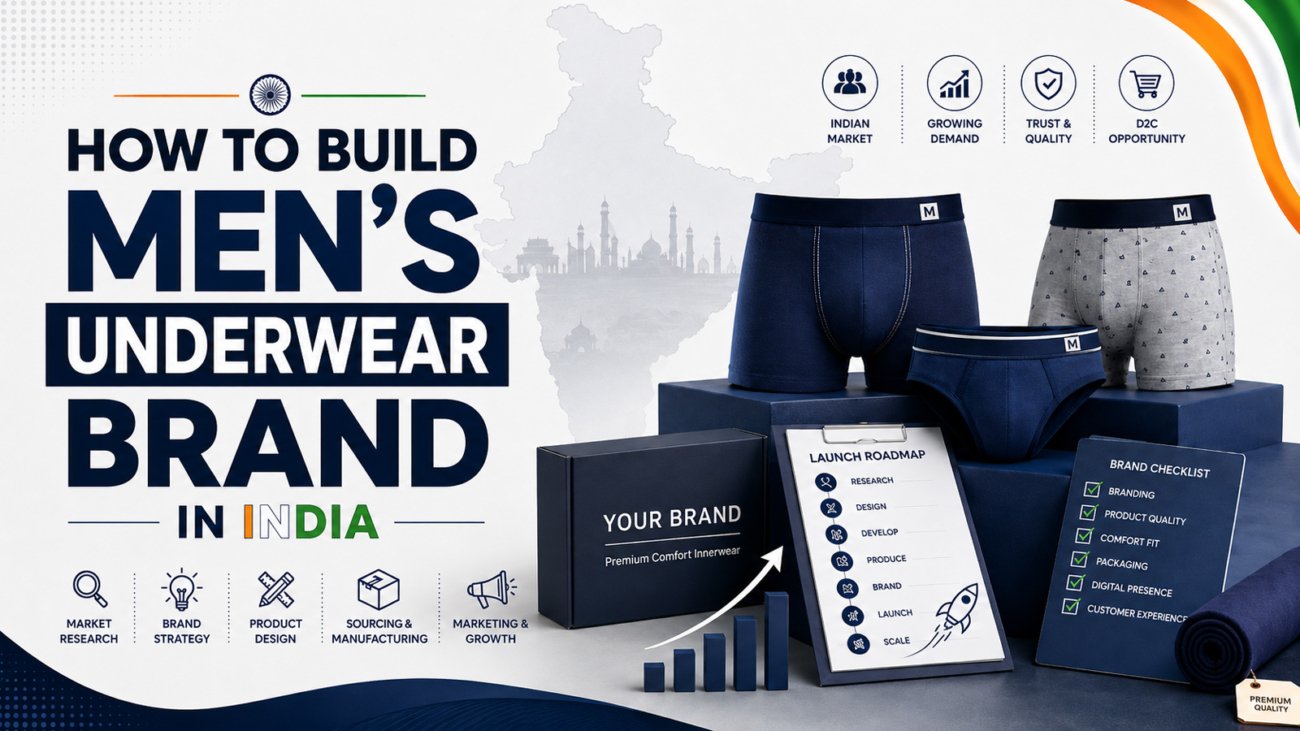
Starting a men’s underwear brand in India can be a strong business opportunity because innerwear is a repeat-purchase product. Unlike fashion products that customers buy occasionally, underwear is used daily, replaced frequently, and purchased in multiple packs. The Indian innerwear market was valued at around ₹1.03 lakh crore approx in 2025 and is projected to reach ₹1.86 lakh crore by 2034, growing at a CAGR of 6.49%. The growth is driven by comfort awareness, branded product demand, e-commerce, fabric innovation, and premiumization.
India also has a strong textile and apparel manufacturing base. The textile and apparel industry supports mass-market as well as premium apparel demand and employs more than 45 million people, which makes India a suitable country for building an innerwear manufacturing or private-label business.
Understand the Men’s Underwear Market
Men’s underwear is no longer only a basic clothing product. Today, customers look for comfort, fitting, fabric quality, waistband softness, pouch support, sweat control, stretch, and stylish prints. Modern consumers are moving toward premium fabrics such as modal, micro modal, bamboo, cotton stretch, nylon blends, and polyester-lycra performance fabrics. IMARC notes that comfort, functionality, fabric technology, moisture-wicking, antibacterial, seamless, and stretchable fabrics are important demand drivers in the Indian innerwear market.
Popular men’s underwear categories
Product Type
Best For
Business Potential
Brief
Daily wear, classic customers
Stable demand
Trunk
Modern fit, young customers, e-commerce
Very strong
Boxer
Relaxed comfort, nightwear, casual wear
Strong
Boxer Brief
Longer coverage, gym, travel
Growing
Vest
Innerwear + loungewear
Good add-on category
Plus Size Underwear
3XL, 4XL, 5XL customers
High opportunity
For a new brand, the best starting range can be men’s trunks, briefs, boxers, and vests, because these products cover both daily comfort and modern fashion demand.
Choose Your Business Model
Before starting, decide whether you want to manufacture, outsource, or sell through marketplaces.
A. Trading Model
In the Trading Model of the underwear brand business, you do not manufacture the product yourself. Instead, you buy ready-made underwear such as trunks, briefs, boxers, vests, or combo packs from manufacturers, wholesalers, or stockists and sell them through your own sales channels. These channels can include retail shops, wholesalers, Amazon, Flipkart, Myntra, IndiaMART, Instagram, WhatsApp, or your own website. This model is suitable for beginners because it requires lower investment, no factory setup, no stitching machines, and no labour management. You can quickly test which product, size, colour, fabric, and price range works best in the market.
The main advantage of the Trading Model is that you can start fast with limited risk and offer multiple product varieties without handling production. However, the biggest drawback is limited control over quality, fit, fabric, elastic, and repeat stock availability. Since the same product may also be sold by other traders, brand uniqueness can be low. Profit margins are also usually lower compared to manufacturing or private-label models because you are buying finished goods from another supplier. This model is best for market testing, wholesale selling, and beginners who want to understand customer demand before moving into private label or own manufacturing.
B. White Label Model
In the White Label Model of the underwear brand business, you purchase ready-made underwear products from a manufacturer and sell them under your own brand name. The manufacturer already has existing designs, fabrics, patterns, sizes, and production setup. You only need to choose the product style, fabric quality, colours, size range, packaging, and brand label. For example, a manufacturer may already produce men’s trunks, briefs, boxers, and vests, and you can add your own brand name, logo, MRP sticker, barcode, and packaging before selling them in the market. This model is useful for new underwear brands because it saves time, reduces production headaches, and allows you to launch your brand faster without setting up a factory.
The main advantage of the White Label Model is that it requires less investment compared to own manufacturing and gives you a better brand identity than pure trading. You can sell the product on Amazon, Flipkart, Myntra, IndiaMART, retail stores, or through wholesale channels under your own brand name. However, the drawback is that product customization is limited because the design and fit are mostly controlled by the manufacturer. The same or similar product may also be supplied to other brands, so uniqueness can be low. Profit margin is better than trading in some cases, but lower than full private-label or own manufacturing. This model is best for brands that want to enter the underwear market quickly and test customer demand before investing in custom designs or factory production.
C. Private Label / OEM Model
In the Private Label / OEM Model of the underwear brand business, you create underwear products according to your own brand requirements, and the manufacturer produces them for you. In this model, you can decide the fabric quality, GSM, elastic type, waistband branding, stitching pattern, pouch design, size chart, colours, prints, packaging, MRP, barcode, and brand label. For example, if you want to launch men’s trunks under your own brand, you can give the manufacturer your selected fabric, elastic design, label details, size range, and packing style. The manufacturer will produce the final product as per your specifications. This model gives you more control than trading or white label because the product is made especially for your brand.
The main advantage of the Private Label / OEM Model is that you can build a unique product identity with better quality control, premium packaging, and customized branding. It is suitable for brands that want to sell on Amazon, Flipkart, Myntra, Ajio, IndiaMART, offline wholesale, or their own D2C website. However, this model requires more planning, sampling, minimum order quantity, quality checking, and investment compared to trading or white label. Sampling may take time because the fit, fabric, waistband, and stitching need to be approved before bulk production. Still, this is one of the best models for serious underwear brands because it helps create a professional brand image, better customer trust, and long-term repeat business.
D. Own Manufacturing Model
In the Own Manufacturing Model of the underwear brand business, you set up your own production unit and manufacture products under your own brand. In this model, you control the complete process, including fabric sourcing, pattern making, size grading, cutting, stitching, elastic attachment, finishing, quality checking, packing, and dispatch. You can produce men’s trunks, briefs, boxers, vests, kids’ underwear, or plus-size underwear according to your own designs and quality standards. This model is best for businesses that want full control over product quality, fit, fabric, waistband, stitching, packaging, and production planning.
The main advantage of the Own Manufacturing Model is higher long-term profit margin, complete customization, better quality control, and the ability to supply products to other brands through OEM or private-label orders. It also helps build a strong and trusted underwear brand because you can maintain consistent product quality. However, this model requires higher investment in machines, workers, factory space, fabric stock, elastic stock, cutting setup, packing material, and production management. There is also more responsibility, such as labour handling, wastage control, machine maintenance, QC issues, and stock planning. This model is best for serious brands that want to scale in online marketplaces, offline wholesale, and B2B private-label supply.
E. Marketplace + D2C Model
In the Marketplace + D2C Model of the underwear brand business, you sell your products through online marketplaces like Amazon, Flipkart, Myntra, Ajio, Meesho, and IndiaMART, along with your own direct sales channels such as Shopify website, Instagram, Facebook, WhatsApp, and your brand website. Marketplaces help you reach a large customer base quickly because they already have traffic, payment systems, delivery support, and customer trust. For a new men’s underwear brand, this model is useful because you can launch products like trunks, briefs, boxers, vests, and combo packs without depending only on offline distributors or retailers.
The main advantage of the Marketplace + D2C Model is wider reach, faster brand visibility, direct customer feedback, and better opportunity to scale across India. D2C sales give you more control over branding, pricing, customer data, offers, and repeat purchases, while marketplaces help generate sales volume. However, this model also has challenges such as high competition, marketplace commission, shipping charges, returns, advertising cost, discount pressure, and strict listing guidelines. To succeed in this model, your product images, size chart, fabric details, reviews, packaging, pricing, and customer service must be very strong.
Build the Right Product Range
Do not launch too many products at once. Start with limited but strong SKUs.
Suggested launch plan
Category
Launch Quantity
Men’s Trunk
6–12 colours/prints
Men’s Brief
4–8 colours
Men’s Boxer
4–6 designs
Men’s Vest
3 basic colours
Combo Packs
Pack of 2 and Pack of 3
Design and Fit Development is one of the most important parts of underwear product creation because comfort depends not only on fabric but also on correct pattern, pouch shape, rise, leg opening, waistband placement, and size grading. A good underwear design should provide proper support without being too tight, allow easy movement, and stay comfortable for daily wear, office use, travel, gym, and sleep. For men’s trunks, briefs, and boxers, the pouch area must be shaped properly, the thigh opening should not roll up, and the waistband should sit smoothly on the body. The design should also match the target customer, such as basic daily wear, premium fashion wear, plus-size comfort, or sports/active underwear.
Fit development includes making samples, testing them on different body types, checking size accuracy, and improving the pattern before bulk production. Important points include waistband comfort, fabric stretch recovery, no skin irritation, no loose fitting, no tight marks, no riding up, and proper coverage from front and back. A strong size chart from M to 5XL helps reduce returns and customer complaints, especially in online selling. Before final production, the product should be tested after washing to check shrinkage, elastic recovery, colour fading, and overall comfort. A well-developed fit helps build customer trust and increases repeat purchases for an underwear brand.
Pack-of-3 is very useful for online marketplaces because customers feel they are getting better value. For premium products, pack-of-2 also works well.
Brand Name, Logo and Trademark
Your brand name should be short, memorable, premium, and easy to pronounce. Before finalizing the name, check whether the same or similar name is already registered as a trademark. India’s official trademark public search portal allows brand-name searches by wordmark, phonetic search, and class.
For clothing and innerwear, trademark filing is usually done under Class 25, but you should confirm exact filing details with a trademark professional before applying.
Brand identity should include
Brand name
Logo
Tagline
Packaging style
Size chart
Product story
Fabric story
Social media look
E-commerce image style
Example positioning line: “Premium everyday comfort for modern Indian men.”
Costing and Pricing
Costing and Pricing is a very important part of underwear product planning because profit does not depend only on selling price. You must calculate every small cost before deciding the final MRP or selling price. The basic cost of an underwear product includes fabric cost, elastic cost, stitching labour, thread, labels, tags, packaging, barcode, transport, wastage, quality checking, and finishing. For example, in men’s trunks, fabric and elastic are usually the main cost factors, but premium packaging, branded waistband, and better stitching can also increase the final product cost.
For online selling, you also need to add marketplace-related expenses such as commission, shipping charges, return cost, advertising cost, discounts, GST, payment gateway charges, and warehouse charges. Many new brands make the mistake of calculating only manufacturing cost and then setting the selling price. But if you sell on Amazon, Flipkart, Myntra, or Ajio, the platform charges can reduce your profit margin quickly. That is why your product costing should include both production cost and selling cost.
A simple pricing formula is: Final Selling Price = Product Cost + Packaging Cost + Logistics Cost + Platform Charges + Marketing Cost + Profit Margin. For example, if one men’s trunk costs ₹100 to manufacture and packaging/logistics/platform expenses add another ₹80, then your total cost becomes ₹180. In this case, if you sell the product at ₹199, your margin will be very low. But if you sell it as a premium product or combo pack at ₹299–₹399, you may get better profit depending on platform charges and return ratio.
For an underwear brand, combo pricing works very well because customers usually prefer buying pack of 2, pack of 3, or pack of 4. Combo packs help increase order value and reduce per-piece logistics cost. Your pricing should also depend on your product positioning. A basic cotton underwear product should be priced competitively, while modal, bamboo, micro modal, premium waistband, plus-size, or printed fashion underwear can be priced higher. The best strategy is to maintain a balance between affordable pricing, premium product quality, and healthy profit margin.
Marketing Strategy & Brand Awareness
For online marketing, product presentation is very important. Underwear products need professional photos, model images, fabric close-ups, waistband details, stretch demonstration, size chart, lifestyle images, and combo pack images. On platforms like Amazon, Flipkart, Myntra, Ajio, and IndiaMART, customers mostly depend on images and product descriptions before buying. The listing title, bullet points, and description should include strong keywords such as men’s trunk underwear, breathable underwear, cotton stretch underwear, bamboo underwear, modal underwear, pack of 3 underwear, plus-size underwear, and anti-rash underwear. Good reviews, clear size guidance, and attractive pricing also help increase conversion and reduce returns.
Social media marketing is also very useful for an underwear brand. Instagram Reels, Facebook posts, YouTube Shorts, and Pinterest creatives can be used to show fabric comfort, product fit, lifestyle use, packing, manufacturing process, and customer benefits. The brand can create content around topics like Trunk vs Brief vs Boxer, Best Underwear for Summer, How to Choose the Right Size, Benefits of Bamboo Fabric, and Why Waistband Quality Matters. Influencer marketing can also help, but the content should look premium, decent, and comfort-focused, not vulgar. For men’s underwear, the best marketing style is clean, confident, modern, and premium.
For offline and B2B marketing, the brand should focus on distributors, garment retailers, wholesalers, IndiaMART buyers, and private-label customers. A strong catalogue, proper price list, sample kit, packaging options, size chart, fabric details, and MOQ details help create trust with buyers. Combo packs, festive offers, dealer margins, and repeat stock availability are important for wholesale growth. The best strategy is to combine marketplace selling + social media branding + offline distribution + B2B private label supply, so the brand can grow from multiple sales channels instead of depending on only one platform.
For stronger awareness, the brand should also focus on reviews, influencer marketing, lifestyle photoshoots, product videos, packaging experience, and repeat customer offers. A customer may not buy a new underwear brand immediately, but if he sees the brand multiple times with a clear comfort message, professional images, and positive reviews, trust slowly develops. Good brand awareness increases customer recall, improves marketplace conversion, builds repeat purchase, and helps the underwear brand compete with bigger brands in both online and offline markets. There many option to increase you brand visibility like facebook marketing, instagram reel, youtube channel, google brand page, or other social media platform.
Profit and Finance
Profit and Finance are very important in the underwear brand business because the final profit depends on proper costing, pricing, sales channel, and stock planning. The main cost in underwear production includes fabric, elastic, stitching, thread, label, packaging, barcode, transport, GST, labour, quality checking, and wastage. If the brand sells online, then marketplace commission, shipping charges, advertising cost, return cost, discount, and warehouse charges must also be added. Many new brands make the mistake of calculating only manufacturing cost, but actual profit comes after deducting all hidden expenses.
In the underwear business, profit margin changes according to the business model. In the trading model, margin is usually lower because the product is purchased from another supplier. In the white label or private label model, margin can be better because the product is sold under your own brand. In the own manufacturing model, long-term profit can be higher because you control fabric purchase, production cost, quality, and bulk manufacturing. Online marketplace selling may show high selling prices, but after commission, ads, returns, and shipping, the net profit can reduce. Offline wholesale gives lower margin but faster bulk movement and repeat orders.
A strong finance plan should include working capital for raw material, production, packaging, photoshoot, marketing, online listing, stock holding, and payment cycle. For example, if one men’s trunk costs ₹100 to manufacture and the total selling expense is ₹60, then your actual cost becomes ₹160. If you sell it at ₹249, your gross profit is ₹89 before other business expenses. Combo packs like Pack of 2, Pack of 3, and Pack of 4 help improve average order value and reduce per-piece shipping cost. The best strategy is to keep proper costing, avoid dead stock, focus on fast-moving sizes, maintain quality, and balance pricing between customer affordability and healthy profit margin.
Legal and Compliance Requirements in India
This section is important before launching.
Business registration
You can start as:
Proprietorship
Partnership
LLP
Private Limited Company
For a small starting brand, proprietorship or partnership is easier. For scaling, investor funding, and stronger brand structure, LLP or Private Limited can be better.
GST registration
GST registration rules depend on business type, turnover, interstate supply, and online selling. The GST Council’s registration guide states that small businesses exclusively supplying goods are generally below the registration requirement up to specified turnover limits, but interstate taxable supply and several other cases require registration.
For e-commerce selling, Section 24 of the CGST Act lists compulsory registration cases, including persons supplying through e-commerce operators required to collect TCS under Section 52.
Udyam / MSME registration
Udyam Registration is useful for MSME recognition. The official Udyam portal requires Aadhaar and PAN verification and is used for MSME registration.
Startup India recognition
If your business is innovative and scalable, you may check DPIIT Startup Recognition. Startup India states that DPIIT-recognised startups can access benefits such as tax benefits, easier compliance, and IPR fast-tracking, subject to eligibility.
Packaging and labelling
Under Legal Metrology rules, packaged commodities require proper declarations. For garments and hosiery sold loose/open, the government has also provided specific declaration requirements such as manufacturer/marketer/brand owner details, consumer care details, size, and MRP inclusive of all taxes.
For underwear packaging, include:
Brand name
Product name
Size
Waist measurement
Fabric composition
MRP inclusive of all taxes
Quantity: pack of 1, 2, 3, etc.
Manufacturer/packer/marketer details
Month and year of manufacture/packing
Customer care email/phone
Country of origin
Wash care
Barcode/SKU code
Conclusion
Starting a men’s underwear brand in India is a practical and scalable business if you focus on the right product, right fabric, right fit, and right sales channel. The opportunity is strong because innerwear is a daily-use product with repeat demand, and Indian customers are shifting toward better comfort, branded products, and premium fabrics.
The best way to start is with a focused range: men’s trunks, briefs, boxers, vests, and pack-of-3 combos. Keep your USP clear: soft fabric, breathable comfort, 4-way stretch, premium waistband, modern fit, and sizes from M to 5XL. With proper branding, legal compliance, product photography, and marketplace strategy, a men’s underwear brand can grow from a small launch into a strong online and offline business.
Undergarment / Innerwear means clothing worn close to the skin, mainly for hygiene, body support, comfort, modesty, warmth, and later fashion. Earlier, undergarments were mostly simple cloth layers. Today, innerwear is a full business category covering men’s underwear, women’s lingerie, vests, bras, shapewear, thermal wear, kidswear, sports innerwear, plus-size, maternity, and athleisure innerwear.
Around 1500 AD / 16th century, people did not wear modern underwear like today’s briefs, trunks, bras, panties, or vests. Men mostly wore linen shirts on the upper body and braies on the lower body. Braies were loose underpants, similar to long shorts or drawers, usually tied at the waist with a cord. Men also wore hose, which covered the legs, and sometimes a codpiece in front, especially in European fashion. Linen was common because it absorbed sweat and was easier to wash than outer garments.
Women usually wore a chemise, also called a shift or smock, under their gown. It was a simple loose linen garment worn next to the skin. In many places, women did not wear modern-style underpants at that time. The chemise protected expensive outer dresses from sweat and body oils, so it worked like both an inner layer and hygiene layer. Wealthy women used finer linen, while poorer women used rougher, simple cloth.
In India and South Asia, common male undergarments were more like langot / kaupina / loincloth-style cloth, especially for daily work, physical activity, and wrestling. The main purpose of undergarments in that period was modesty, support, sweat absorption, and protection of outer clothing—not fashion or branding. There was no innerwear “brand business” like today; most garments were handmade at home, stitched by local tailors, or produced by local weavers.
Historically, underwear changed because of four big forces: body coverage, hygiene, fashion silhouette, and fabric technology. The V&A notes that underwear reflects changes in gender, morality, hygiene, body image, fashion, and fabric innovation.
Century-wise Undergarment Product & Business Model
Century
Main product development
Fabric & technology
Customer / society use
Business model
6th–10th century CE
Basic loincloths, wrapped cloth, simple tunic-like underlayers. In India, traditional forms like kaupinam/langot were used as male underclothing and for wrestling/physical work.
Linen, cotton in warmer regions, wool in colder regions, handwoven cloth.
Main purpose was modesty, protection, sweat absorption, and support during labour.
Mostly home-made, local weavers, village tailoring, barter/local market. No brand concept.
11th century
In Europe, men used loose lower undergarments similar to braies; women used simple chemise/shift under gowns.
Linen became important because it could be washed more easily than heavy outer garments.
Undergarment became a hygiene layer between body and outer clothing.
Cloth was still expensive; people owned limited pieces. Local textile trade grew slowly.
12th century
Braies, hose, chemise, tunics became more organized. Undergarments started differing by class.
More wool, linen, silk for wealthy people.
Rich people used finer fabric; common people used rougher fabric.
Tailors, dyers, cloth merchants grew in towns.
13th century
Men’s hose and braies became common in Europe; women continued chemise/shift as base layer.
Better weaving and dyeing.
Underwear was still not fashion product; it was practical and hidden.
Local guilds and tailoring professions became stronger in Europe.
14th century
Men’s garments became shorter outside, so fitted hose and supportive underlayers became more important.
Linen underlayers, wool hose.
Shape and fit became more visible in men’s clothing.
Tailored garments increased among wealthy and urban customers.
15th century
Chemise became a major women’s undergarment. Men used linen shirts and drawers with hose. FIT’s Fashion History Timeline says that in the 1450s, women’s dress foundation was an undyed linen chemise worn by rich and poor, while men used linen shirts and drawers. (Fashion History Timeline)
Linen was important because it was washable.
Hygiene and layering became more structured.
Tailoring, weaving, and laundering became service-based work in cities.
16th century
Renaissance period: corset-like “bodies,” farthingales, codpieces, chemise, petticoats. Innerwear started shaping the body.
“Bodies” or early stays shaped women’s torso. The line between underwear and outerwear was not always fixed; some garments could be both. Dress historian Sarah Bendall notes that 17th-century “bodies” could be underwear or outerwear depending on status, occasion, and use. (Sarah A. Bendall)
Huge change: corsets, drawers, petticoats, crinolines, bustles, union suits, undershirts. V&A describes the 1870s bustle as a separate undergarment used to support the back shape of skirts. (Victoria and Albert Museum)
Underwear became more structured, especially for women’s silhouette. Men’s practical underwear also became standardized.
Industrial Revolution created mass production, sizes, catalogs, department stores, and ready-made underwear.
Early 20th century
Corsets started declining. Bras, briefs, undershirts, vests, slips, girdles, union suits became common. Mary Phelps Jacob patented the “Backless Brassiere” in 1914; MIT notes she later sold the patent to Warner Brothers Corset Company. (Lemelson MIT)
Cotton knits, elastic, rayon, early synthetic materials.
Women wanted lighter alternatives to corsets. Men wanted comfort and movement.
Branded innerwear companies began growing through department stores and advertising.
1930s–1940s
Men’s modern brief became a major innovation. Jockey says its brief launched in 1935 and sold strongly through Marshall Field & Company. (Jockey) Nylon stockings also became a major textile breakthrough; Science History Institute notes national nylon stocking sales began in 1940 and sold out quickly. (Science History Institute)
Innerwear became a modern consumer product, not just basic clothing.
Branded packaging, store displays, advertising, and mass distribution expanded.
1950s–1960s
Bras, panties, briefs, boxers, vests, girdles, slips, and children’s underwear became common household products.
Lycra/spandex changed fit. LYCRA’s history says Joseph Shivers invented “Fiber K” in 1958, later known as LYCRA/spandex, which could stretch and recover. (Coolmax)
Fit, stretch, femininity, and modern lifestyle became selling points.
Television advertising and national brands became powerful.
Customer wants comfort, hygiene, breathability, style, correct fit, fast delivery, and trusted reviews.
E-commerce, marketplaces, quick commerce, D2C websites, AI search, creator-led ads, marketplace SEO, and data-driven manufacturing.
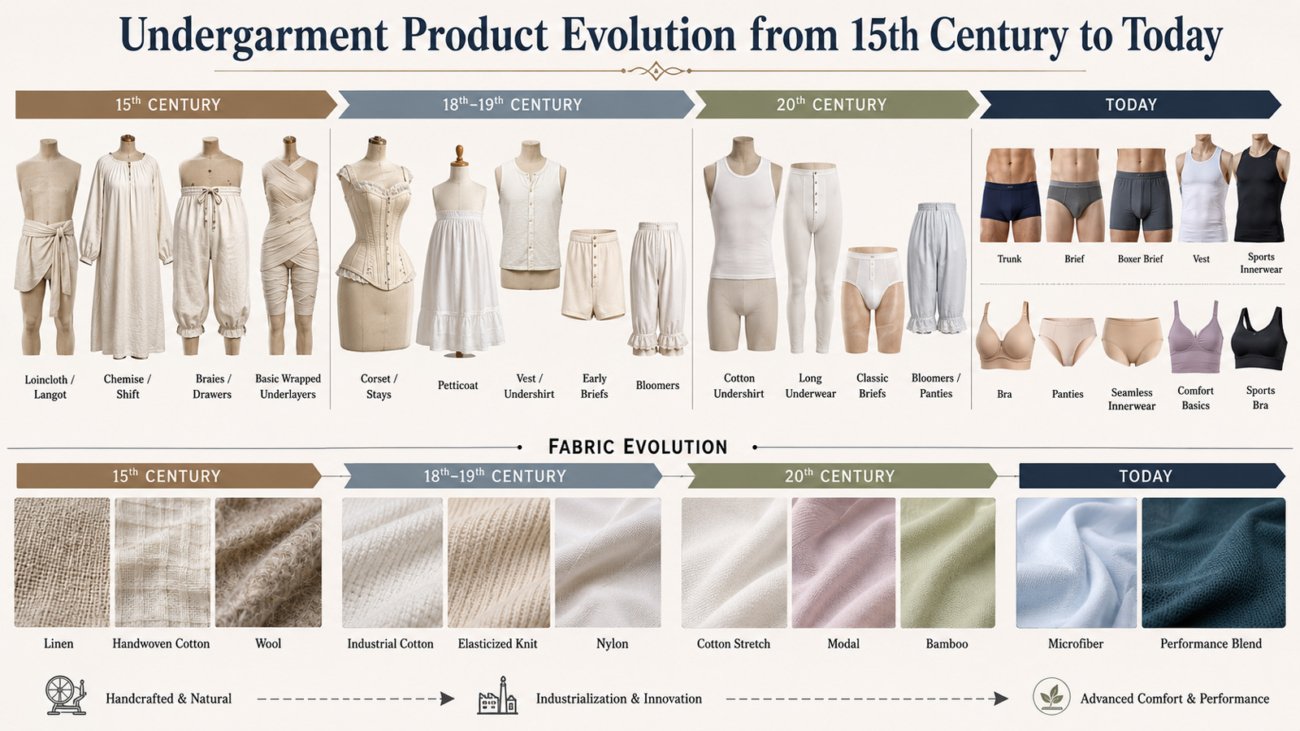
Undergarment Product Evolution from 15th Century to now days
We have to update undergarment products from the 15th century to today because human lifestyle, fabric technology, hygiene needs, and customer expectations have completely changed.
In the 15th century, undergarments were very basic. People mainly used linen shirts, chemise, braies, drawers, or loincloth-style garments. The main purpose was only body coverage, sweat absorption, modesty, and protecting outer clothes. There was no concept of branded innerwear, stretch fabric, perfect fitting, antibacterial finish, or fashion design.
Today, undergarments are not just hidden clothing. They are connected with comfort, skin health, confidence, hygiene, body support, and lifestyle. People wear innerwear for office, gym, travel, sleep, sports, daily work, and fashion. That is why modern products need soft fabric, breathable material, stretch, proper fitting, anti-rash stitching, waistband comfort, plus-size options, and better durability.
So the main reason is: undergarments changed from “basic body covering” to “daily comfort and confidence product.” That is why every innerwear brand must keep updating product design, fabric, fit, packaging, photoshoot, listing content, and customer experience according to modern demand.
“DispenserStore manufactur & delivers innerwear that supports every undergrament lifestyle—whether it’s daily wear, active routines, or relaxed moments at home. We blend innovation with reliable manufacturing to create men, women, and kids undergrament products that not only look good but feel even better. At Dispenserstore, our goal is simple: to make innerwear that offers confidence, comfort, and trust in every wear.“
List Of following data of which are updated undergarments product from 15th century to now days
India-specific undergarment product evolution from the 15th century to today started from very simple, functional clothing. Around the 15th century, common Indian undergarments were not like today’s briefs, trunks, bras, panties, or vests. Men mainly used langot / kaupina / loincloth-style underclothing, especially for daily labour, farming, wrestling, and physical activity. The langot was a simple cotton cloth tied around the waist and between the legs, used for modesty, support, and movement. Even today, it is connected with Indian wrestling, kushti, kabaddi, and akhara culture.
For women, the product evolution was different because Indian clothing was traditionally based on draped garments, not fully stitched garments. Women wore sari-style drapes, ghagra-choli, odhani, and regional clothing forms. In many communities, the idea of a separate stitched blouse and petticoat became more standardized much later. Before the 1870s, some sources describe Indian women’s sari dressing as more fluid, with unstitched fabric being the norm and tailored blouse or petticoat not yet universal.
During the colonial period, Indian undergarment and inner-layer clothing changed strongly. British Victorian ideas of modesty influenced women’s dressing, especially in urban and elite society. The stitched blouse and petticoat became more common under the sari, creating the modern sari silhouette. This was a very important stage because Indian women’s innerwear slowly moved from only draped coverage to more structured supporting garments under outerwear.
From the 1990s to 2010s, Indian innerwear changed from a basic necessity to a branded product. Customers started asking for better fit, fabric, elastic quality, stitching, size chart, color, and packaging. Men’s underwear evolved into briefs, trunks, boxer briefs, boxers, and printed waistbands. Women’s innerwear evolved into padded bras, T-shirt bras, sports bras, seamless panties, hipsters, maternity innerwear, and shapewear. Online shopping also helped because customers could buy innerwear with more privacy and more product choice.
In the 20th century, India’s undergarment market became more organized. Men’s innerwear moved from langot and loose cotton drawers to baniyan, briefs, vests, boxers, and elastic-waist underwear. Women’s products also expanded into bras, panties, slips, petticoats, camisoles, and shapewear. This period created the foundation of India’s hosiery and innerwear business, where local manufacturers, wholesale markets, and retail shops became important.
Nowadays, people no longer see undergarments as just basic clothing worn beneath outerwear. Consumers expect innerwear to provide all-day comfort, proper fit, breathability, skin-friendly fabric, and confidence. Modern customers pay close attention to fabric quality, softness, stretchability, waistband comfort, moisture control, and durability. Many people believe that a good undergarment can improve their daily comfort, productivity, and overall confidence, whether at work, during exercise, or while relaxing at home.
At the same time, undergarments have become a lifestyle and fashion product. Customers look for features such as premium fabrics like cotton, bamboo, modal, and microfiber, along with attractive colors, prints, and modern designs. Online reviews, ratings, brand reputation, and product images strongly influence purchasing decisions. Today’s consumers want innerwear that not only feels comfortable but also reflects quality, personal style, and value for money, making undergarments an important part of their everyday wardrobe rather than just a necessity.
“DispenserStore manufactur & delivers innerwear that supports every undergrament lifestyle—whether it’s daily wear, active routines, or relaxed moments at home. We blend innovation with reliable manufacturing to create men, women, and kids undergrament products that not only look good but feel even better. At Dispenserstore, our goal is simple: to make innerwear that offers confidence, comfort, and trust in every wear.“
A white label brand is a business model where a manufacturer produces products, and another company sells those products under its own brand name. The manufacturer remains behind the scenes, while the retailer or brand owner markets and sells the product as their own. This allows businesses to launch products quickly without investing in manufacturing facilities, product development, or production expertise.
White labeling is common in industries such as innerwear, clothing, cosmetics, food products, electronics, and health supplements. For example, a manufacturer may produce men’s trunks, briefs, and vests, while multiple brands sell the same products with different logos, packaging, and branding. Customers recognize the retailer’s brand rather than the actual manufacturer.
One of the biggest advantages of a white label business is the lower startup cost and faster market entry. Brand owners can focus on marketing, sales, customer service, and brand building instead of managing production. This helps entrepreneurs and retailers create their own product lines without the complexities of manufacturing and inventory development.
For manufacturers, white labeling creates additional business opportunities by allowing them to produce products for multiple brands. For brand owners, it provides flexibility to build a unique market presence through packaging, branding, and marketing strategies. When executed properly, a white label model can be a profitable way to grow a brand while leveraging the expertise and production capabilities of an established manufacturer.
Here are 5 examples of businesses that commonly use white label products:
Fashion & Apparel Brands A company launches its own clothing or innerwear brand but gets products manufactured by a third-party factory. The products are sold under the company’s brand name, while the manufacturer remains hidden.
Supermarket & Retail Store Brands Large retailers often sell products under their own private labels. The products are manufactured by external companies but carry the retailer’s branding and packaging.
Cosmetics & Skincare Brands Many beauty brands do not own manufacturing facilities. Instead, they source white label creams, face washes, shampoos, and skincare products and sell them under their own brand names.
Health Supplements & Nutrition Brands Protein powders, vitamins, and nutritional supplements are frequently produced by specialized manufacturers and then rebranded by fitness and wellness companies.
Home & Kitchen Product Brands Sellers on e-commerce platforms often purchase white label products such as water bottles, storage containers, kitchen tools, and household accessories from manufacturers and market them under their own brands.
Example :
If a retailer wants to launch a men’s innerwear brand called “BONO”, they can partner or job work with Dispenser Store to only manufacture service for trunks, briefs, and vests. Dispenser Store handles production, while the retailer sells the products under the BONO brand name. This is a typical white label business model.
Dispenser Store – Powering Innerwear Brands with White Label Manufacturing
Dispenser Store helps businesses build their own innerwear brands through white label manufacturing solutions. We provide end-to-end production support, allowing entrepreneurs, retailers, wholesalers, and online sellers to launch high-quality innerwear products under their own brand name.
Our white label services cover a complete range of men’s, women’s, and kids’ underwear products. From trunks, briefs, boxers, and vests to women’s panties and kids’ innerwear, we manufacture products that can be customized with your brand identity.
Dispenser Store assists in product development by helping clients select suitable fabrics, designs, fits, and size ranges according to their target market. We offer various fabric options, including cotton blends, bamboo modal, micro modal, and other premium materials to meet different customer preferences.
We also support custom branding requirements such as printed elastic waistbands, brand labels, packaging, hang tags, and polybags. This enables businesses to create a professional and consistent brand image without investing in their own manufacturing setup.
Quality control is an important part of our manufacturing process. Every product undergoes production checks to ensure proper stitching, fabric quality, comfort, fit, and durability before being packed and dispatched to customers.
For businesses entering the market for the first time, Dispenser Store provides guidance on product selection, size planning, packaging requirements, and branding strategies. This helps new brands launch their products with confidence and a strong market presence.
Our manufacturing capabilities allow brands to scale efficiently as their business grows. Whether you require small production quantities for a new launch or larger volumes for established sales channels, we can support your production needs.
By partnering with Dispenser Store for white label innerwear manufacturing, businesses can focus on marketing, sales, and brand growth while we handle the production process. This allows brand owners to launch and expand their innerwear business faster, more efficiently, and with reduced operational complexity.
DISPENSER STORE Production Capacity
Dispenser Store operates with a robust manufacturing infrastructure capable of meeting large-scale production requirements across multiple innerwear categories. Our daily production capacity includes approximately 7000 to 8000 pieces of men’s innerwear, 3,000 pieces of women’s innerwear, and 2,000 pieces of kids’ innerwear.
With a combined production capacity of 12,000 – 13,000 pieces per day, Our Monthly Production is 3Lacs to 3.5lacs. we are well-equipped to support both established brands and emerging businesses through private label and white label manufacturing solutions. Our streamlined production processes, skilled workforce, and strict quality control standards ensure consistent product quality, timely deliveries, and scalable manufacturing support for growing brands.
Complete Guide Line For Innerwear Production Process By DISPENSER STORE
The innerwear manufacturing process begins with product planning, fabric sourcing, and design development. Based on customer requirements, suitable fabrics such as cotton blends, bamboo modal, micro modal, or viscose blends are selected to achieve the desired comfort, durability, and performance characteristics. Once the fabric is finalized, patterns and size specifications are developed, followed by fabric inspection and cutting. Precision cutting ensures consistency across all sizes while minimizing material wastage and maintaining production efficiency.
The next stage involves stitching and garment assembly. Cut fabric panels are stitched using specialized machinery to create the final garment structure. Key components such as elastic waistbands, leg openings, labels, and branding elements are carefully attached during this process. Throughout production, quality checkpoints are implemented to verify stitching accuracy, measurement consistency, fabric appearance, and overall garment construction. Any defects are identified and corrected before proceeding to the finishing stage.
After stitching is completed, the garments undergo finishing, quality inspection, and packaging. This includes thread trimming, ironing or steaming, metal detection (where required), size verification, and final quality checks to ensure every product meets established standards. Approved garments are then folded, tagged, packed into branded polybags or retail packaging, and prepared for dispatch. The finished products are subsequently distributed to retailers, wholesalers, e-commerce platforms, or private label clients, completing the end-to-end innerwear manufacturing cycle from raw fabric to ready-to-sell product.
Brands We Manufacture In Undergarments Categories
Dispenser Store is a trusted innerwear manufacturing partner, providing high-quality production solutions for a diverse portfolio of established and emerging brands. Our manufacturing expertise, quality standards, and scalable production capabilities have enabled us to support multiple brands across the men’s, women’s, and kids’ innerwear segments.
We are currently involved in the production of innerwear products for brands including HRX, Roadster, Dressberry, BONO, M&H (Mast & Harbour), and FIVEFLAG. Each brand has unique product specifications, design requirements, and quality standards, which are carefully managed through our structured manufacturing processes and quality control systems.
By combining modern manufacturing techniques, skilled craftsmanship, and reliable supply chain management, Dispenser Store delivers consistent product quality and timely production support, helping our brand partners strengthen their market presence and meet growing customer demand.
“DispenserStore manufactur & delivers innerwear that supports every undergrament lifestyle—whether it’s daily wear, active routines, or relaxed moments at home. We blend innovation with reliable manufacturing to create men, women, and kids undergrament products that not only look good but feel even better. At Dispenserstore, our goal is simple: to make innerwear that offers confidence, comfort, and trust in every wear.“
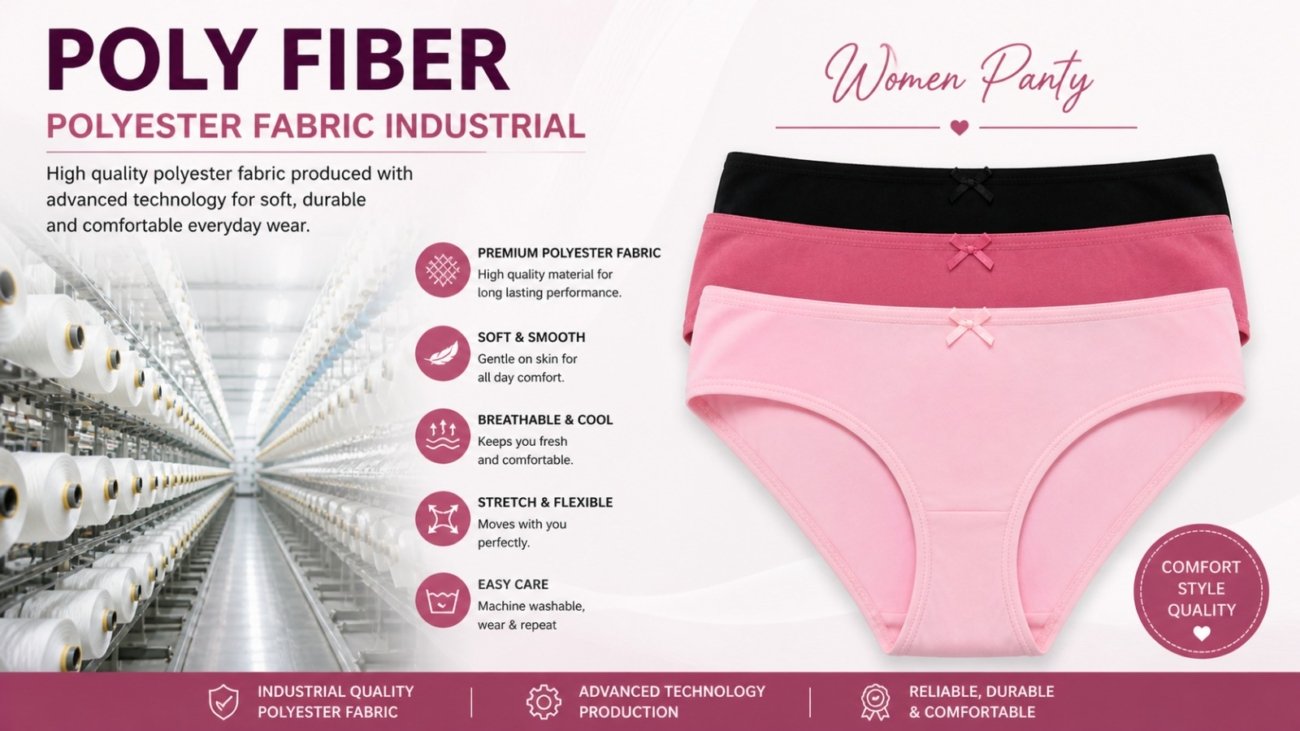
Polyester fiber is a synthetic material made primarily from petroleum-based chemicals, most commonly polyethylene terephthalate (PET). It is widely used in the textile industry because of its durability, strength, and resistance to shrinking and stretching. Polyester fibers are lightweight, quick-drying, and resistant to wrinkles, making them ideal for clothing, upholstery, and home furnishings. They can also be blended with natural fibers like cotton to enhance fabric performance and longevity.
In addition to its practical benefits, polyester fiber is valued for its low cost and easy maintenance. However, it is not very breathable compared to natural fibers and can retain heat, which may cause discomfort in hot climates. Another concern is its environmental impact, as polyester is non-biodegradable and contributes to microplastic pollution when washed. Despite these drawbacks, advancements in recycling technologies have led to the development of eco-friendly recycled polyester, helping to reduce waste and promote sustainability.
IS POLY FIBER GOOD FOR HELTH?
Polyester fiber is generally considered safe for everyday use, especially in clothing and household fabrics. For most people, it does not cause serious health problems. It is non-toxic and resistant to mold and mildew, which can actually make it a good choice in humid conditions. However, because polyester is not very breathable, it can trap heat and sweat against the skin, sometimes leading to discomfort or minor skin irritation, especially in hot weather.
Some individuals with sensitive skin may experience itching or rashes when wearing polyester for long periods. Another concern is that polyester can release tiny microplastics during washing, which may affect the environment more than direct human health. Overall, polyester is fine for regular use, but if you have sensitive skin or live in a very hot climate, choosing natural fabrics like cotton may feel more comfortable.
HOW DO WE MAKE POLY FIBER FOR ENVIRMENT FRIENDLY. Making polyester fiber environmentally friendly starts with using recycled materials instead of new petroleum resources. Recycled polyester (often called rPET) is commonly made from used plastic bottles and waste plastics. These materials are cleaned, melted, and reprocessed into new fibers. This approach helps reduce plastic waste, saves energy, and lowers greenhouse gas emissions compared to producing virgin polyester.
Another important step is improving the manufacturing process. Factories can adopt energy-efficient machines, use renewable energy sources, and reduce water consumption during production. Eco-friendly dyeing techniques and non-toxic chemicals can also minimize pollution of water and soil, making the overall process safer for both humans and the environment.
Designing products for longer use also plays a big role in sustainability. Strong, durable polyester fabrics reduce the need for frequent replacement, which in turn reduces waste. Additionally, avoiding complex blends with other fibers can make recycling easier at the end of the product’s life, supporting a circular economy.
Finally, reducing microplastic pollution is essential. Special washing bags or filters can be used to catch tiny fibers released during laundry. Researchers are also working on biodegradable or plant-based polyester alternatives that break down more easily in nature. These combined efforts help make polyester fiber more environmentally friendly.
“DispenserStore manufactur & delivers innerwear that supports every undergrament lifestyle—whether it’s daily wear, active routines, or relaxed moments at home. We blend innovation with reliable manufacturing to create men, women, and kids undergrament products that not only look good but feel even better. At Dispenserstore, our goal is simple: to make innerwear that offers confidence, comfort, and trust in every wear.“
Polyester fiber is very versatile, and it can be made into several different types of fabrics depending on how it is processed and woven. Broadly, there are 4 main types of polyester fabrics:
Filament polyester fabric – Made from long continuous fibers, this type is smooth, shiny, and strong. It is commonly used in dresses, sportswear, and linings because of its silky appearance.
Staple polyester fabric – Made from short fibers spun together like cotton, this fabric feels softer and more natural. It is often used in everyday clothing and is commonly blended with cotton.
Textured polyester fabric – These fibers are specially treated to add bulk and stretch, making them ideal for activewear, socks, and knit fabrics. They provide comfort and flexibility.
Microfiber polyester fabric – Made from extremely fine fibers, this type is very soft, lightweight, and good at absorbing moisture. It is used in cleaning cloths, sportswear, and high-performance garments.
So, while there are many variations, these four main types cover most polyester fabrics used in daily life.
Polyester fiber can be turned into many different fabric types depending on how it is spun, woven, or finished. Here are 10 common types of fabrics made from polyester fiber:
“DispenserStore manufactur & delivers innerwear that supports every undergrament lifestyle—whether it’s daily wear, active routines, or relaxed moments at home. We blend innovation with reliable manufacturing to create men, women, and kids undergrament products that not only look good but feel even better. At Dispenserstore, our goal is simple: to make innerwear that offers confidence, comfort, and trust in every wear.“
Polyester Filament Fabric – Smooth, shiny, and strong; used in dresses, linings, and formal wear. Polyester Staple Fabric – Soft and cotton-like; often blended with cotton for daily wear. Microfiber Polyester – Extremely fine and soft; used in cleaning cloths and sportswear. Textured Polyester Fabric – Stretchy and bulky; ideal for activewear and knit garments. Polyester Fleece – Warm and lightweight; used in jackets, hoodies, and blankets. Polyester Satin – Glossy and smooth surface; used in gowns, sarees, and decorative fabrics. Polyester Chiffon – Light, sheer, and flowy; used in scarves, sarees, and dresses. Polyester Georgette – Slightly rough and crinkled texture; popular in fashion garments. Polyester Crepe – Wrinkled texture; used in formal wear and stylish outfits. Polyester Mesh – Open and breathable fabric; used in sportswear and bags.
These types show how polyester fiber can be adapted to create fabrics for everything from clothing to home and industrial use.
Polyester fiber is widely used in knitted fabrics because it provides stretch, durability, and comfort. Here are 10 common types of knitted fabrics made from polyester fiber:
“DispenserStore manufactur & delivers innerwear that supports every undergrament lifestyle—whether it’s daily wear, active routines, or relaxed moments at home. We blend innovation with reliable manufacturing to create men, women, and kids undergrament products that not only look good but feel even better. At Dispenserstore, our goal is simple: to make innerwear that offers confidence, comfort, and trust in every wear.“
Polyester Jersey Knit – Soft, stretchy, and lightweight; commonly used in T-shirts and casual wear. Polyester Rib Knit – Has vertical rib lines; very elastic and used in cuffs, collars, and fitted garments. Polyester Interlock Knit – Thick, smooth, and double-sided; used in sportswear and comfortable clothing. Polyester Pique Knit – Textured surface (like polo shirts); breathable and stylish. Polyester Mesh Knit – Open structure; allows airflow, used in sports jerseys, innerwear and activewear. Polyester Tricot Knit – Fine, smooth, and slightly shiny; used in Undergarment, linings, and sportswear. Polyester Raschel Knit – Strong and decorative; used in lace, nets, and outerwear. Polyester Fleece Knit – Soft, brushed fabric; used in hoodies, jackets, and winter wear. Polyester Velour Knit – Plush and velvet-like; used in tracksuits and upholstery. Polyester Spacer Knit – Thick, 3D structure; used in shoes, sports gear, and technical garments.
These knitted fabrics highlight how polyester can be engineered for comfort, flexibility, and performance in many different applications.
Polyester fiber is also widely used to make woven fabrics, which are strong, structured, and commonly used in clothing and home textiles. Here are 10 popular types of woven fabrics made from polyester fiber:
“DispenserStore manufactur & delivers innerwear that supports every undergrament lifestyle—whether it’s daily wear, active routines, or relaxed moments at home. We blend innovation with reliable manufacturing to create men, women, and kids undergrament products that not only look good but feel even better. At Dispenserstore, our goal is simple: to make innerwear that offers confidence, comfort, and trust in every wear.“
Polyester Plain Weave – Simple crisscross pattern; strong and widely used in shirts, dresses, and linings. Polyester Twill Weave – Diagonal pattern; durable and used in uniforms, trousers, and jackets. Polyester Satin Weave – Smooth and shiny surface; used in gowns, sarees, and decorative fabrics. Polyester Taffeta – Crisp and slightly stiff; used in evening wear and linings. Polyester Chiffon – Lightweight and sheer; used in scarves, sarees, and dresses. Polyester Georgette – Slightly rough texture; popular in fashion garments. Polyester Crepe – Crinkled surface; used in formal and stylish clothing. Polyester Organza – Thin, stiff, and transparent; used in bridal wear and decorations. Polyester Canvas – Thick and strong; used in bags, tents, and upholstery. Polyester Jacquard – Intricate woven patterns; used in upholstery, curtains, and luxury garments.
These woven fabrics show how polyester fiber can be used to create a wide range of materials, from lightweight fashion fabrics to heavy-duty industrial textiles.
Polyester fiber is widely used in the industrial sector due to its high strength, durability, and resistance to chemicals and wear. It is used in products like conveyor belts, ropes, safety belts, filters, and industrial fabrics. Polyester performs well under heavy stress and harsh conditions, making it suitable for engineering applications. Its low cost and long service life make it a preferred material in many industries.
Cotton fiber is naturally produced by the cotton plant as soft, fluffy hairs that grow around its seeds inside a protective boll. As the plant matures, these bolls develop and eventually burst open, revealing the white cotton fibers. The fibers are made primarily of cellulose, which forms as the plant converts sunlight, water, and nutrients through photosynthesis. After harvesting, the cotton undergoes a process called ginning, where the fibers are separated from the seeds. These raw fibers are then cleaned, carded, and spun into yarn, making them ready for use in textile production.
Cotton fiber is a natural cellulose fiber obtained from the seed hairs of the cotton plant, widely valued for its softness, breathability, and comfort. It is composed primarily of cellulose, which gives it strength and the ability to absorb moisture efficiently. Cotton fibers have a twisted, ribbon-like structure that helps them spin easily into yarn, making them ideal for textile production. Due to its natural origin, cotton is biodegradable and generally considered skin-friendly, which is why it is extensively used in clothing, especially for innerwear and everyday garments.
In the textile industry, cotton fiber is preferred for its versatility and durability. It can be woven or knitted into a wide range of fabrics, from lightweight muslin to heavy denim. Cotton also has good dye affinity, allowing it to retain color well after multiple washes. However, it may shrink or wrinkle if not treated properly. The quality of cotton fiber is often determined by factors such as staple length, fineness, and strength, with longer fibers producing smoother and stronger fabrics.
HOWMANY TYPE OF COTTON FIBER USED IN INNERWEAR ?
Innerwear typically uses a few key types of cotton fiber, chosen based on comfort, softness, stretch, and durability. The most common is regular (upland) cotton, which is affordable, breathable, and widely used in everyday innerwear. A premium option is combed cotton, where short fibers and impurities are removed, resulting in a smoother, softer, and stronger fabric—ideal for high-quality underwear. Another upgrade is organic cotton, grown without harmful chemicals, making it more skin-friendly and suitable for sensitive skin.
For more premium or performance-focused innerwear, brands may use Pima cotton or Supima cotton, both known for their extra-long staple fibers that provide superior softness, strength, and color retention. In addition, cotton blends (such as cotton with elastane or spandex) are very common in innerwear, as they add stretch, shape retention, and a better fit. Overall, around 4–6 main types or categories of cotton fibers and cotton variants are commonly used in innerwear, depending on the quality level and intended comfort.
“DispenserStore manufactur & delivers innerwear that supports every undergrament lifestyle—whether it’s daily wear, active routines, or relaxed moments at home. We blend innovation with reliable manufacturing to create men, women, and kids undergrament products that not only look good but feel even better. At Dispenserstore, our goal is simple: to make innerwear that offers confidence, comfort, and trust in every wear.“
ABOUT UPLAND COTTON FIBER
Upland cotton is the most widely grown and commonly used type of cotton fiber in the world, especially in the production of everyday garments like innerwear, t-shirts, and casual fabrics. It belongs to the species Gossypium hirsutum and accounts for nearly 90% of global cotton production. This type of cotton has medium staple length, which makes it suitable for mass production while still offering a good balance of softness, strength, and affordability.
One of the key advantages of upland cotton is its versatility and durability. The fibers are strong enough to withstand regular washing and daily wear, making them ideal for products that require long-term use. While it may not be as soft or luxurious as premium varieties like Pima or Supima cotton, upland cotton still provides a comfortable and breathable fabric. This makes it a preferred choice for innerwear where comfort and cost-effectiveness are both important factors.
In textile manufacturing, upland cotton is easy to spin and dye, which allows it to be used in a wide range of fabric types and finishes. It absorbs color well, ensuring good color retention after multiple washes. Additionally, it can be blended with other fibers such as elastane to enhance stretch and fit, which is especially useful in modern innerwear design. Overall, upland cotton remains a practical and reliable choice for both manufacturers and consumers due to its availability, performance, and value.
Cotton men’s trunk underwear is one of the best choices for summer because of its natural breathability. Cotton fibers allow air to circulate freely, which helps keep the body cool even in hot and humid weather. This ventilation reduces heat buildup around the skin, making cotton trunks far more comfortable than synthetic alternatives during long, sweaty days.
Another major benefit is excellent moisture absorption. Cotton can absorb sweat efficiently and keep the skin feeling dry for longer periods. In summer, when sweating is unavoidable, this property helps prevent that sticky, uncomfortable feeling and allows you to stay fresh throughout the day, whether you’re at work or on the move.
Cotton is also extremely gentle on the skin, making it ideal for sensitive areas. Men’s trunk underwear made from cotton reduces the risk of irritation, itching, or rashes that are more common in hot weather. Its soft texture ensures minimal friction against the skin, which is especially important when sweat increases skin sensitivity.
Hygiene is another strong advantage. Because cotton is breathable and moisture-absorbing, it helps reduce bacterial growth caused by sweat and heat. This lowers the chances of odor, infections, or skin problems, making cotton trunks a healthier option for everyday summer wear.
“DispenserStore manufactur & delivers innerwear that supports every undergrament lifestyle—whether it’s daily wear, active routines, or relaxed moments at home. We blend innovation with reliable manufacturing to create men, women, and kids undergrament products that not only look good but feel even better. At Dispenserstore, our goal is simple: to make innerwear that offers confidence, comfort, and trust in every wear.“
Comfort and fit also play a key role. Cotton trunks provide a snug yet flexible fit that supports movement without feeling restrictive. In summer, when you’re more active or wearing lighter clothing, this balance of support and comfort becomes essential for all-day wear.
Lastly, cotton is a durable and easy-care fabric, which makes it practical for daily use in hot seasons. It withstands frequent washing, dries relatively quickly, and maintains its softness over time. This makes cotton men’s trunk underwear a reliable, low-maintenance, and cost-effective choice for staying comfortable during summer.


 Cart is empty