

 Cart is empty
DISPENSER Underwear | Fabric Education & Men’s Innerwear Guide
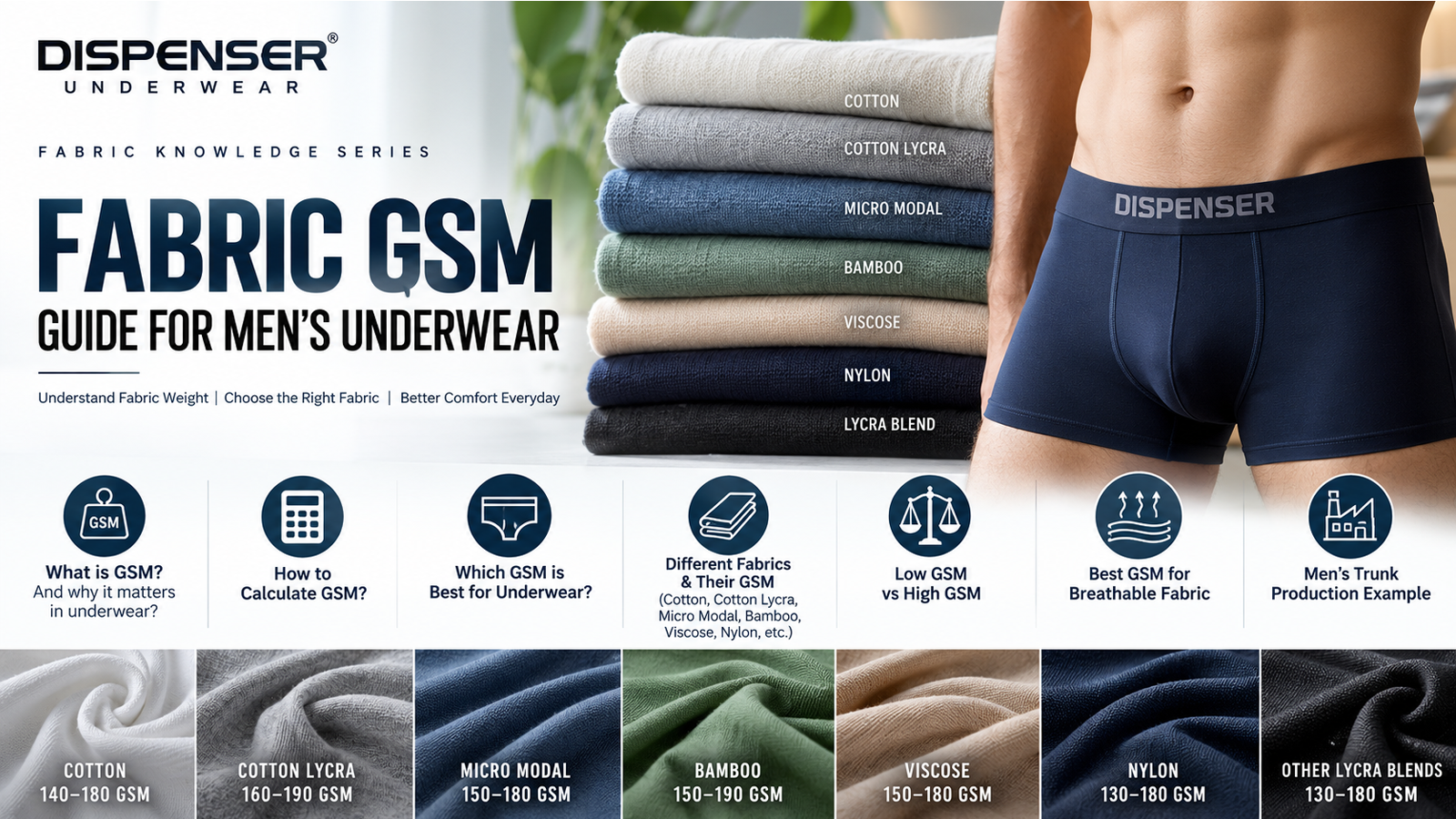
Choosing the right fabric for men’s underwear is not only about softness, stretchability, or appearance. One of the most important factors that influences how underwear feels, fits, and performs is fabric GSM (Grams per Square Meter).
Whether you are buying everyday men’s trunks, premium modal underwear, cotton briefs, or performance innerwear, GSM is an important technical specification to understand.
But does higher GSM always mean better quality? Is lightweight fabric more breathable? Which GSM is best for cotton Lycra, Micro Modal, bamboo, viscose, and nylon underwear?
In this guide, we’ll answer these questions with practical examples based on DISPENSER men’s underwear, while also explaining how GSM influences fabric consumption, comfort, and manufacturing costs.
1. What Is Fabric GSM?
GSM stands for Grams per Square Meter. It measures the weight of one square meter of fabric.
For example:
| Fabric GSM | Weight of 1 m² |
|---|---|
| 140 GSM | 140 grams |
| 160 GSM | 160 grams |
| 180 GSM | 180 grams |
| 200 GSM | 200 grams |
In general, for fabrics with similar fibre composition and knitted construction, a higher GSM indicates a heavier fabric, while a lower GSM indicates a lighter fabric.
However, GSM does not directly measure softness, durability, stretchability, thickness, or breathability.
A well-developed 160 GSM Micro Modal fabric may offer better comfort for a particular customer than a poorly finished 200 GSM cotton fabric.
2. Why Is Fabric GSM Important in Men’s Underwear?
Men’s underwear stays in direct contact with the skin for extended periods. Therefore, fabric selection should provide a suitable balance of comfort, fit, weight, durability, and moisture management.
Comfort and fabric weight: Lightweight fabrics can reduce the heavy feeling associated with dense materials, while medium-weight fabrics may offer more substantial coverage.
Fit and stretch recovery: GSM influences the amount of fabric material in a garment, but elastane percentage, yarn quality, and knitting construction play bigger roles in stretch and recovery.
Breathability: GSM is useful when comparing similar fabrics, but airflow also depends on the spaces between yarns, fabric structure, and finishing.
Coverage and appearance: Higher-GSM fabrics often provide better opacity when compared with equivalent lower-GSM fabrics.
Production cost: Fabric weight directly influences fabric consumption when garment dimensions and fabric construction are comparable.
DISPENSER underwear example
Suppose DISPENSER is developing two cotton Lycra trunks with the same construction:
- Sample A: 150 GSM Cotton Lycra
- Sample B: 180 GSM Cotton Lycra
Sample A may feel lighter, while Sample B may provide a more substantial feel and greater coverage.
The best option cannot be decided by GSM alone. Both samples should be tested for stretch recovery, shrinkage, air permeability, opacity, and wearer comfort.
3. Why Do Manufacturers Calculate Fabric GSM?
Fabric GSM is important not just for garment comfort but also for manufacturing accuracy.
Manufacturers calculate GSM to determine fabric weight consistency, compare samples from suppliers, estimate material consumption, calculate fabric costs, and maintain production standards.
For instance, if DISPENSER approves a 170 GSM cotton Lycra fabric for a particular trunk design, the production team can use that specification to check whether bulk fabric deliveries are consistent with the approved sample.
GSM tolerance should be agreed with the fabric supplier rather than assuming that every fabric roll will have an identical measurement.
4. How to Calculate Fabric GSM

There are two practical methods.
Method 1: Using a GSM Cutter
A common textile testing method uses a circular GSM cutter to obtain a sample covering 100 cm². After cutting the sample, measure its weight using a calibrated precision balance.
Formula:
GSM = Sample Weight (g) X 100
Example: Suppose a sample of DISPENSER cotton Lycra fabric weighs 1.75 grams.
1.75 X 100 = 175Grams
The tested fabric has a GSM of 175.
Method 2: Without a GSM Cutter
A fabric sample of known dimensions can also be weighed.
GSM = Fabric Weight (g) X 10,000 / Fabric Area (CM)²
For example, if a 20 cm × 20 cm knitted fabric sample weighs 7 grams:
GSM = 7 X 10000 / 400 = 175
Interactive GSM Calculator
Length (cm)Width (cm)Weight (g)
Calculated fabric GSM
175.0 GSM
Sample area: 400.0 cm²
For reliable fabric quality control, samples should be conditioned appropriately, measured without stretching, and collected from multiple locations across the fabric. The average GSM should then be calculated.
5. Which Fabric GSM Is Best for Men’s Underwear?
There is no single ideal GSM for every underwear fabric. Different materials require different fabric weights depending on their fibre properties, construction, and intended use.
The following table provides practical starting ranges for men’s underwear development.
| Fabric Type | Suggested GSM | Best Application |
|---|---|---|
| 100% Cotton | 140–180 | Relaxed boxers, everyday underwear |
| Cotton Lycra | 160–190 | Daily wear trunks and briefs |
| Micro Modal Lycra | 150–180 | Premium soft underwear |
| Bamboo Viscose Lycra | 150–190 | Soft, smooth innerwear |
| Viscose Lycra | 150–180 | Lightweight comfort trunks |
| Nylon Lycra | 130–160 | Sports and performance trunks |
| Polyester Lycra | 130–160 | Quick-drying active underwear |
| Cotton Modal Lycra | 160–190 | Premium everyday trunks |
These ranges are development guidelines, not universal quality standards. Actual selection should be confirmed through physical fabric samples and testing.
6. Understanding Different Underwear Fabrics and Their GSM
A. Cotton Fabric — 140–180 GSM
Cotton is widely used for men’s underwear because it is naturally absorbent, familiar to wear, and suitable for everyday garments. A 150–170 GSM cotton jersey is a useful sampling range for relaxed boxers, while some denser constructions may require greater weight.
DISPENSER Example: A relaxed-fit cotton boxer could be developed using 160 GSM cotton jersey for a soft, lightweight feel.
B. Cotton Lycra Fabric — 160–190 GSM
Cotton Lycra combines cotton’s absorbency with the elasticity of Lycra, a branded elastane fibre. A common reference composition is 95% cotton and 5% elastane.
DISPENSER Example: For regular-fit men’s trunks, DISPENSER could evaluate 170–180 GSM cotton Lycra to balance coverage, stretch, and everyday comfort.
C. Micro Modal Fabric — 150–180 GSM
Micro Modal is valued for its fine, smooth feel and fluid drape. It is often blended with elastane to create soft, close-fitting underwear.
DISPENSER Example: A premium Micro Modal trunk could begin testing at 160–175 GSM, comparing lightness, opacity, stretch recovery, and washing performance.
D. Bamboo Fabric — 150–190 GSM
Many fabrics marketed as bamboo are actually bamboo-origin viscose or rayon. They can provide a smooth feel and good moisture absorption, but their performance depends on how they are made.
DISPENSER Example: A bamboo-origin viscose elastane trunk could be evaluated at 160–180 GSM for a soft everyday product.
E. Viscose Fabric — 150–180 GSM
Viscose is a regenerated cellulosic fibre known for its smooth hand feel and drape. It absorbs moisture but requires good fabric finishing and shrinkage control.
DISPENSER Example: A 165–175 GSM viscose Lycra sample could be considered for a smooth-fitting comfort trunk.
F. Nylon Fabric — 130–180 GSM
Nylon is commonly selected for technical underwear because of its strength, smoothness, and potential for quick-drying performance when engineered correctly.
DISPENSER Example: A 150–170 GSM nylon elastane fabric could be considered for active trunks, provided its ventilation, moisture-wicking, and drying performance are tested.
G. Polyester Lycra and Other Stretch Fabrics — 130–180 GSM
Polyester Lycra is suitable for performance-oriented products when engineered to transport moisture and dry quickly. Other useful blends include cotton-modal Lycra and lyocell elastane.
DISPENSER Example: A 150 GSM polyester elastane mesh could be compared with a 170 GSM smooth-knit fabric for an Active Collection.
An important consideration for brands is accurate fibre labelling. Bamboo-derived viscose should not automatically be described as naturally antibacterial or environmentally superior without appropriate evidence.
7. Low GSM vs High GSM Fabric: Which Is Better for Underwear?
Low GSM (130–160)
- Lighter fabric weight
- Potentially better for lightweight designs
- May require opacity checks
- Can have lower material consumption
High GSM (180–220)
- Heavier fabric weight
- Often provides fuller coverage
- May feel more substantial
- Generally increases material consumption for comparable constructions
A higher GSM is not automatically better quality, and a lower GSM is not automatically more breathable.
For example, DISPENSER could compare 150 GSM and 185 GSM cotton Lycra fabrics with the same composition. The lighter version may suit a summer-focused collection, while the heavier version may suit customers who prefer greater coverage.
The actual result would still depend on knitting density, elastane content, finishing, and fit.
8. Which GSM Is Best for Breathable Men’s Underwear?
Breathability is particularly important in warm and humid conditions, including much of India’s climate.
However, GSM alone cannot tell us which fabric allows more air to pass through it. A lightweight but tightly knitted fabric can be less breathable than a heavier fabric with a more open structure.
For breathable underwear, manufacturers should consider air permeability, moisture absorption, wicking, drying time, garment fit, and fabric weight together.
Suggested GSM Ranges for Lightweight Summer Underwear
| Fabric | Sampling Range |
|---|---|
| Cotton Lycra | 150–170 GSM |
| Micro Modal Lycra | 150–170 GSM |
| Bamboo Viscose Lycra | 150–175 GSM |
| Viscose Lycra | 150–170 GSM |
| Nylon Performance Knit | 130–160 GSM |
| Polyester Performance Mesh | 130–160 GSM |
DISPENSER Example: For a summer underwear range, two promising starting samples would be a 160 GSM cotton Lycra trunk and a 160 GSM Micro Modal Lycra trunk.
The cotton Lycra sample could target dependable everyday comfort, while the Micro Modal sample could target a softer, smoother premium feel. Airflow and wearer testing would help determine the better choice.
9. Average Fabric Consumption in Men’s Trunk Production
In men’s trunk manufacturing, average fabric consumption is influenced by GSM, finished fabric width, garment size, pattern design, cutting efficiency, and shrinkage allowances. For example, assume DISPENSER develops a men’s medium-size trunk using 175 GSM cotton Lycra. If its total cut-panel area is approximately 0.20 m², the finished fabric required for the cut panels would weigh around 35 grams per trunk. This figure covers the main cut fabric panels, not the waistband, labels, thread, or packaging.
In actual production, fabric consumption increases because of marker wastage, cutting losses, and process allowances. Assuming an illustrative 15% fabric allowance, the purchasing estimate becomes approximately 40.25 grams per trunk. For a production order of 1,000 trunks, the estimated fabric requirement would be approximately 40.25 kg, before any additional contingency for fabric defects or process variation.
Therefore, the average fabric consumption of a DISPENSER men’s trunk cannot be accurately determined from GSM alone. Every size, including M, L, XL, and 2XL, has different pattern dimensions. The manufacturer should confirm average consumption through an approved marker plan, fabric width, actual size ratio, and sample cutting data.
10. How DISPENSER Can Select the Right GSM for Different Underwear Collections
The following is an illustrative product-development framework rather than a statement of DISPENSER’s existing product specifications.
| Collection Example | Fabric | Starting GSM |
|---|---|---|
| Everyday Comfort Trunks | Cotton Lycra | 170–180 |
| Premium Soft Trunks | Micro Modal Lycra | 160–175 |
| Summer Comfort Trunks | Cotton Lycra | 150–165 |
| Smooth Comfort Trunks | Viscose Lycra | 160–175 |
| Active Performance Trunks | Nylon Elastane | 150–170 |
| Relaxed Cotton Boxers | Cotton Jersey | 150–170 |
For consistent customer experience, the fabric development process should also specify fibre composition, finished width, GSM tolerance, shrinkage, colour fastness, stretch recovery, and air permeability.
11. Frequently Asked Questions (FAQs)
Is 180 GSM good for men’s underwear?
Yes. A well-constructed 180 GSM cotton Lycra fabric can be suitable for everyday trunks and briefs, depending on the required fit and comfort.
Is 150 GSM too thin for underwear?
Not necessarily. A 150 GSM fabric can work well in lightweight Micro Modal or performance underwear. Opacity, strength, and durability need to be checked.
Does higher GSM mean better underwear quality?
No. Better-quality underwear depends on fibre quality, yarn, knitted construction, finishing, garment construction, and testing.
What GSM should I choose for cotton Lycra trunks?
A practical starting range is 160–190 GSM, with approximately 170–180 GSM worth testing for everyday trunks.
Is Micro Modal better than cotton Lycra?
Micro Modal may offer a softer, smoother feel, while cotton Lycra is a versatile choice for everyday use. Neither is universally superior.
Which GSM is suitable for hot weather?
Lightweight fabrics around 150–170 GSM are useful starting points for several summer underwear designs, but the best result depends on air permeability and moisture management.
Does 200 GSM fabric last longer than 160 GSM fabric?
Not always. A well-engineered 160 GSM fabric may outperform a poor-quality 200 GSM fabric in durability testing.
Why is Lycra added to underwear?
Lycra or elastane adds stretch and improves the garment’s ability to recover its original shape after stretching.
Conclusion: Which Fabric GSM Is Best for Men’s Underwear?
When it comes to men’s underwear, the best fabric GSM is not simply the highest or lowest number.
For everyday cotton Lycra trunks, 160–180 GSM is a useful starting point. Premium Micro Modal, summer-focused cotton Lycra, and performance nylon fabrics may benefit from different weight ranges.
The key is to balance fabric weight with softness, stretch recovery, coverage, breathability, and durability.
For DISPENSER underwear, this means evaluating fabrics based on the intended product and the comfort customers expect, rather than selecting materials by GSM alone.
The right fabric is not necessarily the heaviest fabric. It is the one that delivers the right balance of comfort, fit, and performance.
Disclaimer: The GSM ranges and manufacturing calculations in this article are general development references and illustrative examples. They do not represent verified specifications or actual production averages for DISPENSER products. Confirm product-specific technical details through approved fabric specifications and testing.
Add a Comment