

 Cart is empty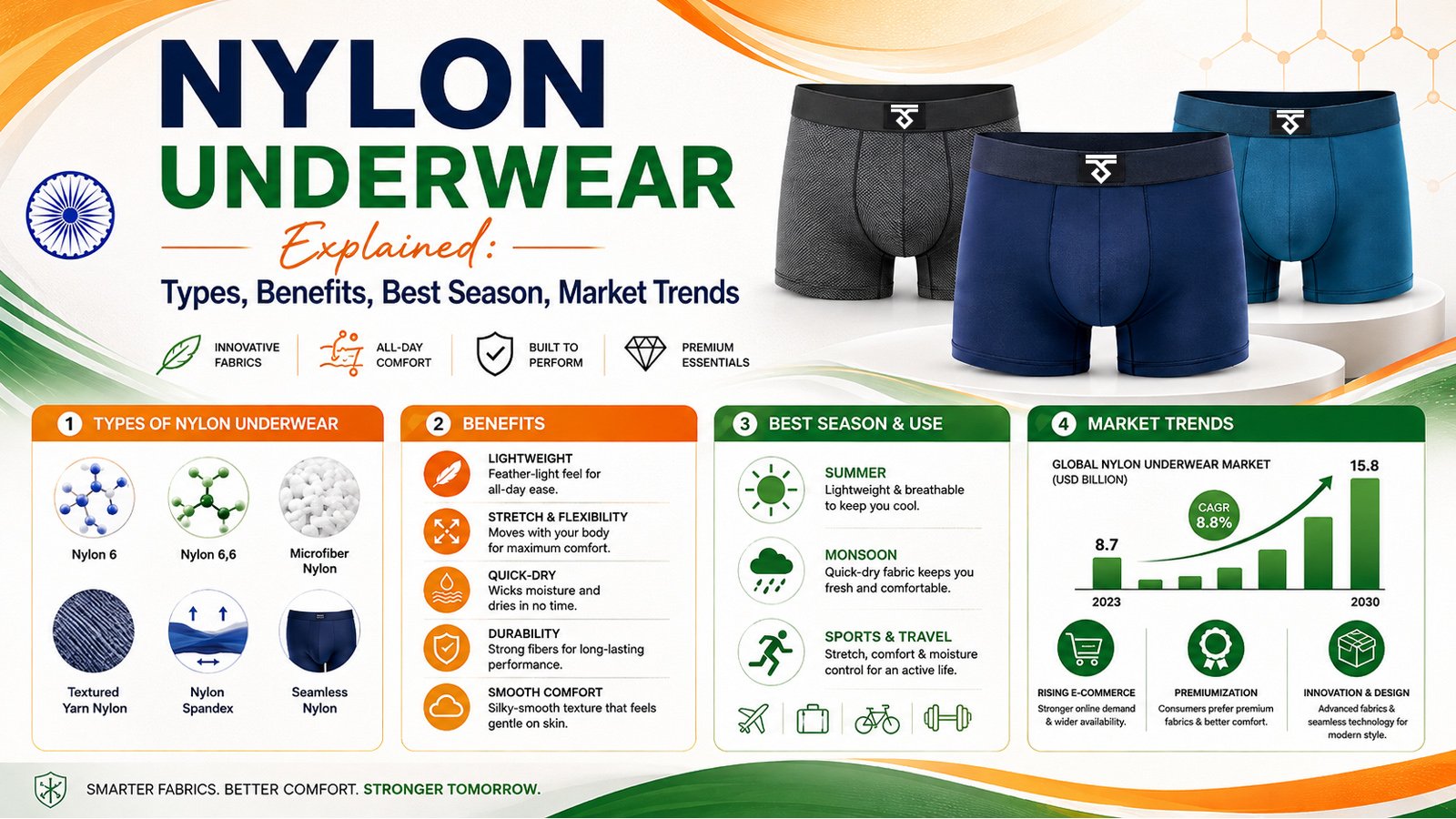
Nylon yarn plays an important role in underwear because it provides strength, flexibility, smoothness, and durability to the fabric. Nylon is a synthetic fibre known for being lightweight yet very strong. When blended with cotton, modal, bamboo, polyester, or elastane, it helps the underwear maintain its structure while still feeling soft and comfortable against the skin. This makes nylon especially useful in products designed for daily wear, sports, travel, and active lifestyles.
One of the main purposes of nylon yarn in underwear is to improve stretch and shape retention. Underwear needs to move with the body throughout the day without becoming loose or losing its original fitting. Nylon fibres have good elasticity and recovery, so they help the garment return to its original shape after stretching. When nylon is combined with spandex or elastane, it can provide even better flexibility and a comfortable body-hugging fit.
Nylon yarn also improves the durability and life of the garment. Underwear goes through frequent washing, stretching, rubbing, and everyday movement. Nylon has excellent resistance to abrasion, which means the fabric is less likely to wear out quickly in high-friction areas. It can also be used in waistbands, leg openings, seams, and stretch fabrics to provide additional strength without making the garment heavy or uncomfortable.
Another benefit of nylon is its ability to support moisture management and quick drying. Nylon itself absorbs relatively little moisture compared with fibres such as cotton, so moisture can evaporate more quickly from properly engineered nylon-blend fabrics. This is especially useful in performance underwear, gym wear, travel underwear, and hot-weather products. However, moisture-wicking performance depends on the complete fabric construction and finishing, not only on the presence of nylon yarn.
TYPE OF YARN USED IN NYLON UNDERWEAR
1. Nylon 6
Nylon 6 is one of the most commonly used nylon fibres in the textile and innerwear industry. It is produced from caprolactam and is known for its good balance of softness, strength, flexibility, and affordability. Because underwear is worn directly against the skin for long hours, the fabric needs to be lightweight and comfortable. Nylon 6 can be produced in very fine yarn counts, allowing manufacturers to make smooth and soft knitted fabrics suitable for everyday innerwear.
A major advantage of Nylon 6 is its good stretch and recovery characteristics, especially when blended with elastane or spandex. The fabric can follow body movement without feeling excessively stiff. It also has good abrasion resistance, which helps underwear withstand repeated movement, washing, and friction. This makes it suitable for men’s trunks, women’s panties, briefs, sports underwear, and seamless products.
Nylon 6 also dyes relatively well, allowing manufacturers to produce bright, deep, and fashionable colours. It can be used in solid-colour underwear as well as jacquard, rib, mesh, or textured constructions. Depending on yarn type and knitting construction, Nylon 6 fabric can be made shiny, semi-dull, or matte.
Common applications: seamless panties, men’s trunks, briefs, active innerwear, stretch waist panels and lightweight performance underwear.
2. Nylon 6,6
Nylon 6,6 is another important nylon fibre used in textiles. Compared with Nylon 6, Nylon 6,6 generally offers higher strength, better heat resistance, dimensional stability, and abrasion resistance. Because of these properties, it is especially useful in areas of underwear that experience repeated stretching or friction.
For example, Nylon 6,6 may be used in elastic waistbands, leg openings, support zones, reinforcement areas, or technical innerwear fabrics. It helps the garment maintain its shape even after repeated wearing and washing. This can be important for premium underwear where long-term durability is a major selling point.
Nylon 6,6 can also be manufactured into very fine filament yarns, so increased strength does not necessarily mean the fabric must feel heavy. With the correct yarn denier and knitting structure, it can provide a smooth and comfortable surface while increasing the garment’s durability.
However, Nylon 6,6 may cost more than basic Nylon 6 in some applications. Therefore, manufacturers normally select it when performance, durability, heat stability, or abrasion resistance is especially important.
Common applications: premium underwear, performance innerwear, durable waistbands, technical stretch fabrics, leg openings and reinforcement zones.
3. Microfiber Nylon
Microfiber nylon refers to nylon made from extremely fine individual filaments. Because the fibres are much finer than conventional yarn, microfiber nylon fabric can feel exceptionally smooth, soft, lightweight, and silky against the skin. This is why it is widely used in premium underwear.
The fine filaments create a fabric surface with very little roughness. This helps reduce bulky or coarse sensations and allows the garment to sit smoothly underneath trousers, dresses, leggings, or fitted clothing. Microfiber nylon is particularly useful when the desired product positioning is soft touch, premium feel, invisible appearance, or second-skin comfort.
Microfiber nylon also gives manufacturers good flexibility in fabric engineering. It can be knitted into smooth jersey, mesh, rib, jacquard, seamless structures, or high-stretch fabrics. When blended with spandex, the fabric becomes highly flexible and can closely follow body contours.
Another advantage is its relatively quick-drying nature compared with fabrics containing large amounts of cotton. However, actual moisture-wicking performance depends on the fabric structure and finishing treatment.
Microfiber nylon is commonly used for women’s panties, men’s premium trunks, seamless underwear, shapewear, activewear, bras and lightweight innerwear.
4. Textured Nylon Yarn
Textured nylon is created by processing smooth filament yarn so that the filaments develop crimp, loops, coils, or increased bulk. The purpose of texturing is to improve properties such as softness, stretch, volume, flexibility, and covering ability.
A very common form is DTY — Draw Textured Yarn. Textured nylon can provide natural-looking stretch even before adding elastane. When it is combined with spandex, manufacturers can produce fabrics with excellent body movement and recovery.
Another benefit is better fabric coverage. Because textured yarn has more bulk than flat filament yarn, it can create a fuller fabric while maintaining relatively low weight. It can also make the material feel warmer and softer compared with completely flat nylon filament.
In underwear, textured nylon yarn can be particularly useful in seamless knitting machines, where different zones of compression, ventilation, ribbing, support, and stretch can be created within the same garment.
Manufacturers may use textured nylon in body fabric, waist areas, leg openings, jacquard designs, mesh zones, and stretch panels.
Key benefits: elasticity, bulk, softness, flexibility, good coverage, shape recovery and seamless-machine compatibility.
5. Nylon-Spandex / Nylon-Elastane Blend
A Nylon-Spandex blend is one of the most important fabric combinations in modern stretch underwear. In this combination, the two fibres perform different jobs. Nylon provides strength, smoothness, durability and lightweight performance, while spandex provides high stretch and recovery.
For example, a fabric composition such as 90% Nylon + 10% Spandex can provide excellent flexibility for everyday underwear. A composition containing a higher percentage of elastane may be selected when additional stretch, compression, body contouring, or support is required.
This type of fabric can stretch with walking, sitting, exercising, bending, and other daily movement while returning toward its original dimensions afterward. Good recovery is particularly important because poor-quality underwear can become loose around the waist, seat, or leg openings after repeated use.
Nylon-spandex fabrics can also be made very lightweight. This helps manufacturers create underwear that fits close to the body without using thick or heavy fabrics.
The exact percentage should always be selected according to the product. Everyday underwear, shapewear, sports underwear, compression garments, and seamless panties may all require different constructions.
Common examples include:
95% Nylon + 5% Spandex – light stretch
90% Nylon + 10% Spandex – good everyday stretch
85% Nylon + 15% Spandex – higher stretch and recovery
80% Nylon + 20% Spandex – strong stretch/compression applications
These percentages are examples rather than universal standards.
6. Seamless Nylon Fabric
Seamless nylon underwear is technically more of a garment construction or knitting category than a completely separate type of nylon. It is commonly produced using circular seamless knitting machines with nylon, textured nylon, microfiber nylon and elastane yarns.
The biggest advantage is that large sections of the garment can be knitted without traditional side seams. This can reduce seam bulk and create a smoother appearance under clothing. Seamless technology can also allow manufacturers to engineer different structures directly into the same garment.
For example, one section can have higher stretch, another can have mesh ventilation, and another can provide additional support or coverage. This zonal construction is one of the major reasons seamless technology is popular in modern underwear and activewear.
Nylon is particularly suitable for seamless manufacturing because fine nylon yarns have good strength and can run efficiently through high-speed knitting machines. When nylon is combined with elastane, the final garment can provide close fitting, stretch, recovery, and a smooth body-contouring appearance.
Seamless nylon fabrics are widely used in women’s hipsters, briefs, men’s trunks, sports underwear, shapewear, bras, camisoles and performance innerwear.
Simple comparison
| Type | Main Purpose in Underwear | Main Advantage |
|---|---|---|
| Nylon 6 | General underwear fabric | Soft + durable |
| Nylon 6,6 | Higher-performance areas | Higher strength |
| Microfiber Nylon | Premium soft underwear | Smooth second-skin feel |
| Textured Nylon | Stretch/seamless knitting | Bulk + flexibility |
| Nylon + Spandex | Stretch underwear | Excellent stretch & recovery |
| Seamless Nylon | Seam-free garment construction | Smooth fit + engineered zones |
For modern premium underwear manufacturing, Microfiber Nylon + Spandex or Textured Nylon + Spandex in seamless construction is usually a particularly useful combination because it can deliver softness, stretch, shape recovery and a clean premium appearance.
From these 6 types, the most commonly used in modern underwear is Nylon + Spandex/Elastane blend.
A very common construction is around 85–95% nylon with 5–15% spandex, depending on how much stretch, support, and compression the product needs. Nylon gives the fabric strength, smoothness, lightweight feel, durability, and quick-drying performance, while spandex gives stretch and shape recovery.
For premium and seamless underwear, manufacturers often use microfiber nylon or textured nylon together with spandex. So practically, the most common combinations are:
- Nylon + Spandex — most widely used overall
- Microfiber Nylon + Spandex — premium soft underwear
- Textured Nylon + Spandex — very common in seamless underwear
- Nylon 6 — commonly used as the base nylon fibre
- Nylon 6,6 — used more selectively where extra strength is needed
- Seamless Nylon — a construction method, usually made using textured/microfiber nylon + spandex
So if you are developing men’s trunks, women’s panties, or seamless underwear, I would mainly consider Nylon 6 / microfiber or textured nylon + spandex, rather than using 100% nylon alone.
BENIFITS OF NYLON UNDERWEAR
Nylon underwear has several practical benefits. It is lightweight, smooth, strong, and durable, so it can feel comfortable while also handling repeated washing and daily movement. Nylon also has good abrasion resistance, which helps the fabric last longer in high-friction areas. When combined with spandex, it gives excellent stretch and shape recovery, so the underwear can fit close to the body without becoming loose quickly.
Another major benefit is quick drying. Nylon absorbs much less water than cotton, so nylon underwear can dry faster after sweating or washing. This makes it especially useful for people who travel, exercise, or live in humid areas. Nylon fabrics can also be made very fine and smooth, which gives underwear a premium, second-skin feel and makes it easier to wear under fitted clothing.
Nylon underwear is also suitable for sports and active use because it is lightweight and flexible. With the right fabric construction and moisture-management finish, it can help move sweat away from the skin and dry faster. Nylon-spandex blends are especially good for gym wear, running, travel, and everyday movement because they provide stretch without adding much weight.
Best season for nylon underwear
The best season is summer and humid weather, especially when the fabric is lightweight, breathable, and designed for moisture management. Quick-drying nylon can be very useful during hot weather because sweat does not stay trapped in the fabric as long as it can in heavier cotton garments.
It is also very good during the monsoon season because clothes often take longer to dry in humid conditions. Nylon underwear generally dries faster, making it convenient for daily use and travel.
For winter, nylon underwear can still be comfortable, but it is not necessarily the best choice purely for warmth. Cotton blends, modal, or thermal fabrics may feel warmer depending on the product.
So, in simple terms: Summer + Monsoon + Sports + Travel are the strongest use cases for nylon underwear, especially when using a good-quality nylon + spandex fabric with breathable construction.
TOP 5 COUNTRY OF NYLON UNDERWEAR SUPPLIER
1. China — Best Overall Nylon Underwear Supply Base
China is probably the strongest country for nylon underwear manufacturing because it has the complete supply chain—from nylon chips and yarn to knitting, dyeing, seamless machines, elastic, garment manufacturing and packaging. China is especially strong in Nylon 6, microfiber nylon, textured nylon DTY, nylon-spandex fabrics and seamless underwear.
For men’s and boys’ knitted underpants made from man-made fibres, World Bank/WITS trade data shows China as by far the largest exporter in the available dataset, at about US$934 million in 2022.
Best for: Seamless underwear, nylon-spandex trunks, women’s panties, microfiber underwear, sports innerwear and high-volume private-label manufacturing.
2. Vietnam — Strong Export-Quality Manufacturer
Vietnam has become a major global apparel manufacturing centre and is particularly strong in synthetic-fibre garments and performance clothing. It is attractive to international brands because of good factory quality, export infrastructure and experience handling technical fabrics.
World Bank/WITS data lists Vietnam as the second-largest exporter of men’s/boys’ knitted underpants made from man-made fibres in its 2022 dataset, with exports of approximately US$229 million.
Best for: Premium nylon underwear, sports underwear, branded OEM production, nylon-elastane products and performance innerwear.
3. India — Strong and Growing Opportunity
India already has a huge cotton and knitwear industry, but its use of man-made fibres such as nylon and polyester is expanding. Tiruppur, one of India’s biggest knitwear manufacturing centres, is actively increasing its man-made-fibre capabilities. Industry reporting says thousands of Tiruppur units have begun working with MMF products as the cluster tries to expand beyond its traditional cotton base.
India was also among the significant exporters of men’s/boys’ man-made-fibre underpants in WITS data, with approximately US$56 million of exports in 2022.
Best for: Men’s trunks, briefs, panties, private labels, nylon blends and companies wanting to develop a China-alternative supply chain.
For an Indian underwear manufacturer, nylon + spandex and seamless underwear could be an especially interesting area to develop, because India’s MMF manufacturing capability is currently expanding.
4. Bangladesh — Best for Large-Volume Garment Production
Bangladesh is one of the world’s major apparel manufacturing countries. Its biggest strength is large-volume production at competitive costs. Large international retailers source significant garment volumes from Bangladesh, particularly basic and mass-market products. Recent sourcing discussions continue to compare Bangladesh with China, Vietnam and India as major Asian apparel manufacturing locations.
Bangladesh is traditionally particularly strong in cotton garments, so for very specialized nylon yarn, microfiber or seamless technology, China or parts of East Asia may have a stronger upstream supply chain. But Bangladesh remains important for cut-and-sew underwear manufacturing at scale.
Best for: High-volume underwear, basic briefs/trunks, large retailer orders and cost-sensitive production.
5. Turkey — Strong for Premium & European Markets
Turkey has a mature textile and apparel industry and is particularly attractive when supplying Europe because of its geographic proximity. It has experience in lingerie, hosiery, stretch fabrics, seamless products and premium garment manufacturing.
Turkey may not match China’s enormous synthetic-material supply chain, but it can be attractive for higher-value products, faster European deliveries and smaller premium collections.
Best for: Premium underwear, women’s lingerie, seamless products, fashion collections and European brands.
PRICE OF NYLON UNDERWEAR FOR INDIA MARKET
For the Indian retail market, nylon underwear ranges from very low-cost marketplace products to premium branded microfiber/nylon-elastane underwear. Current listings show nylon men’s briefs/trunks starting around ₹87–₹117 per piece on the low end, while premium branded nylon underwear can go above ₹1,000 per piece.
| Level | Approx. Retail Price / Piece | Typical Product |
|---|---|---|
| Very Low | ₹80–₹150 | Basic nylon brief/trunk, local or marketplace brands |
| Budget | ₹150–₹250 | Basic Nylon 6 / simple nylon stretch underwear |
| Economy Plus | ₹250–₹400 | Better nylon-spandex, improved waistband & stitching |
| Mid Range | ₹400–₹600 | Nylon-elastane / Tactel / better microfiber |
| Premium | ₹600–₹900 | Microfiber nylon + spandex, performance underwear |
| High Premium | ₹900–₹1,500 | Premium seamless/performance/branded underwear |
| Luxury | ₹1,500–₹3,000+ | International premium/luxury brands |
For a DISPENSER-type mass-premium range, I would particularly study the ₹299–₹599 segment. It gives enough room to communicate softness + quick dry + 4-way stretch + lightweight + shape recovery without entering expensive international-brand territory.
On Indian e-commerce, the strongest-selling nylon-underwear segment appears to be men’s trunks made from microfiber/Tactel nylon + elastane, especially in the ₹400–₹700 range. Exact unit sales are usually not public, so the best signals are marketplace “Bestseller” tags, review volumes, ratings, and how prominently products rank in nylon/trunk searches.
Jockey IC28 Tactel Microfiber Elastane Trunk is probably the most important product for you to study. Amazon search results identify Jockey IC28 as a bestseller, while Myntra currently lists the Tactel Microfiber Stretch Solid Trunk at around ₹649. The product-search data also shows roughly 4.5/5 from 1,100 reviews, which is a strong demand signal.
Tactel is another strong online positioning. XYXX currently has a Solid Tactel Trunk around ₹499, while Myntra’s nylon-trunk category also surfaces it prominently.
At the premium seamless end, Jockey’s Tactouch Microfiber Seamfree Bonded Tech and Texcelight Microfiber Bonded Tech trunks are currently around ₹899.
The important finding is that plain nylon itself is not the strongest proposition. The marketplace leaders usually combine nylon/microfiber with elastane, moisture management, quick-dry performance, mesh, seamless construction, or premium soft-touch positioning.
conclusion:
If you are planning to develop a nylon underwear range, the best direction is Microfiber or Tactel Nylon + Spandex, with a focus on quick dry, 4-way stretch, lightweight comfort, smooth premium feel, shape recovery, and moisture management. This gives the product a much stronger market position than selling it only as “nylon underwear.
Add a Comment