how to make your own brand in underwear

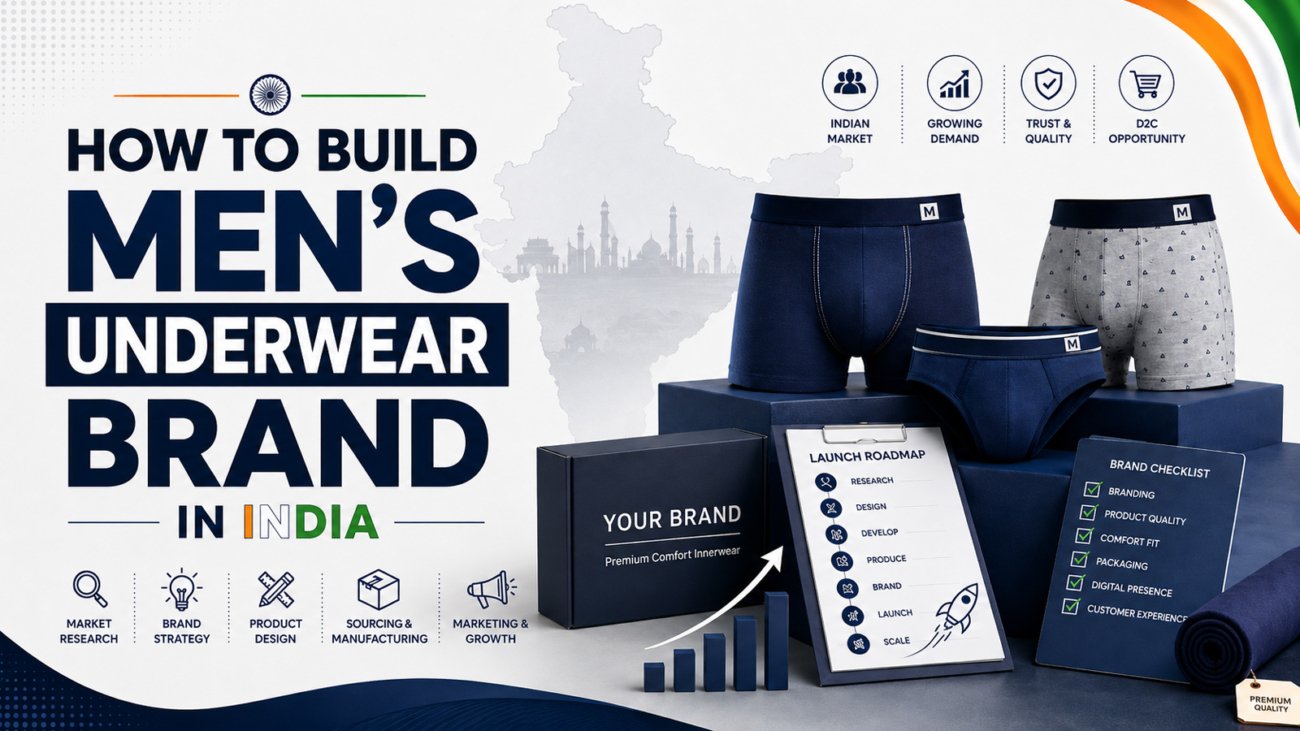
HOW TO BUILD MEN’S UNDERWEAR BRAND IN INDIA

HOW TO BUILD MEN’S UNDERWEAR BRAND IN INDIA

Starting a men’s underwear brand in India can be a strong business opportunity because innerwear is a repeat-purchase product. Unlike fashion products that customers buy occasionally, underwear is used daily, replaced frequently, and purchased in multiple packs. The Indian innerwear market was valued at around ₹1.03 lakh crore approx in 2025 and is projected to reach ₹1.86 lakh crore  by 2034, growing at a CAGR of 6.49%. The growth is driven by comfort awareness, branded product demand, e-commerce, fabric innovation, and premiumization.

India also has a strong textile and apparel manufacturing base. The textile and apparel industry supports mass-market as well as premium apparel demand and employs more than 45 million people, which makes India a suitable country for building an innerwear manufacturing or private-label business.

Understand the Men’s Underwear Market

Men’s underwear is no longer only a basic clothing product. Today, customers look for comfort, fitting, fabric quality, waistband softness, pouch support, sweat control, stretch, and stylish prints. Modern consumers are moving toward premium fabrics such as modal, micro modal, bamboo, cotton stretch, nylon blends, and polyester-lycra performance fabrics. IMARC notes that comfort, functionality, fabric technology, moisture-wicking, antibacterial, seamless, and stretchable fabrics are important demand drivers in the Indian innerwear market.

Popular men’s underwear categories

Product TypeBest ForBusiness Potential
BriefDaily wear, classic customersStable demand
TrunkModern fit, young customers, e-commerceVery strong
BoxerRelaxed comfort, nightwear, casual wearStrong
Boxer BriefLonger coverage, gym, travelGrowing
VestInnerwear + loungewearGood add-on category
Plus Size Underwear3XL, 4XL, 5XL customersHigh opportunity

For a new brand, the best starting range can be men’s trunks, briefs, boxers, and vests, because these products cover both daily comfort and modern fashion demand.

Choose Your Business Model

Before starting, decide whether you want to manufacture, outsource, or sell through marketplaces.

A. Trading Model

In the Trading Model of the underwear brand business, you do not manufacture the product yourself. Instead, you buy ready-made underwear such as trunks, briefs, boxers, vests, or combo packs from manufacturers, wholesalers, or stockists and sell them through your own sales channels. These channels can include retail shops, wholesalers, Amazon, Flipkart, Myntra, IndiaMART, Instagram, WhatsApp, or your own website. This model is suitable for beginners because it requires lower investment, no factory setup, no stitching machines, and no labour management. You can quickly test which product, size, colour, fabric, and price range works best in the market.

The main advantage of the Trading Model is that you can start fast with limited risk and offer multiple product varieties without handling production. However, the biggest drawback is limited control over quality, fit, fabric, elastic, and repeat stock availability. Since the same product may also be sold by other traders, brand uniqueness can be low. Profit margins are also usually lower compared to manufacturing or private-label models because you are buying finished goods from another supplier. This model is best for market testing, wholesale selling, and beginners who want to understand customer demand before moving into private label or own manufacturing.

B. White Label Model

In the White Label Model of the underwear brand business, you purchase ready-made underwear products from a manufacturer and sell them under your own brand name. The manufacturer already has existing designs, fabrics, patterns, sizes, and production setup. You only need to choose the product style, fabric quality, colours, size range, packaging, and brand label. For example, a manufacturer may already produce men’s trunks, briefs, boxers, and vests, and you can add your own brand name, logo, MRP sticker, barcode, and packaging before selling them in the market. This model is useful for new underwear brands because it saves time, reduces production headaches, and allows you to launch your brand faster without setting up a factory.

The main advantage of the White Label Model is that it requires less investment compared to own manufacturing and gives you a better brand identity than pure trading. You can sell the product on Amazon, Flipkart, Myntra, IndiaMART, retail stores, or through wholesale channels under your own brand name. However, the drawback is that product customization is limited because the design and fit are mostly controlled by the manufacturer. The same or similar product may also be supplied to other brands, so uniqueness can be low. Profit margin is better than trading in some cases, but lower than full private-label or own manufacturing. This model is best for brands that want to enter the underwear market quickly and test customer demand before investing in custom designs or factory production.

C. Private Label / OEM Model

In the Private Label / OEM Model of the underwear brand business, you create underwear products according to your own brand requirements, and the manufacturer produces them for you. In this model, you can decide the fabric quality, GSM, elastic type, waistband branding, stitching pattern, pouch design, size chart, colours, prints, packaging, MRP, barcode, and brand label. For example, if you want to launch men’s trunks under your own brand, you can give the manufacturer your selected fabric, elastic design, label details, size range, and packing style. The manufacturer will produce the final product as per your specifications. This model gives you more control than trading or white label because the product is made especially for your brand.

The main advantage of the Private Label / OEM Model is that you can build a unique product identity with better quality control, premium packaging, and customized branding. It is suitable for brands that want to sell on Amazon, Flipkart, Myntra, Ajio, IndiaMART, offline wholesale, or their own D2C website. However, this model requires more planning, sampling, minimum order quantity, quality checking, and investment compared to trading or white label. Sampling may take time because the fit, fabric, waistband, and stitching need to be approved before bulk production. Still, this is one of the best models for serious underwear brands because it helps create a professional brand image, better customer trust, and long-term repeat business.

D. Own Manufacturing Model

In the Own Manufacturing Model of the underwear brand business, you set up your own production unit and manufacture products under your own brand. In this model, you control the complete process, including fabric sourcing, pattern making, size grading, cutting, stitching, elastic attachment, finishing, quality checking, packing, and dispatch. You can produce men’s trunks, briefs, boxers, vests, kids’ underwear, or plus-size underwear according to your own designs and quality standards. This model is best for businesses that want full control over product quality, fit, fabric, waistband, stitching, packaging, and production planning.

The main advantage of the Own Manufacturing Model is higher long-term profit margin, complete customization, better quality control, and the ability to supply products to other brands through OEM or private-label orders. It also helps build a strong and trusted underwear brand because you can maintain consistent product quality. However, this model requires higher investment in machines, workers, factory space, fabric stock, elastic stock, cutting setup, packing material, and production management. There is also more responsibility, such as labour handling, wastage control, machine maintenance, QC issues, and stock planning. This model is best for serious brands that want to scale in online marketplaces, offline wholesale, and B2B private-label supply.

E. Marketplace + D2C Model

In the Marketplace + D2C Model of the underwear brand business, you sell your products through online marketplaces like Amazon, Flipkart, Myntra, Ajio, Meesho, and IndiaMART, along with your own direct sales channels such as Shopify website, Instagram, Facebook, WhatsApp, and your brand website. Marketplaces help you reach a large customer base quickly because they already have traffic, payment systems, delivery support, and customer trust. For a new men’s underwear brand, this model is useful because you can launch products like trunks, briefs, boxers, vests, and combo packs without depending only on offline distributors or retailers.

The main advantage of the Marketplace + D2C Model is wider reach, faster brand visibility, direct customer feedback, and better opportunity to scale across India. D2C sales give you more control over branding, pricing, customer data, offers, and repeat purchases, while marketplaces help generate sales volume. However, this model also has challenges such as high competition, marketplace commission, shipping charges, returns, advertising cost, discount pressure, and strict listing guidelines. To succeed in this model, your product images, size chart, fabric details, reviews, packaging, pricing, and customer service must be very strong.

Build the Right Product Range

Do not launch too many products at once. Start with limited but strong SKUs.

Suggested launch plan

CategoryLaunch Quantity
Men’s Trunk6–12 colours/prints
Men’s Brief4–8 colours
Men’s Boxer4–6 designs
Men’s Vest3 basic colours
Combo PacksPack of 2 and Pack of 3

Design and Fit Development is one of the most important parts of underwear product creation because comfort depends not only on fabric but also on correct pattern, pouch shape, rise, leg opening, waistband placement, and size grading. A good underwear design should provide proper support without being too tight, allow easy movement, and stay comfortable for daily wear, office use, travel, gym, and sleep. For men’s trunks, briefs, and boxers, the pouch area must be shaped properly, the thigh opening should not roll up, and the waistband should sit smoothly on the body. The design should also match the target customer, such as basic daily wear, premium fashion wear, plus-size comfort, or sports/active underwear.

Fit development includes making samples, testing them on different body types, checking size accuracy, and improving the pattern before bulk production. Important points include waistband comfort, fabric stretch recovery, no skin irritation, no loose fitting, no tight marks, no riding up, and proper coverage from front and back. A strong size chart from M to 5XL helps reduce returns and customer complaints, especially in online selling. Before final production, the product should be tested after washing to check shrinkage, elastic recovery, colour fading, and overall comfort. A well-developed fit helps build customer trust and increases repeat purchases for an underwear brand.

Pack-of-3 is very useful for online marketplaces because customers feel they are getting better value. For premium products, pack-of-2 also works well.

Brand Name, Logo and Trademark

Your brand name should be short, memorable, premium, and easy to pronounce. Before finalizing the name, check whether the same or similar name is already registered as a trademark. India’s official trademark public search portal allows brand-name searches by wordmark, phonetic search, and class.

For clothing and innerwear, trademark filing is usually done under Class 25, but you should confirm exact filing details with a trademark professional before applying.

Brand identity should include

  • Brand name
  • Logo
  • Tagline
  • Packaging style
  • Size chart
  • Product story
  • Fabric story
  • Social media look
  • E-commerce image style

Example positioning line:
“Premium everyday comfort for modern Indian men.”

Costing and Pricing

Costing and Pricing is a very important part of underwear product planning because profit does not depend only on selling price. You must calculate every small cost before deciding the final MRP or selling price. The basic cost of an underwear product includes fabric cost, elastic cost, stitching labour, thread, labels, tags, packaging, barcode, transport, wastage, quality checking, and finishing. For example, in men’s trunks, fabric and elastic are usually the main cost factors, but premium packaging, branded waistband, and better stitching can also increase the final product cost.

For online selling, you also need to add marketplace-related expenses such as commission, shipping charges, return cost, advertising cost, discounts, GST, payment gateway charges, and warehouse charges. Many new brands make the mistake of calculating only manufacturing cost and then setting the selling price. But if you sell on Amazon, Flipkart, Myntra, or Ajio, the platform charges can reduce your profit margin quickly. That is why your product costing should include both production cost and selling cost.

A simple pricing formula is: Final Selling Price = Product Cost + Packaging Cost + Logistics Cost + Platform Charges + Marketing Cost + Profit Margin. For example, if one men’s trunk costs ₹100 to manufacture and packaging/logistics/platform expenses add another ₹80, then your total cost becomes ₹180. In this case, if you sell the product at ₹199, your margin will be very low. But if you sell it as a premium product or combo pack at ₹299–₹399, you may get better profit depending on platform charges and return ratio.

For an underwear brand, combo pricing works very well because customers usually prefer buying pack of 2, pack of 3, or pack of 4. Combo packs help increase order value and reduce per-piece logistics cost. Your pricing should also depend on your product positioning. A basic cotton underwear product should be priced competitively, while modal, bamboo, micro modal, premium waistband, plus-size, or printed fashion underwear can be priced higher. The best strategy is to maintain a balance between affordable pricing, premium product quality, and healthy profit margin.

Marketing Strategy & Brand Awareness

For online marketing, product presentation is very important. Underwear products need professional photos, model images, fabric close-ups, waistband details, stretch demonstration, size chart, lifestyle images, and combo pack images. On platforms like Amazon, Flipkart, Myntra, Ajio, and IndiaMART, customers mostly depend on images and product descriptions before buying. The listing title, bullet points, and description should include strong keywords such as men’s trunk underwear, breathable underwear, cotton stretch underwear, bamboo underwear, modal underwear, pack of 3 underwear, plus-size underwear, and anti-rash underwear. Good reviews, clear size guidance, and attractive pricing also help increase conversion and reduce returns.

Social media marketing is also very useful for an underwear brand. Instagram Reels, Facebook posts, YouTube Shorts, and Pinterest creatives can be used to show fabric comfort, product fit, lifestyle use, packing, manufacturing process, and customer benefits. The brand can create content around topics like Trunk vs Brief vs Boxer, Best Underwear for Summer, How to Choose the Right Size, Benefits of Bamboo Fabric, and Why Waistband Quality Matters. Influencer marketing can also help, but the content should look premium, decent, and comfort-focused, not vulgar. For men’s underwear, the best marketing style is clean, confident, modern, and premium.

For offline and B2B marketing, the brand should focus on distributors, garment retailers, wholesalers, IndiaMART buyers, and private-label customers. A strong catalogue, proper price list, sample kit, packaging options, size chart, fabric details, and MOQ details help create trust with buyers. Combo packs, festive offers, dealer margins, and repeat stock availability are important for wholesale growth. The best strategy is to combine marketplace selling + social media branding + offline distribution + B2B private label supply, so the brand can grow from multiple sales channels instead of depending on only one platform.

For stronger awareness, the brand should also focus on reviews, influencer marketing, lifestyle photoshoots, product videos, packaging experience, and repeat customer offers. A customer may not buy a new underwear brand immediately, but if he sees the brand multiple times with a clear comfort message, professional images, and positive reviews, trust slowly develops. Good brand awareness increases customer recall, improves marketplace conversion, builds repeat purchase, and helps the underwear brand compete with bigger brands in both online and offline markets. There many option to increase you brand visibility like facebook marketing, instagram reel, youtube channel, google brand page, or other social media platform.

Profit and Finance

Profit and Finance are very important in the underwear brand business because the final profit depends on proper costing, pricing, sales channel, and stock planning. The main cost in underwear production includes fabric, elastic, stitching, thread, label, packaging, barcode, transport, GST, labour, quality checking, and wastage. If the brand sells online, then marketplace commission, shipping charges, advertising cost, return cost, discount, and warehouse charges must also be added. Many new brands make the mistake of calculating only manufacturing cost, but actual profit comes after deducting all hidden expenses.

In the underwear business, profit margin changes according to the business model. In the trading model, margin is usually lower because the product is purchased from another supplier. In the white label or private label model, margin can be better because the product is sold under your own brand. In the own manufacturing model, long-term profit can be higher because you control fabric purchase, production cost, quality, and bulk manufacturing. Online marketplace selling may show high selling prices, but after commission, ads, returns, and shipping, the net profit can reduce. Offline wholesale gives lower margin but faster bulk movement and repeat orders.

A strong finance plan should include working capital for raw material, production, packaging, photoshoot, marketing, online listing, stock holding, and payment cycle. For example, if one men’s trunk costs ₹100 to manufacture and the total selling expense is ₹60, then your actual cost becomes ₹160. If you sell it at ₹249, your gross profit is ₹89 before other business expenses. Combo packs like Pack of 2, Pack of 3, and Pack of 4 help improve average order value and reduce per-piece shipping cost. The best strategy is to keep proper costing, avoid dead stock, focus on fast-moving sizes, maintain quality, and balance pricing between customer affordability and healthy profit margin.

Legal and Compliance Requirements in India

This section is important before launching.

Business registration

You can start as:

  • Proprietorship
  • Partnership
  • LLP
  • Private Limited Company

For a small starting brand, proprietorship or partnership is easier. For scaling, investor funding, and stronger brand structure, LLP or Private Limited can be better.

GST registration

GST registration rules depend on business type, turnover, interstate supply, and online selling. The GST Council’s registration guide states that small businesses exclusively supplying goods are generally below the registration requirement up to specified turnover limits, but interstate taxable supply and several other cases require registration.

For e-commerce selling, Section 24 of the CGST Act lists compulsory registration cases, including persons supplying through e-commerce operators required to collect TCS under Section 52.

Udyam / MSME registration

Udyam Registration is useful for MSME recognition. The official Udyam portal requires Aadhaar and PAN verification and is used for MSME registration.

Startup India recognition

If your business is innovative and scalable, you may check DPIIT Startup Recognition. Startup India states that DPIIT-recognised startups can access benefits such as tax benefits, easier compliance, and IPR fast-tracking, subject to eligibility.

Packaging and labelling

Under Legal Metrology rules, packaged commodities require proper declarations. For garments and hosiery sold loose/open, the government has also provided specific declaration requirements such as manufacturer/marketer/brand owner details, consumer care details, size, and MRP inclusive of all taxes.

For underwear packaging, include:

  • Brand name
  • Product name
  • Size
  • Waist measurement
  • Fabric composition
  • MRP inclusive of all taxes
  • Quantity: pack of 1, 2, 3, etc.
  • Manufacturer/packer/marketer details
  • Month and year of manufacture/packing
  • Customer care email/phone
  • Country of origin
  • Wash care
  • Barcode/SKU code

Conclusion

Starting a men’s underwear brand in India is a practical and scalable business if you focus on the right product, right fabric, right fit, and right sales channel. The opportunity is strong because innerwear is a daily-use product with repeat demand, and Indian customers are shifting toward better comfort, branded products, and premium fabrics.

The best way to start is with a focused range: men’s trunks, briefs, boxers, vests, and pack-of-3 combos. Keep your USP clear: soft fabric, breathable comfort, 4-way stretch, premium waistband, modern fit, and sizes from M to 5XL. With proper branding, legal compliance, product photography, and marketplace strategy, a men’s underwear brand can grow from a small launch into a strong online and offline business.

white-label production

White Label Manufacturing: Empowering Brands with Faster Market Entry and Sustainable Growth

A white label brand is a business model where a manufacturer produces products, and another company sells those products under its own brand name. The manufacturer remains behind the scenes, while the retailer or brand owner markets and sells the product as their own. This allows businesses to launch products quickly without investing in manufacturing facilities, product development, or production expertise.

White labeling is common in industries such as innerwear, clothing, cosmetics, food products, electronics, and health supplements. For example, a manufacturer may produce men’s trunks, briefs, and vests, while multiple brands sell the same products with different logos, packaging, and branding. Customers recognize the retailer’s brand rather than the actual manufacturer.

One of the biggest advantages of a white label business is the lower startup cost and faster market entry. Brand owners can focus on marketing, sales, customer service, and brand building instead of managing production. This helps entrepreneurs and retailers create their own product lines without the complexities of manufacturing and inventory development.

For manufacturers, white labeling creates additional business opportunities by allowing them to produce products for multiple brands. For brand owners, it provides flexibility to build a unique market presence through packaging, branding, and marketing strategies. When executed properly, a white label model can be a profitable way to grow a brand while leveraging the expertise and production capabilities of an established manufacturer.

Here are 5 examples of businesses that commonly use white label products:

  1. Fashion & Apparel Brands
    A company launches its own clothing or innerwear brand but gets products manufactured by a third-party factory. The products are sold under the company’s brand name, while the manufacturer remains hidden.
  2. Supermarket & Retail Store Brands
    Large retailers often sell products under their own private labels. The products are manufactured by external companies but carry the retailer’s branding and packaging.
  3. Cosmetics & Skincare Brands
    Many beauty brands do not own manufacturing facilities. Instead, they source white label creams, face washes, shampoos, and skincare products and sell them under their own brand names.
  4. Health Supplements & Nutrition Brands
    Protein powders, vitamins, and nutritional supplements are frequently produced by specialized manufacturers and then rebranded by fitness and wellness companies.
  5. Home & Kitchen Product Brands
    Sellers on e-commerce platforms often purchase white label products such as water bottles, storage containers, kitchen tools, and household accessories from manufacturers and market them under their own brands.

Example :

If a retailer wants to launch a men’s innerwear brand called “BONO”, they can partner or job work with Dispenser Store to only manufacture service for trunks, briefs, and vests. Dispenser Store handles production, while the retailer sells the products under the BONO brand name. This is a typical white label business model.

Dispenser Store – Powering Innerwear Brands with White Label Manufacturing

Dispenser Store helps businesses build their own innerwear brands through white label manufacturing solutions. We provide end-to-end production support, allowing entrepreneurs, retailers, wholesalers, and online sellers to launch high-quality innerwear products under their own brand name.

Our white label services cover a complete range of men’s, women’s, and kids’ underwear products. From trunks, briefs, boxers, and vests to women’s panties and kids’ innerwear, we manufacture products that can be customized with your brand identity.

Dispenser Store assists in product development by helping clients select suitable fabrics, designs, fits, and size ranges according to their target market. We offer various fabric options, including cotton blends, bamboo modal, micro modal, and other premium materials to meet different customer preferences.

We also support custom branding requirements such as printed elastic waistbands, brand labels, packaging, hang tags, and polybags. This enables businesses to create a professional and consistent brand image without investing in their own manufacturing setup.

Quality control is an important part of our manufacturing process. Every product undergoes production checks to ensure proper stitching, fabric quality, comfort, fit, and durability before being packed and dispatched to customers.

For businesses entering the market for the first time, Dispenser Store provides guidance on product selection, size planning, packaging requirements, and branding strategies. This helps new brands launch their products with confidence and a strong market presence.

Our manufacturing capabilities allow brands to scale efficiently as their business grows. Whether you require small production quantities for a new launch or larger volumes for established sales channels, we can support your production needs.

By partnering with Dispenser Store for white label innerwear manufacturing, businesses can focus on marketing, sales, and brand growth while we handle the production process. This allows brand owners to launch and expand their innerwear business faster, more efficiently, and with reduced operational complexity.

DISPENSER STORE Production Capacity

Dispenser Store operates with a robust manufacturing infrastructure capable of meeting large-scale production requirements across multiple innerwear categories. Our daily production capacity includes approximately 7000 to 8000 pieces of men’s innerwear, 3,000 pieces of women’s innerwear, and 2,000 pieces of kids’ innerwear.

With a combined production capacity of 12,000 – 13,000 pieces per day, Our Monthly Production is 3Lacs to 3.5lacs. we are well-equipped to support both established brands and emerging businesses through private label and white label manufacturing solutions. Our streamlined production processes, skilled workforce, and strict quality control standards ensure consistent product quality, timely deliveries, and scalable manufacturing support for growing brands.

Complete Guide Line For Innerwear Production Process By DISPENSER STORE

The innerwear manufacturing process begins with product planning, fabric sourcing, and design development. Based on customer requirements, suitable fabrics such as cotton blends, bamboo modal, micro modal, or viscose blends are selected to achieve the desired comfort, durability, and performance characteristics. Once the fabric is finalized, patterns and size specifications are developed, followed by fabric inspection and cutting. Precision cutting ensures consistency across all sizes while minimizing material wastage and maintaining production efficiency.

The next stage involves stitching and garment assembly. Cut fabric panels are stitched using specialized machinery to create the final garment structure. Key components such as elastic waistbands, leg openings, labels, and branding elements are carefully attached during this process. Throughout production, quality checkpoints are implemented to verify stitching accuracy, measurement consistency, fabric appearance, and overall garment construction. Any defects are identified and corrected before proceeding to the finishing stage.

After stitching is completed, the garments undergo finishing, quality inspection, and packaging. This includes thread trimming, ironing or steaming, metal detection (where required), size verification, and final quality checks to ensure every product meets established standards. Approved garments are then folded, tagged, packed into branded polybags or retail packaging, and prepared for dispatch. The finished products are subsequently distributed to retailers, wholesalers, e-commerce platforms, or private label clients, completing the end-to-end innerwear manufacturing cycle from raw fabric to ready-to-sell product.

Brands We Manufacture In Undergarments Categories

Dispenser Store is a trusted innerwear manufacturing partner, providing high-quality production solutions for a diverse portfolio of established and emerging brands. Our manufacturing expertise, quality standards, and scalable production capabilities have enabled us to support multiple brands across the men’s, women’s, and kids’ innerwear segments.

We are currently involved in the production of innerwear products for brands including HRX, Roadster, Dressberry, BONO, M&H (Mast & Harbour), and FIVEFLAG. Each brand has unique product specifications, design requirements, and quality standards, which are carefully managed through our structured manufacturing processes and quality control systems.

By combining modern manufacturing techniques, skilled craftsmanship, and reliable supply chain management, Dispenser Store delivers consistent product quality and timely production support, helping our brand partners strengthen their market presence and meet growing customer demand.

“DispenserStore manufactur & delivers innerwear that supports every undergrament lifestyle—whether it’s daily wear, active routines, or relaxed moments at home. We blend innovation with reliable manufacturing to create men, women, and kids undergrament products that not only look good but feel even better. At Dispenserstore, our goal is simple: to make innerwear that offers confidence, comfort, and trust in every wear.“

role of elastic in underwear

THE ROLE OF WAISTBAND ELASTIC IN QUALITY UNERWEAR

THE ROLE OF WAISTBAND ELASTIC IN QUALITY UNERWEAR

Waistband elastic plays a crucial role in determining the overall comfort, fit, support, and durability of quality underwear. A well-designed elastic waistband keeps the garment securely in place without feeling too tight or restrictive, ensuring all-day comfort during daily activities.

High-quality elastic provides excellent stretch and recovery, allowing the waistband to maintain its shape and support even after repeated wear and washing. It also helps prevent rolling, twisting, sagging, or loss of fit, which are common issues with lower-quality elastics.

In addition to functionality, premium waistband elastic enhances the overall appearance and longevity of underwear. Whether exposed or fabric-covered, a durable and soft elastic waistband contributes significantly to a better wearing experience, making it an essential component of high-quality underwear.

“DispenserStore manufactur & delivers innerwear that supports every undergrament lifestyle—whether it’s daily wear, active routines, or relaxed moments at home. We blend innovation with reliable manufacturing to create men, women, and kids undergrament products that not only look good but feel even better. At Dispenserstore, our goal is simple: to make innerwear that offers confidence, comfort, and trust in every wear.“

FOLLOWING LIST OF ELASTIC WAIST BAND ARE USED IN UNDERWEAR

  1. Knitted Elastic
    • Knitted elastic is produced using knitting machines that interlock yarns together, creating a soft and flexible structure. It is one of the most commonly used elastics in underwear manufacturing. Typical usage of this elastic in Men’s trunks, Briefs, Women’s panties, Kids’ underwear. benifits of knitted elastic are soft against skin, lightweight and breathable, does not narrow significantly when stretched, Comfortable for all-day wear, Cost-effective
  2. Woven Elastic
    • Woven elastic is manufactured by weaving fibers together, resulting in a stronger and firmer elastic structure. It provides superior durability and shape retention. Typical usage of this elastic in premium men’s underwear, sports underwear, high-support garments.
  3. Plush Back Elastic
    • Plush back elastic features a soft brushed surface on the side that touches the skin. This construction greatly improves comfort. Typical usage of this elastic Premium men’s trunks, Women’s lingerie, Kids’ underwear.
  4. Exposed Branded Elastic
    • This is the most popular waistband style in modern men’s underwear. The elastic remains visible and carries a woven, knitted, or printed brand logo. Typical usage of this elastic in Men’s trunks, Boxer briefs, Premium underwear collections. benifts of elastic are Premium appearance, Strong branding opportunity, Excellent support Modern fashion look.
  5. Fold-Over Elastic (FOE)
    • Fold-over elastic is designed with a center crease that allows it to fold neatly over fabric edges. Typical usage of this elastic in Women’s panties, Bikini briefs, Seamless underwear.
  6. Microfiber Elastic
    • Microfiber elastic is covered with ultra-fine synthetic fibers that create a smooth, luxurious surface. Typical usage of this elastic in Premium men’s underwear , Women’s seamless underwear, Luxury collections
  7. Jacquard Elastic
    • Jacquard elastic allows logos, patterns, and graphics to be woven directly into the waistband rather than printed. Typical usage of this elastic in Branded men’s trunks, Designer underwear, Premium fashion underwear
  8. Covered Elastic
    • The elastic is completely enclosed inside a fabric casing, preventing direct skin contact.
  9. Silicone Grip Elastic
    • Contains silicone strips that help keep garments in place and prevent slipping. Typical usage of this elastic in Women’s shapewear, Specialty underwear Sportswear.

Does Waistband Elastic Size Matter in Underwear?

Yes, the width of the waistband elastic plays a major role in the comfort, support, appearance, and durability of underwear. Choosing the right waistband size can significantly improve the overall wearing experience. There is no single perfect size for every product, but for modern premium men’s trunks, 40 mm to 44 mm Jacquard Plush-Back Elastic is generally considered the best choice. For a premium men’s innerwear brand like DISPENSER, a 38 mm to 44 mm plush-back jacquard waistband elastic offers the best combination of comfort, durability, branding, and premium market appeal.

Elastic WidthUsageComfort Level
25 mm (1 inch)Basic briefs, women, kids’ underwearGood
30 mmStandard men’s briefsGood
34 mmMid-range trunks and briefsVery Good
38 mmPremium trunks and boxer briefsExcellent
42 mmLuxury and fashion underwearExcellent
44 mm+Sports and performance underwearExcellent

A wider waistband like 35mm, 40mm and 45mm distributes pressure more evenly around the waist, reducing the chances of digging into the skin. Narrow elastics can sometimes create pressure points and discomfort during extended wear. Wider waistbands provide better grip and stability, helping the underwear stay in place during walking, running, exercising, or daily activities. They also reduce rolling and folding.

The Importance of Waistband Elastic in Men’s Underwear

A men’s underwear waistband is one of the most important components of the garment because it directly affects comfort, fit, support, and durability. Manufacturers carefully consider elastic width, stretch recovery, softness, skin comfort, branding possibilities, and long-term performance before selecting a waistband elastic. The waistband must provide a secure fit without feeling too tight or causing discomfort during daily activities, exercise, or extended wear.

High-quality men’s waistband elastics are typically made from a blend of polyester, nylon, and elastane (spandex). The elastic should offer excellent softness against the skin while maintaining strong tensile strength and stretch recovery. Premium elastics return to their original shape after repeated stretching, helping prevent sagging or loss of support. A smooth, brushed surface and soft backing further enhance all-day comfort and reduce skin irritation.

Manufacturers also evaluate the elastic’s life cycle, including wash durability, color fastness, logo retention, and resistance to curling or folding. Common types used in men’s underwear include exposed branded elastic, plush-back elastic, knitted elastic, woven elastic, and microfiber-covered elastic. A premium waistband should maintain its elasticity, appearance, and comfort through hundreds of wear and wash cycles, ensuring long-lasting performance and customer satisfaction.

The Importance of Waistband Elastic in Women’s Underwear

Women’s underwear requires a more delicate balance between comfort, flexibility, appearance, and support. Manufacturers select waistband elastics that feel soft and gentle against sensitive skin while providing enough stretch to move naturally with the body. The elastic must remain lightweight and comfortable throughout daily activities without creating pressure marks or discomfort.

Softness is a critical factor in women’s underwear waistband design. Premium elastics often feature brushed or plush-backed surfaces that provide a smooth touch and minimize friction. Materials such as microfiber-covered elastic and soft knitted elastic are commonly used to create a luxurious feel while maintaining excellent flexibility and recovery.

Elastic quality is evaluated through stretch performance, recovery strength, shape retention, and durability after repeated washing. High-quality elastics maintain their elasticity without becoming loose, twisted, or uncomfortable over time. Manufacturers also test resistance to moisture, body oils, detergents, and everyday wear to ensure long-lasting comfort and performance.

Several types of waistband elastics are used in women’s underwear, including picot elastic, fold-over elastic, knitted elastic, brushed elastic, microfiber elastic, and exposed branded elastic. Depending on the style—whether briefs, bikinis, hipsters, boyshorts, or seamless underwear—the elastic is selected to provide the ideal combination of softness, fit, durability, and aesthetic appeal. A premium waistband should continue delivering comfort and support throughout its intended life cycle while maintaining its original appearance.

“DispenserStore manufactur & delivers innerwear that supports every undergrament lifestyle—whether it’s daily wear, active routines, or relaxed moments at home. We blend innovation with reliable manufacturing to create men, women, and kids undergrament products that not only look good but feel even better. At Dispenserstore, our goal is simple: to make innerwear that offers confidence, comfort, and trust in every wear.“

The Importance of Waistband Elastic in Kid’s Underwear

For children’s underwear, manufacturers place the highest priority on softness, safety, flexibility, and skin comfort. The waistband elastic must be gentle enough for sensitive skin while providing a secure fit that allows children to move, play, and remain comfortable throughout the day. Soft knitted elastics and plush-backed elastics are commonly preferred because they reduce irritation and pressure around the waist.

Quality children’s waistband elastics are designed with excellent stretch recovery, durability, and wash resistance. They must withstand frequent washing and active use without losing elasticity or becoming rough. Common options include knitted elastic, brushed elastic, covered elastic, and soft microfiber elastic. A well-manufactured waistband retains its softness, shape, and performance through numerous wear and wash cycles, ensuring long-lasting comfort for growing children.

bono men underwear

BONOMEN Underwear – Reliable Support , Comfort & Innovative Design

BONOMEN’s underwear combines premium comfort, modern style, and everyday durability for confident all-day wear. Designed with soft breathable fabrics and a body-fit structure, BONO trunks deliver a snug yet flexible fit with stylish printed designs. Perfect for active and fashion-conscious men, BONO offers comfort, support, and a premium waistband finish for daily use

What Makes BONOMEN Underwear “Innovative”?

Innovative underwear goes beyond basic comfort by combining advanced fabric technology, ergonomic design, and modern functionality. Features like moisture-wicking materials, stretchable fabric blends, breathable mesh zones, anti-odor protection, and seamless construction help improve comfort, hygiene, and overall performance throughout the day. A well-designed waistband, body-contouring fit, and reduced friction areas also make underwear feel more supportive and premium.

Today’s innovative underwear is also focused on lifestyle and fashion. Brands are creating stylish prints, better pouch support, lightweight fabrics, and performance-based fits for gym wear, travel, and daily use. Sustainable materials, long-lasting elasticity, and smart tailoring further enhance durability and comfort, making modern underwear a blend of technology, style, and everyday practicality.

“DispenserStore manufactur & delivers innerwear that supports every undergrament lifestyle—whether it’s daily wear, active routines, or relaxed moments at home. We blend innovation with reliable manufacturing to create men, women, and kids undergrament products that not only look good but feel even better. At Dispenserstore, our goal is simple: to make innerwear that offers confidence, comfort, and trust in every wear.“

Innerwear Fabric Material Science: To focuses on improving comfort, breathability, durability, and performance through advanced material engineering. Modern underwear fabrics often include moisture-wicking properties to keep the skin dry, stretchable elastane for better flexibility and fit. A breathable cotton blends for airflow, anti-odor and antibacterial treatments for hygiene, and soft-touch finishes that reduce irritation.

Important Point in Underwear Pattern And Stitching:

  • Clean and even stitching with no loose threads or skipped seams,
  • Flatlock or seamless stitching to reduce skin irritation and friction,
  • Symmetrical panel cutting and accurate alignment of fabric patterns,
  • Proper pouch construction for comfort, support, and natural fit,
  • Smooth leg openings with balanced stretch and recovery,
  • Reinforced stress points to prevent tearing during movement
  • Precision finishing and neat hemming for a premium appearance

Tested Durability Of BONOMEN’s Underwear : BONO Men’s underwear durability is tested by evaluating fabric strength, stitching quality, elasticity, color fastness, and wash performance. Manufacturers perform repeated stretch tests on waistbands and leg openings to check elasticity retention, while seam strength tests ensure stitching can handle daily movement without tearing. Fabric abrasion tests measure resistance to friction and pilling, and wash tests are conducted through multiple laundry cycles to verify shape retention, softness, and color durability.

Key Function of Underwear Waistband: The waistband is one of the most important functional parts of men’s underwear, designed to provide secure fit, comfort, flexibility, and support throughout the day. A high-quality waistband keeps the underwear in place without rolling, slipping, or creating excessive pressure on the waist. It also helps maintain garment shape, improves overall fit, and enhances comfort during daily activities, workouts, and movement. Premium waistbands use soft, stretchable elastic materials that offer long-lasting elasticity, durability, and a stylish finish while reducing skin irritation and discomfort.

BONOMEN Plus Size Underwear Collection (M to 5XL) : The collection is crafted for modern men who want style, durability, and freedom of movement in every size. With reinforced stitching, shape-retention technology, and stylish modern designs, BONOMEN ensures that comfort and confidence are never limited by size.

“DispenserStore manufactur & delivers innerwear that supports every undergrament lifestyle—whether it’s daily wear, active routines, or relaxed moments at home. We blend innovation with reliable manufacturing to create men, women, and kids undergrament products that not only look good but feel even better. At Dispenserstore, our goal is simple: to make innerwear that offers confidence, comfort, and trust in every wear.“

The Gen’Z Design Philosophy of BONOMEN Underwear

BONOMEN underwear is designed for the Gen Z generation that values comfort, confidence, style, and individuality in everyday essentials. With modern fits, premium fabrics, bold aesthetics, and performance-driven comfort, BONOMEN blends fashion-forward design with all-day functionality.

Gen-Z Boy’s Thinking About Underwear : Gen Z boy see underwear as more than a basic necessity — they want a combination of comfort, style, performance, and self-expression. Soft breathable fabrics, stretch fit, moisture-wicking technology, and stylish waistbands are highly important for daily wear and gym lifestyles. Many young men also prefer premium-looking designs, bold prints, minimal branding, and underwear that feels fashionable enough to match their personality and confidence. Sustainability, ethical production, and body-inclusive sizing are also becoming major buying factors for this generation.

Gen-Z Girl’s Thinking About Underwear : Gen Z women prioritize comfort, confidence, inclusivity, and versatility in underwear. They prefer soft seamless fabrics, wire-free support, breathable materials, and body-positive fits that work for everyday comfort without compromising style. Women today also look for underwear brands that promote diversity, sustainability, gender-neutral thinking, and authentic representation rather than unrealistic beauty standards. Matching sets, aesthetic colors, fashionable cuts, and eco-friendly fabrics are highly popular, but comfort remains the top priority for most women while shopping for innerwear.

Gen Z Thinking About Underwear Design & Pattern : This generation sees underwear as part of personal style rather than just a basic essential. They are attracted to premium waistbands, clean silhouettes, body-fit cuts, and designs that feel fashionable enough for social media, gym culture, and modern lifestyles. Comfort remains important, but visual appeal and individuality strongly influence buying decisions.

Most Popular Gen Z Underwear Design & Pattern Choices

  • Minimal solid colors with premium waistband branding
  • Bold typography and logo-based waistband designs
  • Urban streetwear-inspired prints and patterns
  • Geometric and abstract modern patterns
  • Monochrome luxury themes (black, grey, navy, olive)
  • Sporty athletic designs with performance look
  • Stylish camouflage and textured prints
  • Graphic and youth-inspired artistic prints
  • Seamless and contour-fit modern cuts
  • Matching couple or coordinated color themes
  • Eco-friendly and soft natural fabric aesthetics
  • Limited-edition fashion collections and trendy seasonal colors

Gen Z mainly chooses underwear that looks stylish, feels premium, photographs well, and reflects confidence, personality, and lifestyle identity.

“DispenserStore manufactur & delivers innerwear that supports every undergrament lifestyle—whether it’s daily wear, active routines, or relaxed moments at home. We blend innovation with reliable manufacturing to create men, women, and kids undergrament products that not only look good but feel even better. At Dispenserstore, our goal is simple: to make innerwear that offers confidence, comfort, and trust in every wear.“