
 Cart is empty
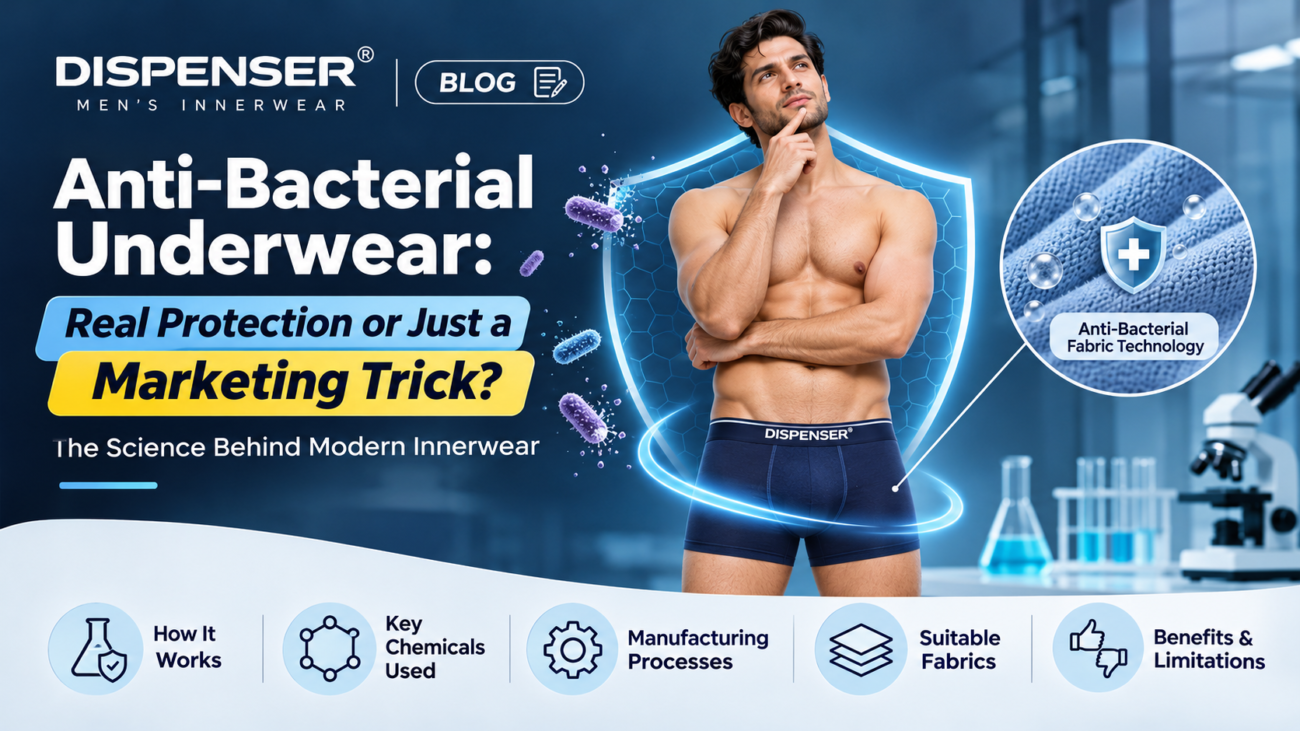
Introduction: Are We Paying for Real Technology or Just a Fancy Word?
Walk into an innerwear store or browse an online marketplace today, and you will find products advertised with words such as Anti-Bacterial, Anti-Odour, Anti-Microbial, Hygiene Protection, and Advanced Freshness Technology.
These phrases sound impressive. They can also influence customers to pay more for what appears to be a healthier and technologically advanced product.
But an important question remains:
Is antibacterial underwear genuinely useful, or is the term simply being used to make customers spend more money?
The answer is that antibacterial textile technology is real and scientifically measurable. However, not every product advertised as antibacterial necessarily delivers meaningful, long-lasting performance.
At DISPENSER, we believe customers should understand the science behind modern innerwear rather than buying products based solely on attractive packaging or technical-sounding claims.
Let’s explore how antibacterial underwear works, the chemicals used, the industrial processes involved, and whether these products are worth choosing.
1. What Is Anti-Bacterial Underwear?
Antibacterial underwear is innerwear made from textile material designed or treated to inhibit the growth of certain bacteria or reduce their survival on the fabric.
Normal underwear can collect sweat, skin oils, dead skin cells, and other organic material during everyday use. In warm and humid environments, these conditions can support the growth of some microorganisms.
Antibacterial underwear attempts to control bacterial activity on the textile surface.
There are two important types of antibacterial action:
- Bacteriostatic: Prevents or slows bacterial multiplication.
- Bactericidal: Kills certain bacteria under specified conditions.
These are not identical claims. A fabric that slows bacterial growth does not necessarily kill bacteria.
2. Is Anti-Bacterial Underwear Real Science or a Marketing Gimmick?
The technology is real. The confusion usually comes from how it is advertised.
Antibacterial textiles have been researched for applications including healthcare fabrics, sportswear, socks, uniforms, bedding, and everyday clothing.
Scientists have developed different textile treatments using silver, zinc compounds, copper compounds, polymer-based agents, and other substances.
These technologies can produce measurable antibacterial activity.
However, several factors determine whether a product delivers genuine value:
- Which antibacterial ingredient is used?
- How much active ingredient remains on or inside the fabric?
- Which bacterial species were tested?
- How much bacterial reduction was achieved?
- Does the finish remain effective after repeated washing?
- Is the treatment suitable for prolonged skin contact?
- Does it provide a practical advantage over ordinary underwear?
Understanding the Famous “99.9% Bacteria Reduction” Claim
Suppose a laboratory starts with 100,000 viable bacterial cells in a controlled textile test.
After the specified test period:
- Untreated reference: 100,000 viable cells
- Treated sample: 100 viable cells
The calculated reduction relative to the reference would be:
Bacterial reduction = [(100,000 − 100) ÷ 100,000] × 100 = 99.9%
This is a simplified illustration, not a real DISPENSER test result. Actual standardized methods use defined controls, incubation conditions, and calculation procedures.
Even a genuine 99.9% laboratory result applies only to the tested organism and conditions. It does not mean a garment will eliminate 99.9% of all bacteria during everyday wear.
Our Verdict
Antibacterial underwear is not inherently a gimmick, but an unverified antibacterial claim can be misleading.
A reliable manufacturer should have evidence to support the exact claim being made.
3. How Is Underwear Made Anti-Bacterial?
Ordinary cotton, modal, polyester, or blended fabric does not automatically become antibacterial simply because it feels soft, absorbs moisture, or dries quickly.
Manufacturers generally impart antibacterial activity through one or more of three broad approaches:
Approach 1: Functional finishing
An antibacterial formulation is applied to manufactured yarn or fabric, often during wet processing or finishing.
Approach 2: Built-in antimicrobial fibres
An approved antimicrobial additive is incorporated into certain synthetic fibres during fibre production.
Approach 3: Chemical surface modification
Antibacterial molecules or coatings are chemically attached or otherwise immobilized on textile surfaces.
Each approach has advantages and limitations concerning cost, wash durability, performance, hand feel, manufacturing feasibility, and environmental impact.
Example: Developing a DISPENSER Antibacterial Trunk
Consider a hypothetical DISPENSER product made with 95% cotton and 5% elastane.
A possible development route would be:
- Select suitable knitted Cotton Lycra fabric.
- Complete scouring, dyeing, and other required preparation.
- Select a textile-grade antibacterial finish compatible with cotton and elastane.
- Apply the treatment through an approved finishing process.
- Dry and cure the fabric under the chemical supplier’s validated conditions.
- Test bacterial activity, shade variation, stretch recovery, and fabric hand feel.
- Repeat antibacterial testing after a defined number of washes.
- Conduct skin-contact safety and restricted-substance evaluations.
- Proceed to cutting, stitching, quality control, and packaging only after the material meets specifications.
The chemical selection, concentration, treatment temperature, pH, and curing conditions must be validated by the textile processor. There is no universal recipe suitable for every antibacterial compound.
4. Which Chemicals Are Used to Make Underwear Anti-Bacterial?
Several chemical families are used or researched for antibacterial textile treatments.
The important point is that not all antibacterial chemicals have the same safety profile, durability, environmental impact, or regulatory status.
A. Silver-Based Antibacterial Agents
Silver-based materials are among the best-known antimicrobial textile technologies. Silver-Based Antibacterial Agents
Silver-based antibacterial agents are widely used in textile manufacturing to reduce the growth of bacteria on fabrics. Silver has natural antimicrobial properties, mainly due to the activity of silver ions (Ag⁺), which can interact with bacterial cell membranes, proteins, and enzymes. These interactions disrupt essential bacterial functions and may prevent bacterial multiplication or cause bacterial cell death. In underwear manufacturing, silver-based technologies can be applied through silver-ion textile finishes, silver-containing zeolites, silver nanoparticles, or silver additives incorporated into synthetic fibres. For example, DISPENSER could develop premium antibacterial men’s trunks using Cotton Lycra or Micro Modal fabric treated with a suitable silver-ion formulation. Such a treatment may help reduce the growth of certain odour-causing bacteria on the fabric, making it potentially useful for daily wear, gym activities, travelling, and hot or humid weather conditions.
The effectiveness and durability of silver-based antibacterial underwear depend on the type of silver compound, application process, chemical concentration, fabric composition, and washing conditions. In textile manufacturing, silver-based treatments may be applied using pad–dry–cure finishing, coating, or fibre-level incorporation. Some formulations are designed to retain antibacterial activity after repeated washing, but this must be verified through laboratory testing, such as ISO 20743 or AATCC TM100. For example, if DISPENSER develops a silver-treated antibacterial trunk, the finished fabric could be tested before washing and after 10, 20, or 50 wash cycles to measure how much antibacterial effectiveness remains. Although silver-based treatments can provide measurable antibacterial performance, they may increase production costs, release silver into wastewater, and require additional skin-contact safety assessments. Silver-treated underwear should not be marketed as preventing skin infections or killing all bacteria on the human body, because antibacterial activity measured on fabric does not automatically establish medical protection.
Examples:
- Silver ions (Ag⁺)
- Silver-containing zeolites
- Silver-based inorganic additives
- Silver nanoparticles
How they work:
Silver ions can interact with bacterial cell structures, proteins, and enzymes, interfering with vital biological processes.
Some silver formulations gradually release active silver ions from a textile carrier, while others are incorporated into fibre structures.
Advantages: Potential antibacterial performance across different textile applications; certain formulations can offer good washing durability.
Disadvantages: Higher ingredient cost, possible release during washing, environmental concerns, and the need to assess skin exposure and wash durability.
Silver nanoparticles are not automatically safer or more effective than other technologies.
B. Zinc-Based Antibacterial Agents
Zinc-containing materials are also researched and used in functional textile applications.
Zinc-based antibacterial agents are used in textile manufacturing to reduce bacterial growth on fabric surfaces and improve hygiene-related fabric performance. One commonly researched compound is Zinc Oxide (ZnO), which exhibits antibacterial properties through mechanisms such as the release of zinc ions (Zn²⁺), interaction with bacterial cell membranes, and the generation of reactive oxygen species under certain conditions. These mechanisms can damage bacterial cells and inhibit their multiplication. In underwear manufacturing, zinc-based antibacterial treatments can be incorporated into synthetic fibres or applied to fabrics through pad–dry–cure finishing, coating, or other specialized textile treatment processes. For example, DISPENSER could develop antibacterial Cotton Lycra or Polyester-Spandex men’s trunks using a suitable zinc oxide formulation to help reduce the growth of certain odour-causing bacteria on the fabric, particularly during gym workouts, travelling, and daily activities in hot and humid climates. Zinc-based treatments may offer effective antibacterial performance, but their durability depends on the formulation, application method, and washing conditions. Manufacturers must conduct laboratory testing, such as ISO 20743 or AATCC TM100, to verify antibacterial effectiveness before and after repeated washing. Although zinc-based technology can improve fabric functionality, it may increase production costs, affect fabric softness if poorly applied, and raise environmental or skin-safety concerns depending on the formulation. Therefore, DISPENSER should select appropriately evaluated textile-grade zinc compounds and verify performance and safety before making antibacterial product claims.
Examples:
- Zinc oxide (ZnO)
- Zinc-containing inorganic antimicrobial additives
- Selected zinc salt formulations
Zinc oxide is studied for antibacterial performance involving interactions with bacterial membranes, zinc ions, and, under certain conditions, reactive oxygen species.
Advantages: Multiple formulation possibilities; compatibility with certain polymer and textile systems.
Disadvantages: Effectiveness varies significantly with particle characteristics and formulation. Some treatments may change fabric appearance or feel.
Not every zinc-based chemical is interchangeable. In particular, zinc pyrithione has distinct regulatory and toxicological concerns and should not be treated as a routine substitute for zinc oxide.
C. Quaternary Ammonium Compounds (QACs)
Quaternary ammonium compounds are a family of positively charged antimicrobial chemicals. Quaternary Ammonium Compounds (QACs) are chemical-based antibacterial agents used in textile finishing to control bacterial growth on fabric surfaces. These compounds contain positively charged molecules that interact with negatively charged bacterial cell membranes, potentially damaging their structure and disrupting essential functions. In underwear manufacturing, certain textile-grade QAC formulations can be applied to Cotton Lycra, Micro Modal, and Polyester-Spandex fabrics through pad–dry–cure, coating, or chemical bonding processes. For example, DISPENSER could develop antibacterial men’s trunks using an appropriately selected QAC treatment to help reduce the growth of certain odour-causing bacteria on the fabric during daily activities, workouts, and travelling.
One advantage of certain QAC-based treatments is their ability to bond to textile fibres and retain antibacterial activity after repeated washing, depending on the formulation and application method. However, some QACs may cause skin irritation or sensitization, and their release into wastewater can raise environmental concerns. Therefore, DISPENSER should select suitable textile-grade QAC formulations, evaluate skin-contact safety, and verify antibacterial performance through recognized laboratory methods such as ISO 20743 or AATCC TM100 before making product claims.
Example: Certain organosilane quaternary ammonium compounds formulated for textiles.
How they work:
Their positively charged groups can interact with negatively charged bacterial cell surfaces. Some QACs can disrupt bacterial membranes, leading to leakage of cellular contents.
In textiles, some formulations are designed to bond to the fibre surface.
Advantages: Certain formulations can be applied using established textile finishing machinery.
Disadvantages: Possible irritation or sensitization, environmental concerns, and considerable differences in wash durability between formulations.
The phrase “QAC treatment” by itself provides insufficient information about performance or safety.
D. PHMB — Polyhexamethylene Biguanide
PHMB is a polymeric antimicrobial substance that has been investigated and used in certain textile treatment applications. Polyhexamethylene Biguanide (PHMB) is a synthetic polymer-based antimicrobial agent used in certain textile finishing applications to inhibit bacterial growth on fabric surfaces. PHMB works mainly by interacting with negatively charged bacterial cell membranes, disrupting their structure and essential cellular functions, which can prevent bacterial multiplication or cause bacterial cell death. In underwear manufacturing, PHMB-based formulations can be applied to fabrics such as Cotton Lycra, Micro Modal, and other cellulosic blends through processes such as padding, exhaustion, or specialized coating. For example, DISPENSER could investigate PHMB-treated men’s trunks to help reduce the growth of certain odour-causing bacteria on the fabric during daily wear, workouts, and travelling. Some PHMB formulations can provide wash-resistant antibacterial performance when properly applied, but effectiveness depends on the treatment chemistry and manufacturing conditions. However, PHMB has important regulatory and toxicological concerns, including restrictions affecting certain uses and markets
It can interact with bacterial surfaces and disrupt cellular processes.
Example: A PHMB-containing formulation may be evaluated on cellulosic fabrics such as cotton.
Advantages: Potential antibacterial performance on compatible textile substrates.
Disadvantages: Regulatory restrictions, substance classification, and toxicological considerations make product-specific legal and safety review essential.
For skin-contact underwear, PHMB should never be assumed suitable simply because it is used in other antimicrobial applications.
E. Chitosan — A Bio-Based Alternative
Chitosan is a polymer commonly derived from chitin, which is found in crustacean shells and other biological sources. Chitosan — A Bio-Based Alternative
Chitosan is a natural, biodegradable polymer derived from chitin, which is commonly found in the shells of shrimp, crabs, and other crustaceans, as well as certain fungi. It is widely researched as an eco-friendly alternative to conventional synthetic antibacterial chemicals in textile manufacturing. Chitosan exhibits antibacterial properties mainly through its positively charged amino groups, which can interact with negatively charged bacterial cell membranes, potentially disrupting their structure and inhibiting bacterial growth. In underwear manufacturing, chitosan-based treatments can be applied to Cotton Lycra, Bamboo Viscose, and Micro Modal fabrics through pad–dry–cure, coating, or other textile finishing processes. For example, DISPENSER could develop premium antibacterial men’s trunks using a chitosan-treated Cotton Lycra fabric to help reduce the growth of certain odour-causing bacteria while maintaining softness and comfort. One major advantage of chitosan is its bio-based origin and potential biodegradability, making it attractive for developing more environmentally conscious textile products. However, its antibacterial effectiveness depends on factors such as molecular weight, concentration, pH, and application method, while repeated washing can reduce its performance if the treatment is not properly fixed to the fabric. Therefore, DISPENSER should verify its antibacterial effectiveness, washing durability, and skin-contact safety through appropriate laboratory testing before making product claims.
Researchers have studied its antimicrobial functionality and its ability to form films on textile surfaces.
How it works:
Depending on its chemistry and the surrounding conditions, positively charged chitosan groups may interact with bacterial cell surfaces.
Advantages: Bio-based origin and useful film-forming characteristics.
Disadvantages: Performance depends on pH, molecular properties, fixation chemistry, and washing conditions. Crosslinking or other stabilization may be needed.
“Natural” or “bio-based” does not automatically guarantee skin safety.
F. Copper-Based Compounds
Copper-containing agents may damage bacterial cells through released copper ions and oxidative mechanisms. Chitosan is a natural, biodegradable polymer derived from chitin, which is commonly found in the shells of shrimp, crabs, and other crustaceans, as well as certain fungi. It is widely researched as an eco-friendly alternative to conventional synthetic antibacterial chemicals in textile manufacturing. Chitosan exhibits antibacterial properties mainly through its positively charged amino groups, which can interact with negatively charged bacterial cell membranes, potentially disrupting their structure and inhibiting bacterial growth. In underwear manufacturing, chitosan-based treatments can be applied to Cotton Lycra, Bamboo Viscose, and Micro Modal fabrics through pad–dry–cure, coating, or other textile finishing processes. For example, DISPENSER could develop premium antibacterial men’s trunks using a chitosan-treated Cotton Lycra fabric to help reduce the growth of certain odour-causing bacteria while maintaining softness and comfort. One major advantage of chitosan is its bio-based origin and potential biodegradability, making it attractive for developing more environmentally conscious textile products. However, its antibacterial effectiveness depends on factors such as molecular weight, concentration, pH, and application method, while repeated washing can reduce its performance if the treatment is not properly fixed to the fabric
Copper-based additives can be used in selected functional textile technologies.
G. Triclosan — Why It Requires Caution
Triclosan is a synthetic antimicrobial substance historically used in different consumer and textile applications.
It can interfere with bacterial fatty-acid synthesis.
However, triclosan has faced significant regulatory scrutiny because of environmental, resistance-related, and toxicological concerns.
For modern everyday underwear, manufacturers should generally prioritize better-substantiated and appropriately permitted alternatives rather than adopting triclosan as a standard treatment.
Chemical Comparison Table
| Chemical family | Typical textile application | Main consideration |
|---|---|---|
| Silver-based agents | Fibre additives and fabric finishes | Cost, silver release, wash durability |
| Zinc-based agents | Coatings and fibre additives | Formulation, safety, performance |
| QACs | Surface finishing | Skin compatibility, fixation |
| PHMB | Selected textile treatments | Regulatory and safety review |
| Chitosan | Bio-based finishing | Wash durability and fixation |
| Copper compounds | Fibre incorporation or finishing | Release, shade, environmental effects |
| Triclosan | Historical antimicrobial applications | Regulatory and environmental concerns |
Important manufacturing note: Chemical trade names, concentrations, and application recipes must come from qualified textile-chemical suppliers. A laboratory trial and safety assessment are necessary before industrial production.
5. How Many Manufacturing Processes Are Used to Make Antibacterial Underwear?
There is no single fixed number because textile manufacturing technologies overlap and continue to evolve.
However, seven major processing approaches are particularly useful for understanding antibacterial textile production.
Process 1: Pad–Dry–Cure Finishing
This is one of the most established methods of applying functional finishes to fabric.
Step-by-step process:
- A finishing bath is prepared using the selected antibacterial formulation.
- The fabric passes through the treatment bath.
- Squeeze rollers remove excess liquid and control wet pickup.
- The fabric passes through a drying stage.
- When required, a curing stage helps fix the treatment.
- The fabric is tested and inspected.
Advantages: Suitable for continuous fabric processing; potentially uniform treatment; scalable for commercial production.
Limitations: Some finishes require elevated curing temperatures that may affect elastane performance, shade, shrinkage, or fabric hand feel.
Process 2: Exhaust or Batch Treatment
The fabric is processed in a liquor containing the selected antibacterial agent.
During the treatment, the chemical may be absorbed or deposited onto the fibre, depending on the formulation and process conditions.
Advantages: Can integrate with certain batch dyeing or finishing workflows.
Limitations: Uptake may be uneven without correct chemical compatibility, pH, temperature, time, and bath control.
Process 3: Spray Application
An antimicrobial formulation is sprayed onto the textile using controlled application equipment.
The fabric may then require drying or curing.
Advantages: Flexible application and selective surface treatment.
Limitations: Uniformity, overspray control, penetration, and washing durability can be challenging.
Spraying an ordinary disinfectant onto underwear does not create professionally engineered antibacterial textile fabric.
Process 4: Fibre-Level Incorporation
An antimicrobial additive is included during the manufacturing of certain synthetic fibres.
For example, an appropriately formulated antimicrobial additive may be introduced into a polyester polymer-processing system before fibre formation.
Advantages: The active ingredient can be distributed within the fibre, and some systems may achieve longer-lasting performance.
Limitations: More complex supply chains, additive compatibility requirements, polymer processing constraints, and potential environmental release.
Built-in does not automatically mean permanent.
Process 5: Surface Coating and Dip-Coating
The fabric is coated or immersed in a solution containing an antimicrobial agent and suitable formulation components.
Binders or other fixation methods may be used.
Advantages: Adaptable to different agents and fabrics.
Limitations: Coatings can alter breathability, softness, appearance, stretch, or moisture management.
Process 6: Microencapsulation
The active agent is contained within microscopic capsules that are subsequently applied to the textile.
Depending on their design, capsules may provide controlled release or protect an active ingredient during processing.
Advantages: Potential controlled release and protection of sensitive ingredients.
Limitations: Capsule durability, release consistency, washing resistance, exposure, and environmental behaviour require careful investigation.
Process 7: Grafting, Plasma Activation, and Advanced Surface Modification
Advanced processes modify the fibre surface to improve the attachment of functional substances.
Plasma treatment can prepare or activate textile surfaces, while chemical grafting can attach functional molecules to the material.
Advantages: Potential for stronger surface attachment and more durable functionality.
Limitations: Higher technical complexity, equipment requirements, process optimization, and commercial cost.
Which Process Is Best for DISPENSER?
For an initial commercial development project, pad–dry–cure or a compatible exhaust finish could be practical starting options because they can integrate with established textile processing.
For a higher-end performance collection, sourcing an already-developed antimicrobial synthetic fibre could be another option.
The final process should be selected through cost analysis, compatibility trials, safety assessments, and independent testing, rather than choosing whichever supplier promises the highest bacterial reduction.
6. What Happens to the Human Body When Someone Wears Anti-Bacterial Underwear?
This is one of the most misunderstood aspects of antibacterial innerwear.
When someone wears antibacterial underwear, the textile treatment primarily acts on susceptible bacteria that come into contact with the treated fabric.
It is not supposed to act as an antibiotic treatment inside the body.
A Simple Explanation
Imagine a person wearing a pair of DISPENSER trunks during a long working day in India’s hot climate.
The body produces sweat, particularly around the waist, thighs, and groin.
Some sweat components and skin secretions can be metabolized by microorganisms, contributing to unpleasant odour.
With ordinary underwear, bacteria may multiply on the textile under favourable conditions.
With properly treated antibacterial fabric, growth of certain bacteria on the material may be reduced.
As a result, the fabric may develop less bacteria-related odour under some wearing conditions.
However, this depends on the bacterial species, finish chemistry, sweat level, fabric structure, and real-world usage.
Does Antibacterial Underwear Kill Bacteria on Your Skin?
Not necessarily. A treatment designed for the textile surface is not automatically proven to kill skin bacteria or protect the wearer from infection.
Our skin naturally contains diverse microorganisms, many of which are part of its normal biological ecosystem. A comfortable, healthy skin environment does not require eliminating all bacteria.
Can It Prevent Fungal Infections or Jock Itch?
Antibacterial and antifungal properties are different. Jock itch is commonly caused by fungi, and antibacterial activity alone does not establish protection against fungal infections.
Even a product tested for antifungal activity should not be advertised as preventing or treating a medical condition without appropriate clinical evidence and regulatory authorization.
Similarly, antibacterial underwear is not a substitute for treatment of persistent itching, rash, discharge, or suspected infection.
What About Body Temperature and Sweat?
Antibacterial agents generally do not directly regulate body temperature or stop sweat production.
Cooling, moisture absorption, breathability, and quick-drying behaviour are separate fabric-performance characteristics.
A soft, breathable, untreated DISPENSER trunk may feel more comfortable than a poorly constructed antibacterial trunk.
The goal should be a comfortable textile with appropriately tested functionality—not simply adding chemicals to fabric.
7. Benefits of Anti-Bacterial Underwear
When properly developed, tested, and used, antibacterial innerwear may offer several advantages.
1. Reduced Bacterial Growth on Fabric
The primary purpose is to inhibit or reduce certain bacteria on the textile.
2. Potential Odour Control
Some microorganisms contribute to fabric odour. Reducing their growth may help control certain unpleasant smells.
However, all odours are not bacterial, and antibacterial treatment is not a guaranteed all-day freshness solution.
3. Useful for Active Lifestyles
People participating in gym workouts, sports, cycling, or extended outdoor activities may appreciate effective fabric odour-control performance.
4. Potential Textile Freshness Benefits
A properly developed finish may limit the growth of particular microorganisms on the fabric during certain use conditions.
5. Additional Functional Value
When supported by independent tests, antibacterial performance can offer a verifiable product feature in premium innerwear.
6. Product Differentiation
For brands such as DISPENSER, a genuinely tested antibacterial finish could be one way to distinguish a performance-oriented product from standard innerwear.
The most important benefit, however, remains measurable functionality that customers can trust.
8. Disadvantages and Risks of Anti-Bacterial Underwear
Antibacterial underwear is not automatically better than regular underwear.
1. Skin Irritation and Sensitization
Some treatments or residual processing chemicals may irritate sensitive skin. The risk depends on the formulation, concentration, fabric, and wearer.
2. Loss of Performance After Washing
Some antibacterial finishes gradually wash out, become less available, or lose effectiveness.
A product may perform well when new but much less effectively after repeated laundering.
3. Environmental Impact
Certain antimicrobial compounds can be released into wastewater during manufacture or washing.
Their persistence and impact on aquatic organisms or beneficial environmental microorganisms are important considerations.
4. Higher Product Cost
Chemical treatments, additional processing, quality control, and laboratory testing increase production costs.
5. Potential Changes to Fabric Feel
Poor finishing can make fabric stiffer, rougher, less breathable, or less elastic.
6. Concerns About Microbial Resistance
Some antimicrobial substances may contribute to selection pressure for tolerant or resistant microorganisms under certain exposure conditions.
This is an area requiring careful assessment rather than assuming that every treated garment will create resistance.
7. Unsupported Health Claims
Perhaps the biggest commercial problem is misleading advertising.
Claims such as “prevents all infections,” “100% germ-free,” or “protects your private parts from disease” may create false expectations.
8. Possible Effects on Skin Microorganisms
Because skin hosts beneficial microbial communities, unnecessary antimicrobial exposure deserves consideration. The actual effects of a specific treated garment on the skin microbiome cannot be assumed without relevant studies.
For consumers with sensitive skin or known allergies, a well-made untreated garment may be preferable.
9. Why Is the New Generation Interested in Anti-Bacterial Undergarments?
Younger consumers are increasingly exposed to performance-oriented product features and hygiene-related marketing.
Their interest may be influenced by several trends.
Fitness and active lifestyles: Gym training, sports, and travel can involve prolonged sweating, making odour-control features appealing.
Product awareness: Online comparisons, social media, and access to textile information encourage interest in product specifications beyond colour and design.
Premiumization: Customers who already purchase advanced skincare, technical sportswear, or specialized footwear may also look for functional innerwear.
Long working days: Commuting, travel, and extended work schedules can increase demand for comfortable, breathable garments.
Awareness of personal hygiene: Consumers increasingly value fabric cleanliness, although marketing messages sometimes exaggerate what antibacterial treatments can achieve.
“Choose innerwear for verified comfort, breathability, and functional performance—not just fashionable technical words.”
10. Which Fabrics Are Most Suitable for Anti-Bacterial Underwear?
The best material depends on whether the priority is softness, moisture handling, stretch, industrial processing, washing durability, or athletic performance.
A. Cotton Lycra — An Excellent Everyday Option
A typical composition is 95% cotton and 5% elastane.
Advantages:
- Soft and familiar cotton hand feel
- Good stretch and fit
- Comfortable for daily wear
- Compatible with selected textile finishing systems
Limitations:
- May retain moisture longer than some performance synthetics
- Some antibacterial finishing conditions may damage elastane
- Durability must be tested
Cotton Lycra is a sensible starting point for developing antibacterial everyday innerwear, provided the formulation does not compromise comfort.
B. Micro Modal — Premium Softness
Micro Modal is a regenerated cellulose fibre valued for its soft touch and drape.
Advantages:
- Very smooth fabric feel
- Comfortable next-to-skin wear
- Good moisture absorption
- Suitable for premium innerwear development
Limitations:
- Moisture absorption does not equal antibacterial activity
- Functional finishes must be tested for fabric compatibility and durability
C. Bamboo-Derived Viscose — Comfortable but Often Misunderstood
Bamboo-derived viscose is popular in underwear because of its softness and comfortable feel.
However, there is a very important scientific distinction:
Bamboo plants and processed bamboo-viscose textile fibres are not the same material.
During the chemical process used to manufacture viscose, the original plant material is substantially transformed.
Therefore, a bamboo-viscose underwear product should not automatically be advertised as naturally antibacterial merely because its cellulose originated from bamboo.
Any antibacterial claim must be verified on the finished textile.
D. Polyester-Spandex — Performance Innerwear
Polyester-elastane fabric is widely used in performance clothing.
Advantages:
- Can provide rapid drying
- Good elasticity
- Durability in many constructions
- Compatible with selected built-in fibre additives or finishing systems
Limitations:
- Some polyester constructions can retain body odour
- Breathability depends on knitting structure
- Chemical finishing and heat exposure must be compatible with elastane
E. Nylon-Spandex — Smooth Technical Performance
Nylon-elastane can provide smoothness, stretch, and resilience.
It may be suitable for specialized technical innerwear with a properly engineered antibacterial treatment.
However, its moisture behaviour, drying, comfort, and bacterial-growth characteristics depend on fabric construction and finishing.
Comparison of Fabrics
| Fabric | Best application | Antibacterial consideration |
|---|---|---|
| Cotton Lycra | Everyday comfort | Suitable for selected finishes |
| Micro Modal | Premium softness | Requires verified treatment |
| Bamboo-derived viscose | Soft, comfortable innerwear | Not automatically antibacterial |
| Polyester-Spandex | Active/performance wear | Fibre additives or finishes possible |
| Nylon-Spandex | Technical, stretch innerwear | Requires compatibility testing |
DISPENSER’s Suggested Fabric Strategy
For a future antibacterial product-development program:
- Daily comfort collection: Cotton Lycra
- Premium softness collection: Micro Modal
- Soft natural-origin cellulose collection: Bamboo-derived viscose, with evidence-based claims
- Sports performance collection: Polyester-Spandex or Nylon-Spandex
There is no single fabric that is universally best for every wearer.
11. How Can Customers Identify Genuine Anti-Bacterial Underwear?
Before paying more for antibacterial underwear, ask these questions.
Question 1: Has the finished fabric been laboratory tested?
Recognized textile methods include ISO 20743 and AATCC TM100.
Question 2: Which bacteria were tested?
Common laboratory challenge organisms may include Staphylococcus aureus and Klebsiella pneumoniae, depending on the testing protocol.
Question 3: Is the claim based on untreated and treated fabric comparisons?
A meaningful test should use the appropriate controls and standardized calculations.
Question 4: Does the treatment survive washing?
Look for post-laundering test results.
For example, a manufacturer claiming antibacterial performance after 30 washes should have a relevant test report supporting that precise claim.
Question 5: Is the chemical suitable for underwear?
Undergarments remain in prolonged contact with sensitive skin. Skin-contact safety and chemical compliance matter.
Question 6: Does the product still deliver comfort?
Softness, stretch, correct sizing, moisture handling, and breathable construction remain essential.
Question 7: Is the brand promising medical benefits?
Be cautious of broad claims about preventing infections, curing rashes, or eliminating all germs.
12. How Should DISPENSER Develop a Genuine Antibacterial Innerwear Collection?
For a manufacturer such as DISPENSER, the strongest approach would be to build an evidence-based product line.
Stage 1: Identify Consumer Requirements
Define whether customers primarily want:
- Odour-control performance
- Daily comfort in hot weather
- Gym and travel underwear
- Premium soft-touch products
- Durable functionality after laundering
Stage 2: Select the Base Fabric
Start with appropriate Cotton Lycra, Micro Modal, or performance synthetics depending on the intended customer.
Stage 3: Shortlist Qualified Chemical Suppliers
Obtain the active ingredient identity, technical data sheet, safety data sheet, recommended processing route, and relevant regulatory information.
Stage 4: Conduct Fabric Trials
Evaluate the treatment’s effect on:
- Bacterial reduction
- Softness and hand feel
- Stretch and recovery
- GSM and dimensional stability
- Shade and colourfastness
- Air permeability and moisture management
- Washing durability
Stage 5: Test Through a Competent Laboratory
Use ISO 20743, AATCC TM100, or another appropriate recognized method.
Test both initial performance and performance after a specified number of washes.
Stage 6: Verify Skin-Contact Safety
Review restricted substances, residual chemicals, and relevant irritation or sensitization risks. Use suitable independent testing and certifications where appropriate.
Stage 7: Communicate Verified Results
If the finished product has substantiated antibacterial performance, DISPENSER could communicate a precise claim such as:
“DISPENSER Antibacterial Trunks — Designed with a tested antibacterial fabric finish to reduce the growth of specified bacteria on the textile.”
Any numerical claim must match the actual test report, and the relevant washing conditions should be disclosed.
Until testing is completed, it is better to describe a product as a development concept rather than advertise an unverified antibacterial benefit.
13. Does Everyone Need Anti-Bacterial Underwear?
No, A person wearing clean, comfortable, well-fitting underwear and maintaining proper hygiene may not need an additional antibacterial treatment. Regular washing, changing underwear after heavy sweating, drying garments thoroughly, and selecting breathable fabrics remain important.
Antibacterial functionality may be worth considering when:
- The wearer values tested fabric odour control.
- The garment is intended for demanding athletic use.
- A specific textile-performance benefit has been demonstrated.
- The added cost is reasonable relative to the benefit.
However, people should not assume that antibacterial underwear is medically necessary or superior for every situation.
14. The Future of Anti-Bacterial Innerwear
The future of innerwear should not simply involve stronger chemicals or more aggressive germ-killing claims.
Instead, promising development areas include:
Durable low-release finishes: Treatments designed to retain functionality with minimal unwanted chemical release.
Advanced functional fibres: Materials engineered for specified performance during fibre production.
Bio-based systems: Chitosan and other bio-derived technologies that meet performance, safety, and environmental requirements.
Improved textile construction: Fabrics that combine breathable knitting structures, effective moisture management, softness, and appropriate odour-control properties.
Transparent testing: Brands providing understandable evidence instead of unsupported marketing claims.
Conclusion: Anti-Bacterial Underwear Is Real, but Proof Matters More Than the Label
Antibacterial underwear is not simply an invented marketing concept. It is based on genuine textile technologies that can inhibit or reduce bacterial growth under specified conditions.
However, an antibacterial label alone does not prove that underwear is healthier, more comfortable, safer for the skin, or effective after repeated washing.
The quality of the base fabric, finishing chemistry, manufacturing process, wash durability, and independent testing all matter.
For customers, the smartest decision is not necessarily to buy the product with the biggest antibacterial claim. It is to choose underwear that offers proven performance and lasting comfort.
For manufacturers, the responsibility is even greater: apply suitable technology, verify the results, consider environmental and skin safety, and communicate claims accurately.
At DISPENSER, we believe genuine innovation begins with understanding fabric technology and turning it into meaningful everyday comfort.
Frequently Asked Questions (FAQs)
Q1. Is antibacterial underwear safe for daily use?
It can be suitable when made using appropriately assessed textile-grade ingredients and compliant manufacturing processes. Safety must be evaluated for the actual product and treatment.
Q2. Can antibacterial underwear prevent infections?
Laboratory antibacterial activity does not establish that a garment prevents infections. Such claims require different evidence and potentially regulatory authorization.
Q3. Is bamboo underwear naturally antibacterial?
Bamboo-derived viscose should not automatically be considered antibacterial. The finished fabric requires testing.
Q4. Does antibacterial underwear stop sweating?
No. Sweating is a normal body function. Antibacterial treatment is not an antiperspirant.
Q5. Does antibacterial underwear eliminate odour completely?
Not necessarily. Certain treatments may reduce bacteria-related fabric odour, but outcomes vary.
Q6. How long does antibacterial treatment last?
It depends on the active ingredient, attachment method, fabric, washing conditions, and actual manufacturing quality. Brands should disclose verified wash durability rather than promise permanent protection.
Q7. Which fabric is best for antibacterial men’s trunks?
Cotton Lycra can be a practical option for daily comfort, while polyester-elastane may suit performance-focused designs. Both require appropriate treatment and testing.
Q8. Is silver better than zinc or chitosan?
No ingredient is universally superior. The correct choice depends on safety, target bacteria, compatibility, durability, environmental concerns, and cost.
Q9. Can ordinary underwear be converted into antibacterial underwear at home?
Spraying household disinfectants onto underwear is not recommended. These products are not necessarily safe for prolonged skin contact or designed to form durable textile finishes.
Q10. Should DISPENSER use antibacterial technology in every product?
Not automatically. It is better to introduce verified, carefully developed functional products where there is a meaningful consumer benefit.
Disclaimer: This article is for textile education and general consumer awareness. Antibacterial textile performance does not establish prevention or treatment of medical conditions. Chemical use, manufacturing parameters, marketing claims, and regulatory compliance require evaluation for the specific formulation, product, and selling market.