
 Cart is empty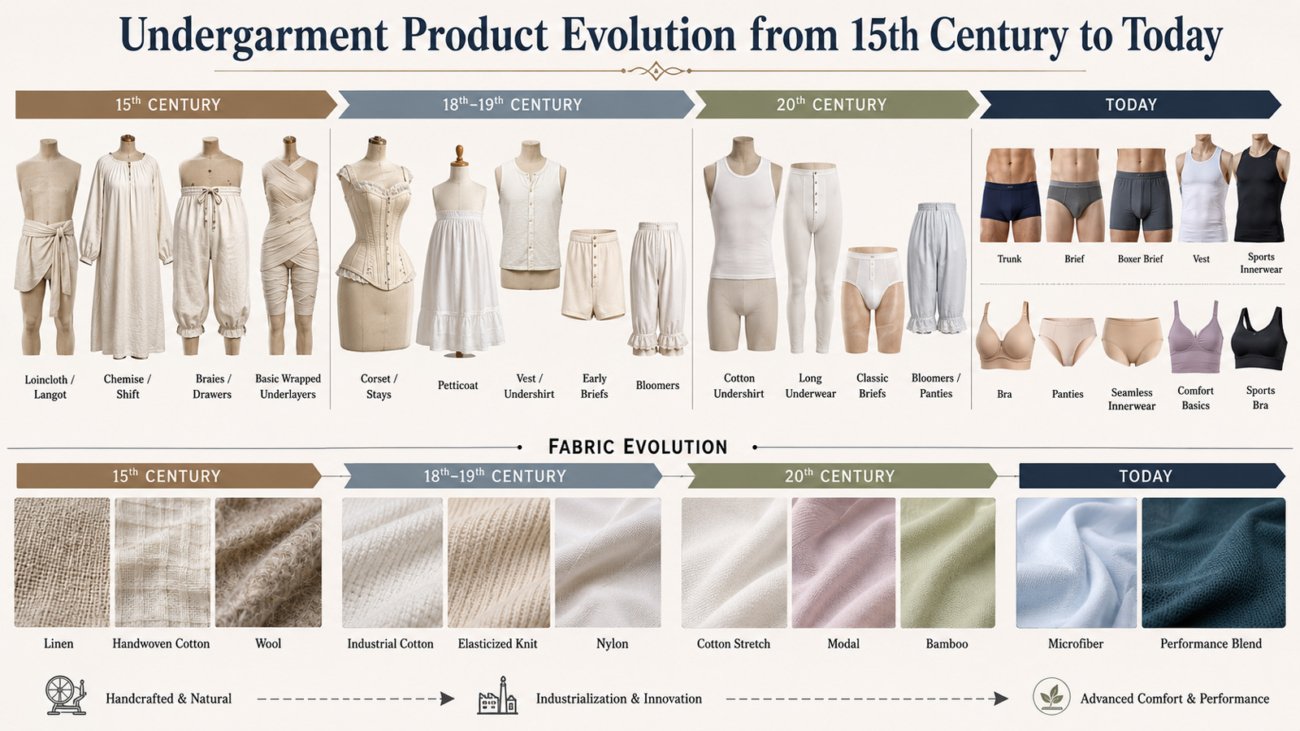
Undergarment / Innerwear means clothing worn close to the skin, mainly for hygiene, body support, comfort, modesty, warmth, and later fashion. Earlier, undergarments were mostly simple cloth layers. Today, innerwear is a full business category covering men’s underwear, women’s lingerie, vests, bras, shapewear, thermal wear, kidswear, sports innerwear, plus-size, maternity, and athleisure innerwear.
Around 1500 AD / 16th century, people did not wear modern underwear like today’s briefs, trunks, bras, panties, or vests. Men mostly wore linen shirts on the upper body and braies on the lower body. Braies were loose underpants, similar to long shorts or drawers, usually tied at the waist with a cord. Men also wore hose, which covered the legs, and sometimes a codpiece in front, especially in European fashion. Linen was common because it absorbed sweat and was easier to wash than outer garments.
Women usually wore a chemise, also called a shift or smock, under their gown. It was a simple loose linen garment worn next to the skin. In many places, women did not wear modern-style underpants at that time. The chemise protected expensive outer dresses from sweat and body oils, so it worked like both an inner layer and hygiene layer. Wealthy women used finer linen, while poorer women used rougher, simple cloth.
In India and South Asia, common male undergarments were more like langot / kaupina / loincloth-style cloth, especially for daily work, physical activity, and wrestling. The main purpose of undergarments in that period was modesty, support, sweat absorption, and protection of outer clothing—not fashion or branding. There was no innerwear “brand business” like today; most garments were handmade at home, stitched by local tailors, or produced by local weavers.
Historically, underwear changed because of four big forces: body coverage, hygiene, fashion silhouette, and fabric technology. The V&A notes that underwear reflects changes in gender, morality, hygiene, body image, fashion, and fabric innovation.
Century-wise Undergarment Product & Business Model
| Century | Main product development | Fabric & technology | Customer / society use | Business model |
|---|---|---|---|---|
| 6th–10th century CE | Basic loincloths, wrapped cloth, simple tunic-like underlayers. In India, traditional forms like kaupinam/langot were used as male underclothing and for wrestling/physical work. | Linen, cotton in warmer regions, wool in colder regions, handwoven cloth. | Main purpose was modesty, protection, sweat absorption, and support during labour. | Mostly home-made, local weavers, village tailoring, barter/local market. No brand concept. |
| 11th century | In Europe, men used loose lower undergarments similar to braies; women used simple chemise/shift under gowns. | Linen became important because it could be washed more easily than heavy outer garments. | Undergarment became a hygiene layer between body and outer clothing. | Cloth was still expensive; people owned limited pieces. Local textile trade grew slowly. |
| 12th century | Braies, hose, chemise, tunics became more organized. Undergarments started differing by class. | More wool, linen, silk for wealthy people. | Rich people used finer fabric; common people used rougher fabric. | Tailors, dyers, cloth merchants grew in towns. |
| 13th century | Men’s hose and braies became common in Europe; women continued chemise/shift as base layer. | Better weaving and dyeing. | Underwear was still not fashion product; it was practical and hidden. | Local guilds and tailoring professions became stronger in Europe. |
| 14th century | Men’s garments became shorter outside, so fitted hose and supportive underlayers became more important. | Linen underlayers, wool hose. | Shape and fit became more visible in men’s clothing. | Tailored garments increased among wealthy and urban customers. |
| 15th century | Chemise became a major women’s undergarment. Men used linen shirts and drawers with hose. FIT’s Fashion History Timeline says that in the 1450s, women’s dress foundation was an undyed linen chemise worn by rich and poor, while men used linen shirts and drawers. (Fashion History Timeline) | Linen was important because it was washable. | Hygiene and layering became more structured. | Tailoring, weaving, and laundering became service-based work in cities. |
| 16th century | Renaissance period: corset-like “bodies,” farthingales, codpieces, chemise, petticoats. Innerwear started shaping the body. | Linen, silk, whalebone, leather, stiffening materials. | Underwear moved from only hygiene to body shaping and social status. | Elite customers ordered custom garments. Court fashion influenced demand. |
| 17th century | “Bodies” or early stays shaped women’s torso. The line between underwear and outerwear was not always fixed; some garments could be both. Dress historian Sarah Bendall notes that 17th-century “bodies” could be underwear or outerwear depending on status, occasion, and use. (Sarah A. Bendall) | Boning, buckram, silk, linen, ribbons, hand-stitching. | Underwear became linked with class, posture, and discipline. | Specialist makers, tailors, and women garment workers developed stronger roles. |
| 18th century | Stays, chemise, petticoats, panniers, drawers in some regions. Underwear created fashionable silhouettes. | Linen, silk, cotton, whalebone, hand embroidery. | Innerwear reflected morality, modesty, and upper-class fashion. | Colonial textile trade increased cotton movement. Made-to-measure garments dominated. |
| 19th century | Huge change: corsets, drawers, petticoats, crinolines, bustles, union suits, undershirts. V&A describes the 1870s bustle as a separate undergarment used to support the back shape of skirts. (Victoria and Albert Museum) | Sewing machine, steel boning, elastic, industrial cotton, factory production. | Underwear became more structured, especially for women’s silhouette. Men’s practical underwear also became standardized. | Industrial Revolution created mass production, sizes, catalogs, department stores, and ready-made underwear. |
| Early 20th century | Corsets started declining. Bras, briefs, undershirts, vests, slips, girdles, union suits became common. Mary Phelps Jacob patented the “Backless Brassiere” in 1914; MIT notes she later sold the patent to Warner Brothers Corset Company. (Lemelson MIT) | Cotton knits, elastic, rayon, early synthetic materials. | Women wanted lighter alternatives to corsets. Men wanted comfort and movement. | Branded innerwear companies began growing through department stores and advertising. |
| 1930s–1940s | Men’s modern brief became a major innovation. Jockey says its brief launched in 1935 and sold strongly through Marshall Field & Company. (Jockey) Nylon stockings also became a major textile breakthrough; Science History Institute notes national nylon stocking sales began in 1940 and sold out quickly. (Science History Institute) | Nylon, elastic waistbands, better knitting machines. | Innerwear became a modern consumer product, not just basic clothing. | Branded packaging, store displays, advertising, and mass distribution expanded. |
| 1950s–1960s | Bras, panties, briefs, boxers, vests, girdles, slips, and children’s underwear became common household products. | Lycra/spandex changed fit. LYCRA’s history says Joseph Shivers invented “Fiber K” in 1958, later known as LYCRA/spandex, which could stretch and recover. (Coolmax) | Fit, stretch, femininity, and modern lifestyle became selling points. | Television advertising and national brands became powerful. |
| 1970s–1980s | Fashion underwear, low-rise briefs, sports underwear, shapewear, branded waistbands, designer innerwear. | Polyester, nylon, spandex blends. | Innerwear became visible in fashion culture. Men’s underwear marketing became aspirational. | Brand identity, celebrity endorsement, department stores, and export licensing grew. |
| 1990s | Boxer briefs, trunks, padded bras, seamless panties, microfiber innerwear, premium men’s underwear. | Microfiber, modal, better elastics, improved stitching. | Comfort + fashion + sex appeal became major demand drivers. | Mall retail, brand stores, catalogs, and early e-commerce started. |
| 2000s | Seamless, no-line panties, athleisure innerwear, shapewear, performance underwear, kids branded innerwear. | Modal, micro modal, bamboo blends, moisture-wicking fabrics. | Customers started caring about comfort, body fit, skin feel, and brand lifestyle. | Organized retail, franchise stores, private labels, OEM/white-label manufacturing expanded. |
| 2010s | D2C brands, online lingerie, plus-size, body positivity, sports bras, printed men’s trunks, subscription underwear. | Bamboo, modal, organic cotton, antimicrobial finish, 4-way stretch. | Innerwear became personal, fashionable, and identity-based. | Marketplaces, influencer marketing, Instagram ads, Amazon/Myntra/Flipkart-style selling. |
| 2020s–today | Comfort-first innerwear, sustainable fibers, bamboo/modal, breathable trunks, anti-rash stitching, seamless bras, shapewear, gender-neutral products, AI-based sizing, online-first launches. | Bamboo modal, recycled fibers, Tencel/lyocell, performance polyester, micro modal, elastane. | Customer wants comfort, hygiene, breathability, style, correct fit, fast delivery, and trusted reviews. | E-commerce, marketplaces, quick commerce, D2C websites, AI search, creator-led ads, marketplace SEO, and data-driven manufacturing. |
Undergarment Product Evolution from 15th Century to now days
We have to update undergarment products from the 15th century to today because human lifestyle, fabric technology, hygiene needs, and customer expectations have completely changed.
In the 15th century, undergarments were very basic. People mainly used linen shirts, chemise, braies, drawers, or loincloth-style garments. The main purpose was only body coverage, sweat absorption, modesty, and protecting outer clothes. There was no concept of branded innerwear, stretch fabric, perfect fitting, antibacterial finish, or fashion design.
Today, undergarments are not just hidden clothing. They are connected with comfort, skin health, confidence, hygiene, body support, and lifestyle. People wear innerwear for office, gym, travel, sleep, sports, daily work, and fashion. That is why modern products need soft fabric, breathable material, stretch, proper fitting, anti-rash stitching, waistband comfort, plus-size options, and better durability.
So the main reason is: undergarments changed from “basic body covering” to “daily comfort and confidence product.” That is why every innerwear brand must keep updating product design, fabric, fit, packaging, photoshoot, listing content, and customer experience according to modern demand.
“DispenserStore manufactur & delivers innerwear that supports every undergrament lifestyle—whether it’s daily wear, active routines, or relaxed moments at home. We blend innovation with reliable manufacturing to create men, women, and kids undergrament products that not only look good but feel even better. At Dispenserstore, our goal is simple: to make innerwear that offers confidence, comfort, and trust in every wear.“
List Of following data of which are updated undergarments product from 15th century to now days
| Undergarments Old version | Undergarments Modern version |
|---|---|
| Loincloth / langot | Briefs, trunks, athletic supporters |
| Chemise / shift | Camisole, slip, nightwear, women’s inner top |
| Braies / drawers | Boxers, briefs, boxer briefs, trunks |
| Corset / stays | Bra, shapewear, waist cincher |
| Petticoat | Saree petticoat, underskirt, shapewear skirt |
| Undershirt | Vest, tank top, T-shirt innerwear |
| Girdle | Modern shapewear |
| Wool thermal layer | Thermal innerwear, winter base layer |
| Handmade cotton undergarment | Branded cotton/modal/bamboo/spandex innerwear |
India-specific Undergarment’s Product evolution
India-specific undergarment product evolution from the 15th century to today started from very simple, functional clothing. Around the 15th century, common Indian undergarments were not like today’s briefs, trunks, bras, panties, or vests. Men mainly used langot / kaupina / loincloth-style underclothing, especially for daily labour, farming, wrestling, and physical activity. The langot was a simple cotton cloth tied around the waist and between the legs, used for modesty, support, and movement. Even today, it is connected with Indian wrestling, kushti, kabaddi, and akhara culture.
For women, the product evolution was different because Indian clothing was traditionally based on draped garments, not fully stitched garments. Women wore sari-style drapes, ghagra-choli, odhani, and regional clothing forms. In many communities, the idea of a separate stitched blouse and petticoat became more standardized much later. Before the 1870s, some sources describe Indian women’s sari dressing as more fluid, with unstitched fabric being the norm and tailored blouse or petticoat not yet universal.
During the colonial period, Indian undergarment and inner-layer clothing changed strongly. British Victorian ideas of modesty influenced women’s dressing, especially in urban and elite society. The stitched blouse and petticoat became more common under the sari, creating the modern sari silhouette. This was a very important stage because Indian women’s innerwear slowly moved from only draped coverage to more structured supporting garments under outerwear.
From the 1990s to 2010s, Indian innerwear changed from a basic necessity to a branded product. Customers started asking for better fit, fabric, elastic quality, stitching, size chart, color, and packaging. Men’s underwear evolved into briefs, trunks, boxer briefs, boxers, and printed waistbands. Women’s innerwear evolved into padded bras, T-shirt bras, sports bras, seamless panties, hipsters, maternity innerwear, and shapewear. Online shopping also helped because customers could buy innerwear with more privacy and more product choice.
In the 20th century, India’s undergarment market became more organized. Men’s innerwear moved from langot and loose cotton drawers to baniyan, briefs, vests, boxers, and elastic-waist underwear. Women’s products also expanded into bras, panties, slips, petticoats, camisoles, and shapewear. This period created the foundation of India’s hosiery and innerwear business, where local manufacturers, wholesale markets, and retail shops became important.
Nowadays, people no longer see undergarments as just basic clothing worn beneath outerwear. Consumers expect innerwear to provide all-day comfort, proper fit, breathability, skin-friendly fabric, and confidence. Modern customers pay close attention to fabric quality, softness, stretchability, waistband comfort, moisture control, and durability. Many people believe that a good undergarment can improve their daily comfort, productivity, and overall confidence, whether at work, during exercise, or while relaxing at home.
At the same time, undergarments have become a lifestyle and fashion product. Customers look for features such as premium fabrics like cotton, bamboo, modal, and microfiber, along with attractive colors, prints, and modern designs. Online reviews, ratings, brand reputation, and product images strongly influence purchasing decisions. Today’s consumers want innerwear that not only feels comfortable but also reflects quality, personal style, and value for money, making undergarments an important part of their everyday wardrobe rather than just a necessity.
“DispenserStore manufactur & delivers innerwear that supports every undergrament lifestyle—whether it’s daily wear, active routines, or relaxed moments at home. We blend innovation with reliable manufacturing to create men, women, and kids undergrament products that not only look good but feel even better. At Dispenserstore, our goal is simple: to make innerwear that offers confidence, comfort, and trust in every wear.“