

 Cart is empty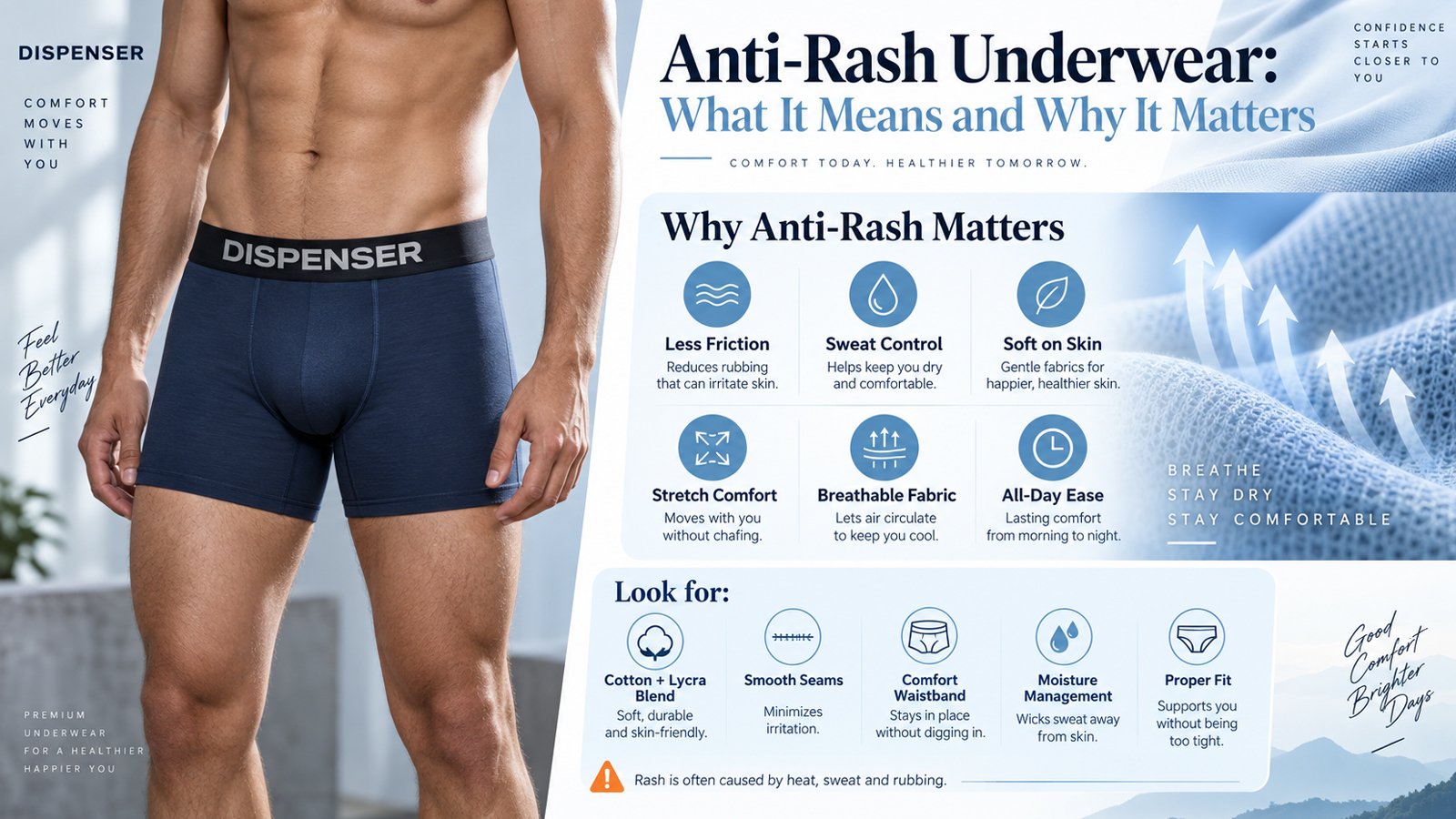
Underwear stays in direct contact with some of the most sensitive areas of our skin for many hours every day. During walking, travelling, exercising, sitting at work, or simply dealing with hot weather, the combination of sweat, heat, moisture and repeated rubbing can make the skin uncomfortable.
This is why the term “anti-rash underwear” has become important in modern innerwear.
But what does anti-rash actually mean? Is it a special chemical treatment? Does it mean the fabric can prevent every type of rash? And what role do fabric, dyes, seams, moisture and fit play?
Let’s understand it in detail with practical examples using DISPENSER underwear.
1. What Is “Anti-Rash”?
“Anti-rash” is commonly used in apparel to describe underwear designed to reduce the conditions that can lead to skin irritation, particularly friction, trapped sweat, excessive moisture, rough fabric contact and uncomfortable seams.
It is important to understand that anti-rash is not one single medical treatment or universally defined textile process. A rash can have many causes, including friction, heat, moisture, allergy, infection or an existing skin condition.
One common example is chafing. When skin or fabric repeatedly rubs against the body, particularly in a warm and sweaty environment, irritation can develop. Medical sources note that friction combined with heat and moisture can contribute to inflammatory conditions such as intertrigo.
Therefore, good anti-rash underwear focuses on creating a better environment between the skin and the garment.
For example, imagine wearing a DISPENSER Cotton Lycra trunk during a long working day. A soft fabric surface, comfortable stretch, breathable construction and smooth seams can help reduce unnecessary rubbing compared with underwear that is rough, poorly fitted or remains heavily damp with sweat.
So, in simple words:
Anti-rash underwear = underwear designed to reduce friction, moisture accumulation and other fabric-related sources of irritation.
It should not be interpreted as a guarantee that a person will never develop a skin rash.
2. What Are the Different Types of Rash Problems Related to Underwear?
When we talk about “anti-rash” underwear, it helps to understand that irritation can come from different sources.
Friction or Chafing
This is one of the most common problems associated with innerwear.
The inner thighs, groin, waistband and leg openings move continuously when we walk, run or exercise. If fabric repeatedly rubs against damp skin, irritation may develop.
Research on skin-textile interaction shows that excessive friction between fabric and the skin can contribute to discomfort, chafing and other forms of irritation.
DISPENSER example:
A properly fitted DISPENSER stretch trunk can move more naturally with the body. Soft fabric, suitable stretch and smoother construction can help minimise excessive fabric-to-skin rubbing during daily movement.
Sweat and Moisture-Related Irritation
Sweat itself does not automatically create a rash. The bigger problem occurs when moisture remains trapped around the skin while heat and friction continue.
Warm and moist environments can increase friction and may also create conditions in which microorganisms can multiply more easily.
DISPENSER example:
A breathable DISPENSER innerwear fabric designed to manage everyday perspiration can provide a more comfortable skin environment than thick, poorly ventilated underwear that stays wet for a long time.
Irritant Contact Dermatitis
Some materials or substances can directly irritate sensitive skin. The problem does not necessarily involve an allergy.
Rough fibres, chemicals, detergents, sweat and repeated physical contact may all contribute to irritation in susceptible people.
Allergic Contact Dermatitis
This is different from normal chafing.
A person may be sensitive or allergic to a substance used in a garment. According to DermNet, textile contact dermatitis is more commonly related to chemical additives used during textile processing than to the fibre itself.
Potential textile allergens may include certain:
- Textile dyes
- Finishing chemicals
- Formaldehyde-based resins
- Rubber or elastic components
- Glues
- Metal accessories
- Other chemical additives
Formaldehyde-containing textile finishes and certain dyes have historically been associated with allergic or irritant textile dermatitis.
This is an important reason why “anti-rash” cannot depend only on softness. Responsible dyeing, finishing and chemical control also matter.
3. What Type of Chemical Allergy Can Come From Fabric?
Modern fabric passes through several manufacturing stages before becoming underwear.
Depending on the textile, processes may include:
Fibre → Yarn → Knitting → Dyeing → Washing → Finishing → Cutting → Stitching → Finished Underwear
Chemicals may be introduced during some of these stages to provide colour, softness, wrinkle resistance, easy-care properties or other performance characteristics.
Most people wear modern textiles without developing a problem. However, sensitive individuals may react to particular substances.
Textile Dyes
Certain textile dyes have been associated with allergic contact dermatitis. Sweat can sometimes encourage loosely bound dye molecules to move from the fabric onto the skin.
The problem may become more noticeable around areas with greater rubbing and perspiration, including the:
- Waist
- Groin
- Buttocks
- Upper thighs
Formaldehyde-Based Finishing Resins
Formaldehyde-based resins have historically been used in some textiles for properties such as wrinkle resistance.
Formaldehyde can act as both an irritant and a sensitiser in susceptible individuals. Clothing-related reactions are more likely around areas where there is considerable friction and sweating.
Rubber and Elastic Components
Waistbands and elastic materials can contain substances that may cause contact reactions in certain people.
This makes waistband quality particularly important in underwear because the waistband remains in direct contact with the skin for many hours.
Finishing Agents
Textile finishing can add useful functionality, but adding more chemicals does not automatically make a fabric better for sensitive skin.
Even antimicrobial textile technologies have to be assessed for skin safety, sensitisation and biocompatibility. Scientific reviews point out that antimicrobial treatments should be evaluated carefully because some textile treatments may themselves cause irritation in susceptible users.
This means an effective anti-rash approach should focus not simply on adding a chemical, but on designing the entire fabric and garment responsibly.
4. How Can the Rash Problem Be Reduced Through Fabric Design?
There is no single fabric treatment that can solve every cause of skin rash. Instead, underwear manufacturers can work on several factors together.
Choose Soft, Skin-Friendly Fabric
A smoother textile surface can help reduce unnecessary mechanical rubbing. there are many fabric are design by pass out anti rush problem like bamboo, and micro modal.
For example, DISPENSER Micro Modal and bamboo based underwear can be designed to combine softness with stretch, allowing the garment to move more naturally with the wearer.
Maintain Good Stretch and Recovery
Underwear that is too tight can create pressure and friction. Underwear that becomes too loose can bunch or move excessively, which may also cause rubbing.
A stretch blend such as Cotton Lycra can help underwear maintain a comfortable body-following fit when properly designed.
Best Combination of 95% cotton, you retain the natural cotton feel, breathability and moisture absorption. The 5% Lycra is usually enough to give 4-way stretch, better recovery and a body-following fit without making the garment feel overly synthetic.
Following table are explain best combination of fabric good stretch and recovery
| Blend | Best for |
|---|---|
| 95% Cotton + 5% Lycra | Daily underwear, trunks, briefs |
| 92% Nylon + 8% Lycra | Stretch-fit / active underwear |
| 90% Poly + 10% Lycra | Compression-style underwear |
| 95% Micro Modal + 5% Lycra | Loose/basic underwear |
| 100% Cotton | Loose underwear |
For example, a DISPENSER 95% Cotton + 5% Lycra trunk can stretch when the customer walks, sits, travels or exercises and then recover toward its original shape instead of becoming loose around the thighs or seat.
For a premium trunk, I would target roughly 170–190 GSM if you want a substantial, durable feel. Around 160–175 GSM can work well if you want a lighter, more breathable summer product.
One important point for your anti-rash positioning: 95/5 alone does not make underwear anti-rash. The final comfort also depends on combed cotton quality, smooth knitting, dyeing/finishing, seam construction, waistband softness, moisture handling and correct sizing.
So for a DISPENSER premium daily-wear product, my preferred specification would be: 95% Combed Cotton + 5% Elastane/Lycra | 170–190 GSM | 4-way stretch | soft finish | smooth/flat seams | soft waistband
Control Moisture
Good breathability and moisture management can help keep the skin environment more comfortable.
This becomes especially important in India’s hot and humid conditions or during gym, travel and outdoor activity.
For example, someone wearing underwear during a full working day may benefit from a fabric construction designed to handle perspiration more comfortably rather than allowing excessive moisture to remain trapped around the skin.
Reduce Rough Seams
A high-quality fabric can still feel irritating if the garment has bulky seams. Smooth or flat-seam construction can reduce prominent edges that continuously rub against the skin. In a trunk Underwear, special attention can be given to high-movement areas such as the thighs, pouch and side seams.
Improve Waistband Comfort
The waistband is one of the most important areas of underwear. A rough, overly tight or badly finished waistband can cause repeated rubbing around the waist. A comfortable waistband should provide enough support to keep the underwear in place without creating unnecessary pressure or harsh skin contact.
5. What Is the “Anti-Rash Process” in Fabric?
Instead of thinking about one chemical called an “anti-rash chemical,” it is more accurate to think about an anti-rash design process.
A responsible process can include several stages.
Step 1: Fibre Selection
The process begins with selecting an appropriate fibre or fibre blend.
For example:
Cotton Lycra:
Cotton provides a familiar soft textile base while elastane/Lycra provides stretch.
Micro Modal Blend:
Modal can provide a smooth, soft hand feel when engineered appropriately.
The exact comfort of the finished garment, however, depends on much more than the fibre name alone.
Step 2: Smooth Fabric Construction
Knitting structure, yarn quality, GSM and finishing influence how the fabric feels against the skin. A smoother surface can help reduce abrasive contact.
Step 3: Controlled Dyeing
Colour should be applied through a properly controlled dyeing process followed by appropriate washing and rinsing. Removing excess unfixed dyes and processing residues is particularly important for garments worn directly against the skin. Textile dye allergy is a recognised cause of allergic contact dermatitis in susceptible people.
Step 4: Washing and Neutralisation
After dyeing and finishing, appropriate washing helps remove residual processing chemicals and unbound material. This stage should be controlled carefully for a direct-skin-contact product such.
Step 5: Appropriate Fabric Finishing
Fabric may be finished to improve its:
- Softness
- Moisture management
- Surface feel
- Dimensional stability
- Hygiene performance
But any finish intended for a skin-contact garment should be selected and controlled appropriately. More chemical treatment does not automatically mean better anti-rash performance.
6. What Are the Benefits of Anti-Rash Fabric?
Well-designed skin-comfort underwear can provide several practical advantages.
Reduced Friction
Smooth fabric and suitable stretch can reduce excessive rubbing between the garment and skin.
Better Comfort in Hot Weather
Breathability and moisture management become especially valuable during summer and humid conditions.
Better Comfort During Movement
Walking, travelling, working and exercising involve thousands of repeated body movements.
Stretchable underwear such as a properly fitted DISPENSER Cotton Lycra trunk can move with the body instead of constantly resisting movement.
More Comfortable Waistband and Seams
Carefully designed construction reduces unnecessary hard contact points.
Suitable for Long Wearing Hours
Many people wear underwear for 8, 10 or even 12 hours before changing.
For such long skin contact, fabric softness, moisture management, fit and seam quality become particularly important.
Better Everyday Confidence
Comfort may not always be visible from the outside, but uncomfortable underwear can distract a person throughout the day.
An anti-rash-focused design aims to make innerwear less noticeable while wearing it—which is exactly what comfortable underwear should do.
7. Why Should We Wear Anti-Rash Underwear?
Think about the situations in which underwear has to perform:
A businessman may sit at a desk for eight hours.
A traveller may spend an entire day in a car, train or aeroplane.
A gym user may continuously sweat and move.
A delivery professional may spend hours walking or riding.
Someone living in a hot and humid city may perspire heavily even during normal daily activity.
In all these situations, heat + sweat + movement + friction can increase discomfort.
That is where underwear designed with skin comfort in mind becomes valuable.
Example
Imagine two men travelling for ten hours.
One is wearing poorly fitted underwear with rough seams and fabric that becomes uncomfortable when damp.
The second is wearing a properly fitted stretch underwear design with soft fabric, comfortable seams, breathable construction and a supportive waistband.
The second garment cannot guarantee that the wearer will never develop a rash, but its design can help reduce several common mechanical and moisture-related causes of discomfort.
That is the practical meaning of anti-rash underwear.
Chemical Safety Matters Too
Because underwear has prolonged direct contact with the skin, responsible chemical management should be an important part of manufacturing.
Independent standards can also provide useful verification. For example, OEKO-TEX® STANDARD 100 tests textile articles for harmful substances, with stricter requirements applying as skin contact becomes more intensive. Underwear falls within its direct-skin-contact product category.
A brand should only claim such certification when the specific product actually holds a valid certification.
Final Thoughts: Better Underwear Starts With Better Skin Comfort
“Anti-rash” should not simply be treated as another label printed on underwear packaging.
True everyday comfort depends on several factors working together:
Soft Fabric + Breathability + Moisture Management + Stretch + Smooth Seams + Comfortable Waistband + Proper Fit + Responsible Textile Processing
For a brand such as DISPENSER, the objective of anti-rash-focused underwear is simple: create an inner layer that remains comfortable when customers are working, travelling, exercising, relaxing or moving through everyday life.
A good pair of underwear should not constantly remind you that you are wearing it.
Add a Comment