

 Cart is empty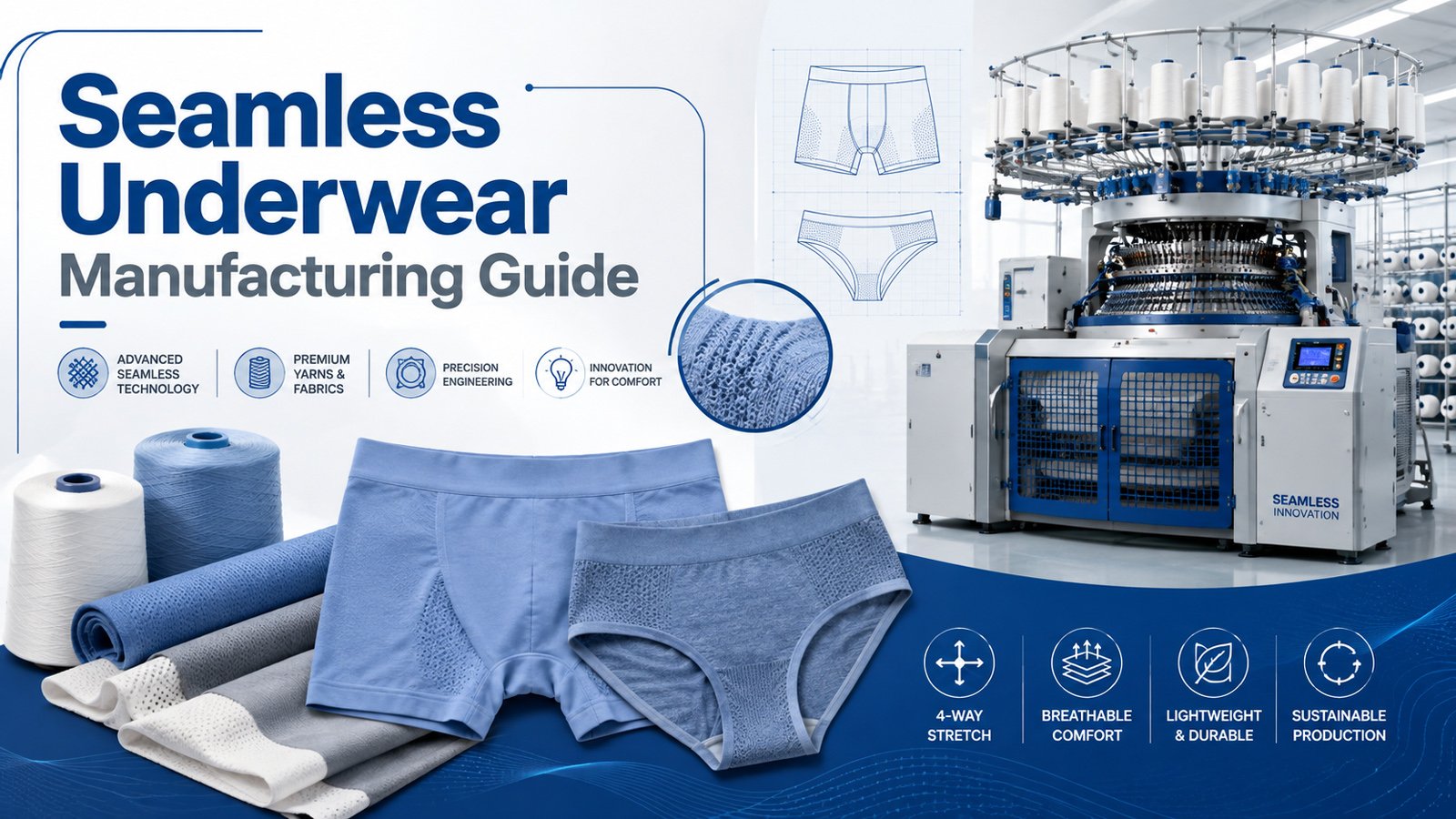
Detail of Seamless Underwear: Fabrics, Machines, Elastic Types, Manufacturing Process, Advantages and Future Business Potential
The underwear industry is continuously evolving with new fabrics, advanced knitting machines, improved fitting technology, and changing consumer preferences. One of the most important developments in modern innerwear manufacturing is seamless underwear.
Consumers increasingly prefer underwear that feels soft, remains invisible under clothing, stretches comfortably with the body, and causes less irritation. Seamless technology helps manufacturers meet these requirements by producing garments with fewer stitched joints than traditional cut-and-sew underwear.
However, “seamless” does not always mean that the garment contains absolutely no stitching. In many products, the main body is knitted as a tube without side seams, while limited cutting, bonding or stitching may still be required at the gusset, waistband, leg opening or finishing points.
What Is Seamless Underwear?
Seamless underwear is an undergarment manufactured with minimal seams, fewer stitched joints or no side seams.
Instead of cutting several fabric panels and stitching them together, the main body of seamless underwear is generally knitted in a tubular form on an electronic circular knitting machine. The machine controls individual needles to create different zones for stretch, support, ventilation, shaping and coverage.
Seamless technology developed from circular hosiery knitting technology. It was initially used mainly for hosiery and underwear but later expanded into sportswear, shapewear, activewear, swimwear, medical garments and outerwear.
A seamless knitting machine can create:
- The main tubular body
- Different knit structures
- Waist support zones
- Ribbed areas
- Ventilation zones
- Compression zones
- Decorative patterns
- Different levels of fabric thickness
- Body-contouring shapes
Santoni, one of the major seamless knitting-machine manufacturers, describes its seamless machine range as suitable for underwear, lingerie, activewear, sportswear, shapewear, swimwear, nightwear and medical garments.
Does Seamless Mean Completely Stitch-Free?
Not always.
The term “seamless underwear” is used for several constructions but it’s depend on garment’s pattern and machine.
1. Seamless-knitted underwear
The garment body is knitted as a tube without conventional side seams. Some stitching may remain at the gusset or crotch. Electronic Circular Seamless Knitting Machine is the main machine used to manufacture seamless-knitted underwear.
- Knit the garment in tubular form
- Remove conventional side seams
- Create rib, mesh and plain knit zones
- Add compression zonesForm ventilation structures
- Create decorative patterns
- Change yarn within the garment
- Integrate a knitted waistband
- Control garment stretch and support
- Produce different sizes through machine diameter and programming
Examples include electronic single-jersey and double-jersey circular seamless machines.
Santoni’s SM8-TOP2V is an electronic single-jersey circular machine designed to manufacture seamless garments for underwear, sportswear, outerwear, beachwear and sanitary applications. It uses needle-by-needle electronic selection to create different structures within the garment.
Seamless garments can be produced as individual tubular pieces instead of continuous fabric rolls. Some manufacturers use different cylinder diameters to cover different garment sizes. In this category, two type of machine are used 1. Single-jersey seamless machine and 2. Double-jersey seamless machine that’s depend on underwear pattern.
2. Bonded seamless underwear
Bonded seamless underwear is underwear in which some or most fabric parts are joined with heat-activated adhesive film or bonding tape instead of conventional needle-and-thread stitching.
The fabric pieces are normally cut into the required shape, overlapped or folded, and then bonded using controlled:
- Heat
- Pressure
- Dwell time
- Cooling
The result is a thin, smooth and low-profile joint that creates fewer visible lines under clothing. Bonded underwear is commonly used for: No-show panties , Women’s seamless briefs, Men’s low-profile trunks, Shapewear Sports underwear, Bonded bras, Laser-cut underwear, and Maternity underwear Swimwear.
The bonding material is normally supplied as a thin thermoplastic adhesive film, web, net or tape. It is placed between two fabric surfaces.
The machine applies heat, causing the adhesive to soften or melt. Pressure forces the activated adhesive into the surface of the fabric, and sufficient dwell time allows the bond to form. Cooling then stabilises the joint. there are many type of machine are used for this underwear manufacture but mostly require Die-cutting or hydraulic press-cutting machine
3. Laser-cut underwear
The fabric edges are cut with laser technology to create thin, clean leg openings that remain less visible under clothing.
Laser-cut underwear is a type of no-show innerwear in which the fabric panels and leg openings are cut using a computer-controlled laser instead of conventional scissors or blade cutting. The laser produces highly accurate, smooth and thin edges, helping the underwear remain almost invisible under fitted trousers, leggings, dresses or sportswear. Laser-cut underwear is commonly made from lightweight stretch fabrics such as nylon-elastane, polyester-spandex, microfiber, tricot or other specially developed raw-cut fabrics that resist fraying and curling.
The main machine used is a CO₂ laser-cutting machine for textiles. The garment pattern is first prepared in CAD software and transferred to the laser machine. The laser beam then follows the digital pattern to cut the front panel, back panel, gusset, waist area and leg openings. Important machine controls include laser power, cutting speed, focus distance, exhaust pressure and fabric-feed tension. Incorrect settings may burn the fabric, harden the edge, create yellow marks or damage the elastane, so every fabric quality requires separate testing.
Laser-cutting alone does not complete the underwear. The cut panels are generally joined using a heat-bonding press, hot-air seam-bonding machine or continuous belt-fusing machine. A thin polyurethane adhesive film or bonding tape is placed between the fabric layers and activated through controlled heat, pressure and time. An adhesive-slitting machine may also be used to cut bonding film into narrow tapes, while a cooling press helps stabilise the bonded seam. A heat-transfer machine is normally used to apply the brand logo, size and wash-care information without adding an uncomfortable stitched label.
The main advantages of laser-cut underwear are smooth leg openings, reduced visible underwear lines, less seam bulk, accurate sizing and a modern premium appearance. However, the product requires compatible fabric, precise laser settings, good-quality bonding adhesive and strict washing tests. Poor-quality production can cause edge curling, adhesive separation, hard cut edges, fabric discolouration or loss of stretch. Therefore, the complete production setup normally includes CAD software, a textile CO₂ laser cutter, bonding equipment, cooling equipment and bond-strength testing facilities.
4. Raw-cut underwear
Special stretch fabric is cut without folding or sewing the leg edge. The fabric must resist curling and fraying.
Raw-cut underwear is a type of no-show innerwear in which the fabric edges, especially around the leg openings and waist, are left without folding, hemming or conventional stitching. The fabric is specially selected and finished so that it does not fray, unravel or curl excessively after cutting. This construction creates an ultra-thin edge that stays smooth under fitted trousers, dresses, leggings and sportswear. Raw-cut underwear is commonly made from lightweight nylon-elastane, microfiber, polyester-spandex, fine tricot or specially engineered stretch fabrics with strong edge stability.
The main machine used is an automatic fabric-cutting machine, die-cutting press or CO₂ laser-cutting machine. For heat-sensitive fabrics, an automatic knife cutter is preferred because it cuts without melting or hardening the edge. A hydraulic die-cutting press is suitable for repetitive bulk production, where sharp metal dies cut identical front, back and gusset panels. A laser cutter may also be used when precise, clean edges are required, but incorrect laser power can damage elastane, create a hard edge or cause yellowing.
Raw-cut panels are usually assembled using a heat-bonding press, hot-air bonding machine or ultrasonic welding machine because conventional stitching can create visible seam lines. Thin polyurethane adhesive tape or film may be used at the side seams, gusset and waistband. A pneumatic heat press applies controlled temperature, pressure and time, while a hot-air bonding machine is useful for curved seams and continuous tape application. A cooling press or flat cooling table helps stabilise the bonded joint after heating.
The main advantages of raw-cut underwear are minimal visible lines, lightweight comfort, smooth leg openings and a premium modern appearance. However, the fabric must have excellent edge stability, stretch recovery and wash durability. Poor-quality fabric may curl, fray, lose shape or become loose after washing. Manufacturers should therefore test edge curling, stretch recovery, wash shrinkage, bond strength and wearer comfort before starting bulk production.
5. Hybrid seamless underwear
Hybrid seamless underwear combines two or more manufacturing technologies in one garment, such as circular seamless knitting, laser cutting, raw-cut edges, heat bonding and limited stitching. For example, the main body may be knitted in tubular form without side seams, while the gusset, waistband, support panel or leg opening is attached using bonding or flatlock stitching. This method allows manufacturers to retain the comfort and stretch of seamless knitting while adding better support, shaping, durability or design flexibility.
The main machine used is an electronic circular seamless knitting machine, which produces the tubular body and creates different zones for stretch, ventilation, ribbing and compression. After knitting and finishing, a CO₂ laser-cutting machine or automatic knife cutter may be used to create accurate leg openings, waist shapes, gussets or reinforcement panels. Laser cutting is suitable for clean no-show edges, while knife cutting is preferred for fabrics that may harden or discolour under laser heat.
For joining the additional components, manufacturers use a pneumatic heat-bonding press, hot-air seam-bonding machine or continuous belt-fusing machine. These machines activate thin polyurethane adhesive tape using controlled heat, pressure and time. A flatlock or overlock sewing machine may also be used only in high-stress areas such as the crotch or gusset, where extra security is required. A heat-transfer press is commonly used for applying the brand logo, size and wash-care details without adding a bulky sewn label.
The main advantage of hybrid seamless underwear is that it offers a balance of comfort, support, durability and design freedom. It can provide a smooth body fit with fewer seams while allowing stronger construction in areas that receive more pressure. However, production is more complex because the knitted body, cut panels, adhesive, stitching and finishing must all work together. Manufacturers must carefully test bond strength, seam stretch, waistband recovery, wash durability, edge curling and wearer comfort before bulk production.
Therefore, brands should clearly understand whether their product is:
- Side-seam-free
- Seamless-knitted
- Bonded
- Laser-cut
- Stitch-free at the leg opening
- Fully seamless
- Nearly seamless
How Many Fabrics Are Used in Seamless Underwear?
There is no fixed number of fabrics used in seamless underwear.
Seamless underwear can be manufactured from many yarn combinations. Most products use two or more fibres because one fibre provides softness while another provides elasticity, strength, moisture control or durability.
The most common materials are listed below.
1. Polyamide or Nylon
Polyamide, commonly called nylon, is one of the most widely used fibres in seamless underwear.
It is popular because it offers:
- Smooth texture
- High strength
- Good elasticity
- Lightweight construction
- Abrasion resistance
- Quick drying
- Good body conformity
- Suitability for fine-gauge knitting machines
Polyamide 6.6 is especially suitable for underwear, activewear and seamless garments because of its soft and smooth feel.
Textured polyamide yarn can provide additional softness, volume, stretch recovery and fabric coverage while maintaining a lightweight feel.
Common composition example
- 85% polyamide
- 15% elastane
This combination is common in premium seamless briefs, panties, bras and shapewear.
2. Polyester
Polyester may be used in performance-oriented seamless underwear.
Its benefits include:
- Fast drying
- High durability
- Good colour retention
- Lower moisture absorption
- Easy care
- Suitability for sports innerwear
- Cost efficiency
Polyester is often used for:
- Sports underwear
- Gym innerwear
- Quick-dry trunks
- Performance briefs
- Base layers
However, standard polyester may not feel as silky as fine polyamide unless microfilament or specialised yarn is used.
Common composition example
- 90% polyester
- 10% elastane
3. Elastane, Spandex or Lycra
Elastane is not normally used alone. It is blended with nylon, polyester, cotton, modal or other fibres.
Its purpose is to provide:
- Four-way stretch
- Shape recovery
- Body-hugging fit
- Compression
- Flexibility
- Size adaptability
- Waist and leg stability
Modern soft-stretch elastane varieties can provide gentle support, four-way stretch and a second-skin feel in underwear and bodywear.
Typical elastane percentage
Seamless underwear may contain approximately:
- 3% to 8% for light stretch
- 8% to 15% for regular body fit
- 15% to 25% for shapewear or compression products
The correct percentage depends on yarn type, knit structure, fabric weight and required compression.
4. Cotton
Cotton is valued for:
- Natural softness
- Breathability
- Familiar skin feel
- Moisture absorption
- Everyday comfort
- Consumer trust
However, 100% cotton is generally not ideal for highly stretchable seamless underwear because it has limited stretch recovery.
Cotton is therefore commonly blended with:
- Polyamide
- Polyester
- Elastane
- Modal
Common composition example
- 60% cotton
- 32% polyamide
- 8% elastane
Cotton-blend seamless underwear can be suitable for daily-use trunks, briefs, panties and vests.
5. Modal and Micro Modal
Modal is a regenerated cellulosic fibre generally produced from wood-based cellulose.
It is used for premium underwear because it can provide:
- Soft hand feel
- Smooth surface
- Good moisture absorption
- Comfortable drape
- Breathability
- Premium appearance
Micro modal uses finer fibres and can provide an even softer, more luxurious feel.
Common composition example
- 70% modal
- 23% polyamide
- 7% elastane
Modal blends are suitable for:
- Premium men’s trunks
- Women’s briefs
- Lounge underwear
- Soft everyday innerwear
6. Viscose
Viscose may be used as a cost-effective cellulosic option.
It can provide:
- Softness
- Moisture absorption
- Smooth drape
- Comfortable skin feel
However, its wet strength and dimensional stability must be carefully controlled through yarn selection, knitting construction and finishing.
7. Bamboo-Viscose Blends
Products described as bamboo underwear usually use regenerated cellulose fibre made from bamboo pulp rather than untreated natural bamboo fibre.
Bamboo-viscose blends can offer:
- Soft texture
- Moisture absorption
- Smooth feel
- Breathability
- Premium marketing appeal
They are commonly blended with elastane and sometimes polyamide.
8. Recycled Nylon and Recycled Polyester
Sustainable seamless underwear may use:
- Recycled polyamide
- Recycled polyester
- Recycled elastane blends
- Bio-based yarn components
Recycled nylon 6.6 is already being developed for seamless apparel, sportswear and lingerie applications.
These materials can help brands build environmentally responsible product ranges, although certification, traceability, shade consistency and performance testing remain important.
9. Functional and Technical Yarns
Advanced seamless underwear may also use yarns designed for:
- Odour control
- Moisture management
- Cooling effect
- Thermal insulation
- Antistatic performance
- Bacteriostatic performance
- Compression
- Sports recovery
- UV protection
These products are more common in premium sportswear, medical wear, shapewear and performance underwear.
Best Fabric Combinations for Seamless Underwear
Daily-wear underwear
- Cotton + polyamide + elastane
- Modal + polyamide + elastane
- Micro modal + elastane
Sports underwear
- Polyamide + elastane
- Polyester + elastane
- Moisture-management yarn + elastane
Shapewear
- High-denier polyamide + higher elastane percentage
Invisible underwear
- Fine-gauge polyamide microfiber + elastane
Sustainable underwear
- Recycled polyamide + recycled or bio-based elastane
- Modal + elastane
- Recycled polyester + elastane
There is no single “best” fabric for every seamless underwear product. The ideal composition depends on target price, customer use, climate, fit, wash performance and product positioning.
Which Types of Elastic Are Used in Seamless Underwear?
Seamless underwear may use a separate elastic waistband, knitted-in elastic yarn or a combination of both.
1. Knitted-In Elastane Waistband
In many seamless garments, the waistband is directly knitted into the garment.
The machine changes:
- Stitch density
- Elastane feed
- Yarn tension
- Rib structure
- Knit construction
Advantages
- No separate waistband seam
- Smooth appearance
- Lower bulk
- Integrated design
- Comfortable body fit
Limitations
- Difficult to replace
- Recovery depends heavily on yarn quality
- Programming and tension must be accurate
- May roll if the structure is poorly designed
2. Exposed Jacquard Elastic
This is a separate waistband with the brand name or logo woven or knitted into it.
It is commonly used in men’s trunks and briefs.
Benefits
- Strong branding
- Good waist support
- Premium appearance
- High durability
- Easy identification
Common materials include:
- Nylon
- Polyester
- Elastane
- Rubber thread
3. Plush-Back Elastic
Plush elastic has a soft inner surface that touches the skin.
It is suitable for:
- Briefs
- Panties
- Bras
- Kids’ underwear
- Sensitive-skin products
Its main benefit is improved comfort and reduced roughness.
4. Knitted Elastic
Knitted elastic is soft, flexible and generally lightweight.
It can be used in:
- Waistbands
- Leg openings
- Light underwear
- Women’s panties
- Children’s garments
It normally remains flexible when stitched but may provide less firm support than woven elastic.
5. Woven Elastic
Woven elastic is more structured and stable.
It is suitable for:
- Men’s trunks
- Sports underwear
- Firm waistbands
- Premium exposed waistband products
It can provide better strength and recovery but may feel thicker than knitted elastic.
6. Fold-Over Elastic
Fold-over elastic folds around the fabric edge.
It is used for:
- Leg openings
- Waist edges
- Bras
- Panties
- Lightweight underwear
It provides both elasticity and edge finishing.
7. Clear Elastic
Clear elastic is usually a transparent polyurethane-based elastic.
It can be used for:
- Stabilising edges
- Supporting leg openings
- Maintaining shape
- Lightweight invisible constructions
It is generally hidden inside the garment.
8. Silicone-Grip Elastic
Silicone lines, dots or strips are added to elastic to reduce slipping.
It is useful in:
- Strapless garments
- Shapewear
- Sportswear
- Cycling garments
- Selected briefs and bras
Silicone-backed elastic can improve grip, although poor silicone quality may cause discomfort or lose grip after repeated washing. Silicone gripper materials can be applied to textile elastic through bonding or roll-to-roll processes.
9. Latex-Free Elastic
Latex-free elastic uses synthetic alternatives instead of natural rubber latex.
It is suitable for:
- Sensitive-skin products
- Medical garments
- Premium underwear
- Products marketed for latex-sensitive consumers
The factory should obtain proper material declarations rather than making unsupported allergy-free claims.
10. Bonded Elastic Film
Thin elastic film may be bonded inside waist or leg areas.
Its benefits include:
- Low thickness
- Smooth appearance
- Reduced visible lines
- Clean bonded construction
However, bond strength and washing durability must be carefully tested.
Which Countries Are Major Manufacturers and Suppliers of Seamless Underwear?
There is no single customs classification covering only seamless underwear, so exact country rankings can be difficult to establish. Seamless garments are usually included within broader underwear, knitted-apparel and intimate-apparel trade categories.
However, several countries are important in seamless technology, manufacturing or sourcing.
1. China
China is one of the largest manufacturing and sourcing centres for:
- Seamless underwear
- Activewear
- Shapewear
- Seamless bras
- Bonded underwear
- Laser-cut underwear
- Knitting machinery components
- Elastic and trims
- Synthetic yarns
Its advantages include:
- Large production scale
- Strong yarn and accessory supply chain
- Access to seamless knitting machines
- Competitive OEM and private-label manufacturing
- Advanced bonding and laser-cutting facilities
China is particularly strong for high-volume orders and complete supply-chain availability.
2. India
India is growing in seamless underwear and activewear manufacturing.
Its strengths include:
- Large domestic underwear market
- Strong cotton and synthetic textile base
- Availability of skilled garment labour
- Increasing installation of electronic circular knitting machines
- Competitive manufacturing cost
- Strong private-label opportunity
- Growing demand for sportswear, shapewear and comfort innerwear
India also has the opportunity to develop seamless products suitable for hot climates, plus-size customers and value-conscious consumers.
3. Turkey
Turkey is an important textile and garment manufacturing centre serving Europe and surrounding markets.
Its strengths include:
- Fast delivery to Europe
- Strong circular knitting experience
- Quality finishing
- Fashion-oriented production
- Smaller and flexible order quantities
- Advanced underwear and activewear manufacturing
Turkey can be suitable for mid-to-premium brands that need faster European supply.
4. Italy
Italy is especially important for seamless technology, machine innovation, premium yarns and high-quality product development.
Santoni, a major seamless circular knitting-machine manufacturer, is based in Italy. Italian companies have played a significant role in the development of seamless knitting technology and technical yarns.
Italy is stronger in:
- Machinery
- Product development
- Premium fibres
- Fashion innovation
- Technical seamless garments
- High-value manufacturing
5. Portugal Vietnam and Cambodia
Portugal is known for premium European textile manufacturing, underwear, knitwear and technical products.
Portuguese suppliers are active in:
- Underwear
- Loungewear
- Circular knits
- Sustainable fabrics
- Premium private-label production
- Seamless bodywear
Portugal has manufacturers with vertically integrated expertise in underwear, technical products and seamless garments.
Vietnam and Cambodia
Vietnam and Cambodia are increasingly important for scalable apparel production.
Major international seamless manufacturers operate production networks across countries including Vietnam, Cambodia, China, India, Romania, Jordan and El Salvador. Tefron, for example, reports production operations across seven countries and substantial monthly garment capacity.
These countries can offer:
- Large-scale production
- Competitive labour cost
- Export-oriented manufacturing
- International brand experience
Major Advantages of Seamless Underwear
1. Better comfort
The reduction of bulky seams can reduce pressure and rubbing against the skin.
This is especially useful for:
- Daily wear
- Gym activities
- Running
- Cycling
- Travel
- Tight-fitting clothing
2. Reduced chafing
Traditional side seams can create friction during repeated movement.
Seamless construction reduces potential friction points, although chafing can still occur if the garment is too tight, poorly fitted or made from unsuitable yarn.
3. Second-skin fit
The tubular knit structure can stretch with the body and provide a close, flexible fit.
4. Better freedom of movement
Seamless knitting allows different stretch levels to be placed in different body areas.
This is valuable in sportswear and active underwear.
5. Body-mapped construction
Manufacturers can create:
- Ventilation zones
- Support zones
- Compression areas
- Ribbed structures
- Mesh sections
- Flexible movement areas
without stitching separate fabric panels.
6. Reduced fabric cutting waste
Because the garment body is knitted closer to its final shape, there can be less cutting waste than in traditional panel cutting.
The actual reduction depends on garment construction, rejected pieces, yarn waste and finishing requirements.
7. Fewer sewing operations
The process can reduce:
- Side-seam sewing
- Panel joining
- Edge finishing
- Labour-intensive assembly
Fulgar identifies fewer seams, reduced finishing requirements and faster sampling among the potential advantages of seamless technology.
8. Faster design variation
A manufacturer can modify knit structures, patterns and body zones through machine programming without creating an entirely new cut-and-sew pattern set.
9. Premium visual appearance
Seamless products often look:
- Cleaner
- More modern
- More technical
- More body-contoured
- More premium
10. Better invisibility under clothing
Laser-cut, raw-cut and bonded underwear can reduce visible panty lines or seam impressions.
11. Product differentiation
Seamless technology helps brands develop unique selling points such as:
- No side seams
- Second-skin comfort
- 360-degree stretch
- Body-mapped ventilation
- Smooth fit
- Invisible finish
Disadvantages of Seamless Underwear
1. High machine investment
Electronic seamless knitting machines, design software and supporting equipment require substantial investment.
Additional cost may include:
- Machine installation
- Technician training
- Spare parts
- Software
- Air compressor
- Power stabilisation
- Yarn inventory
- Dyeing and finishing development
2. Requirement for specialised technicians
Traditional sewing knowledge alone is not enough.
A seamless factory requires technicians who understand:
- Circular knitting
- Needle selection
- Yarn tension
- Programming
- Knit structure
- Elastane behaviour
- Machine maintenance
- Size development
3. Machine-diameter limitations
The tubular garment size depends partly on machine-cylinder diameter.
Once a machine diameter is selected, the manufacturer has limited freedom to create significantly larger widths. Diameter is one of the recognised limitations of circular seamless technology.
Factories may therefore need different machine diameters for different size groups.
4. Size-development challenges
A single machine program cannot always be stretched across every size.
Problems may include:
- Excess compression in larger sizes
- Loose fit in smaller sizes
- Incorrect rise
- Leg-opening pressure
- Waist rolling
- Inconsistent garment length
Plus-size seamless underwear requires dedicated development rather than simply increasing finishing stretch.
5. Limited fabric flexibility
Traditional underwear can combine multiple fabrics and panels easily.
Circular seamless products are more dependent on yarn selection and knit programming. Adding non-knitted panels can reduce the seamless advantage.
6. Difficult fitting corrections
In cut-and-sew underwear, the pattern can be adjusted panel by panel.
In seamless knitting, fit corrections may require:
- Program changes
- Yarn changes
- Stitch-density changes
- Machine-tension changes
- New sampling
- New dyeing and finishing trials
7. Risk of waistband or leg rolling
Poor structure, incorrect elastane percentage or wrong heat setting may cause:
- Waistband rolling
- Leg curling
- Garment riding up
- Loss of shape
8. Yarn-quality dependency
A small difference in elastane quality, yarn denier or tension can significantly affect:
- Garment width
- Compression
- Stretch recovery
- Shade
- Shrinkage
- Surface appearance
9. Higher development cost
Sampling may be quick after the program is perfected, but the initial development process can be expensive.
The factory may need several trials to finalise:
- Fit
- Yarn combination
- Machine program
- Dyeing recipe
- Finishing method
- Size grading
10. Repair and alteration difficulty
Seamless products are generally difficult to alter or repair because their structure is knitted as one integrated body.
11. Bonding durability concerns
Bonded underwear can experience:
- Edge lifting
- Adhesive failure
- Delamination
- Hardening after washing
- Reduced stretch
if the adhesive, fabric or process is unsuitable.
12. Not automatically more breathable
“Seamless” describes construction, not breathability.
A poorly designed polyester garment may feel less breathable than a well-designed cotton cut-and-sew garment. Breathability depends on:
- Fibre type
- Yarn construction
- Knit density
- Fabric thickness
- Mesh zones
- Moisture treatment
- Garment fit
13. Synthetic-fibre dependence
Many seamless garments use nylon, polyester and elastane because these fibres perform well on fine-gauge machines.
This creates challenges related to:
- Microfibre shedding
- Fossil-based raw materials
- Recycling blended fabrics
- End-of-life disposal
The industry is responding with recycled, bio-based and lower-impact yarn options, but large-scale circular recycling remains difficult for multi-fibre elastic blends.
Is Seamless Underwear the Future of the Undergarment Business?
Seamless underwear is an important part of the future, but it will not completely replace traditional underwear.
The most realistic future is a combination of:
- Seamless knitting
- Traditional cut-and-sew manufacturing
- Laser cutting
- Heat bonding
- Automated sewing
- Digital body mapping
- Sustainable yarns
- Functional finishes
Why Traditional Underwear Will Continue
Traditional cut-and-sew underwear will remain important because it provides:
- Greater fabric choice
- Easy panel modification
- Lower initial machinery investment
- Easier small-batch production
- More flexible size grading
- Easier print placement
- Strong suitability for cotton products
- Easier repair and alteration
- More design options using multiple fabrics
Therefore, seamless and traditional underwear will likely grow together, serving different price points and customer needs.
Conclusion
Seamless underwear is manufactured using specialised circular knitting, bonding, laser-cutting or hybrid technology to reduce conventional seams and create smooth, stretchable and body-contoured garments.
The most commonly used materials include:
- Polyamide
- Polyester
- Cotton
- Modal
- Micro modal
- Viscose
- Recycled fibres
- Elastane
The main production equipment is an electronic circular seamless knitting machine supported by design software, yarn-covering equipment, dyeing machines, dryers, heat-setting equipment, laser cutters, bonding machines and limited sewing machinery.
Seamless underwear offers major advantages in comfort, appearance, stretch, body mapping and production efficiency. However, it also involves high machinery investment, specialised technical knowledge, size limitations and strong dependence on yarn and process control.
Seamless technology is therefore not the only future of the undergarment business, but it will be one of its most important growth areas. Brands that combine seamless construction with good fabric, accurate fitting, functional performance, sustainable materials and honest product communication can build a strong position in the next generation of innerwear.
The winning product will not be the one that is called “seamless.” It will be the product that delivers measurable comfort, reliable fit, wash durability and value to the customer.
Add a Comment