

 Cart is empty
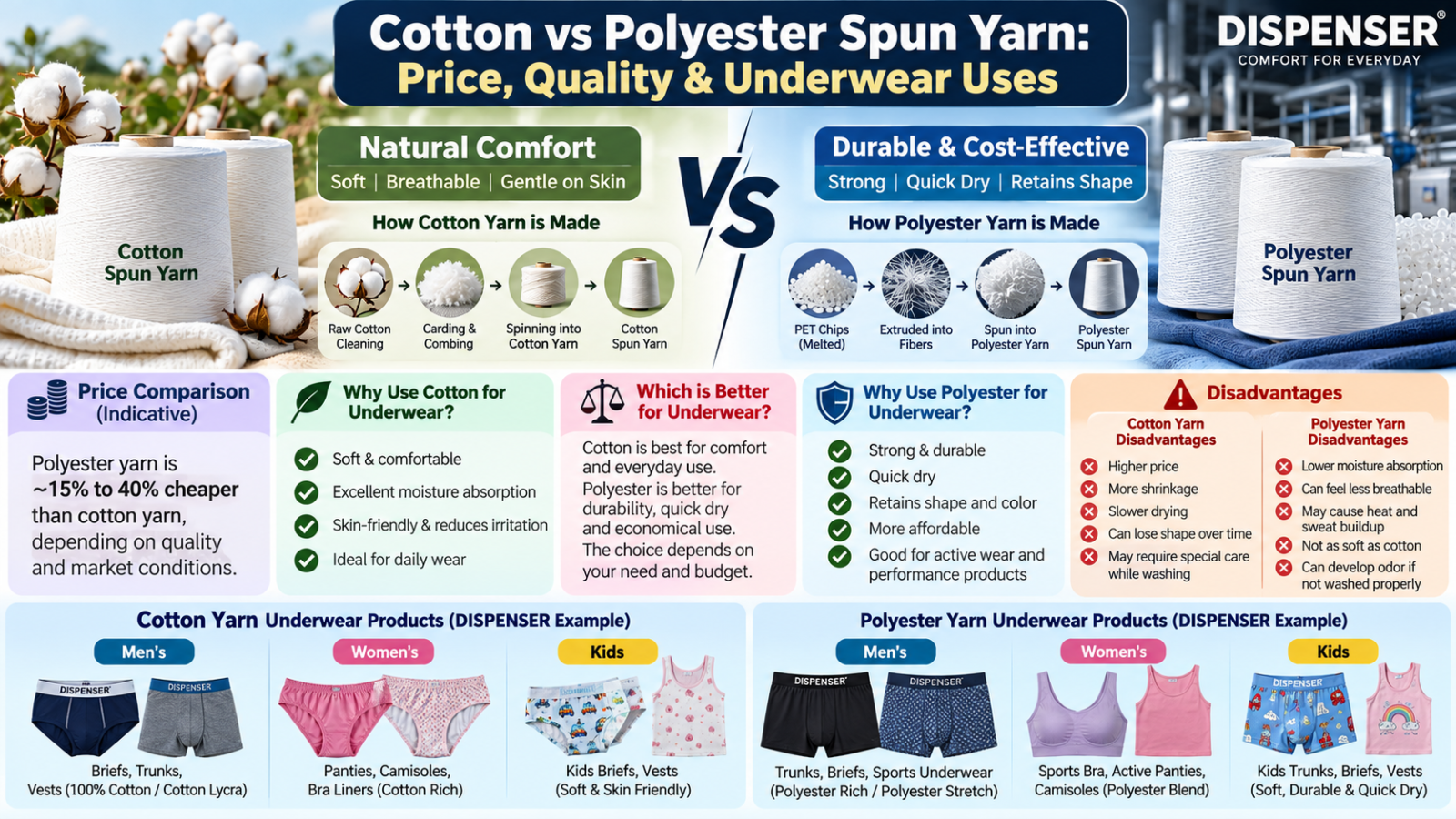
Introduction: Why Yarn Selection Matters in Underwear Manufacturing
The quality of underwear begins long before the fabric is knitted, dyed or stitched. It starts with the selection of yarn.
In the textile and innerwear manufacturing industry, cotton yarn and polyester spun yarn are two important raw materials. Both can be used to manufacture knitted fabrics, but their characteristics, manufacturing processes, comfort levels, durability and production costs differ significantly.
Cotton yarn is valued for its natural softness, moisture absorption and comfortable skin contact. Polyester spun yarn is appreciated for its strength, dimensional stability, quick-drying potential and competitive pricing.
For manufacturers like DISPENSER, selecting the right yarn is essential to developing quality underwear across different customer segments, from everyday men’s trunks to women’s briefs and children’s innerwear.
In this blog, we explain how both yarns are manufactured, compare their prices, examine their advantages and disadvantages, and identify which yarn is better suited to specific innerwear products.
1. What Is Cotton Yarn and How Is It Manufactured?
Cotton yarn is a natural textile yarn produced from the fibres surrounding the seeds of the cotton plant. These fibres are primarily composed of cellulose, which provides natural moisture absorption and contributes to cotton’s characteristic feel.
Cotton yarn is widely used in T-shirts, underwear, vests, baby clothing, hosiery and other garments where comfort and regular skin contact are important.
How cotton yarn is made
COTTON YARN MANUFACTURING FLOW
Cotton harvesting ==> Ginning & cleaning ==> Carding ==> Combing (optional) ==> Drawing & roving ==> Spinning & winding
Stage 1: Cotton harvesting, ginning and cleaning
Cotton production begins with the harvesting of mature cotton bolls. The harvested cotton contains seeds, leaves, dust and other impurities. During ginning, the cotton fibres are separated from the seeds. The cleaned fibres are compressed into bales and transported to spinning mills.
Inside the spinning mill, the bales undergo opening, mixing and cleaning in the blowroom. This process loosens compressed fibre bundles and removes additional impurities. Maintaining consistent fibre length and quality is important because variations can affect yarn strength, softness and uniformity.
Stage 2: Carding, combing and drawing
After cleaning, cotton fibres pass through carding machines, where they are separated, further cleaned and arranged into a continuous strand called a sliver. For higher-quality combed cotton yarn, an additional combing stage removes many shorter fibres and improves fibre alignment.
Drawing machines then combine and stretch the slivers to improve consistency. The material may pass through a roving frame before spinning. These operations help produce smoother, more uniform yarn suitable for fine knitted underwear fabrics.
Stage 3: Spinning, winding and fabric production
During spinning, the prepared fibres are drawn to the required thickness and twisted together to create yarn. Ring spinning is commonly used for softer, finer yarns, while rotor and air-jet spinning provide alternative manufacturing methods.
The finished yarn is wound onto cones and supplied to knitting units. Circular knitting machines can convert it into single jersey, rib or other fabrics used for briefs, trunks, vests and related garments. Fabrics subsequently undergo dyeing, finishing and garment manufacturing. CottonWorks™+2
2. Why Should Cotton Yarn Be Used for Underwear?
Cotton remains one of the most popular choices for everyday innerwear, particularly in markets with warm climates and high demand for comfortable daily-use clothing.
Major advantages of cotton underwear
Natural softness and skin comfort
Cotton knitted fabrics can provide a soft, familiar feel against the skin. High-quality combed cotton is particularly suitable for underwear worn throughout the day.
Good moisture absorption
Cotton absorbs perspiration into its fibres, helping manage small amounts of everyday moisture. However, once heavily saturated, it can remain damp longer than a well-designed polyester performance fabric.
Breathability
Cotton can be knitted into lightweight, air-permeable fabrics. This makes it a practical material for routine wear in India’s warm climate. Actual airflow depends on fabric thickness, knitting structure and finishing.
Suitable for family innerwear
Cotton is a versatile choice for men’s briefs, women’s everyday underwear, children’s trunks and comfortable vests.
Comfort-enhancing blends
Cotton can be combined with elastane or Lycra to improve stretch, fit and shape retention.
DISPENSER example: Cotton Lycra men’s trunk
Consider a DISPENSER men’s trunk developed using a proposed 95% cotton and 5% elastane composition. The cotton contributes natural softness and moisture absorption, while the elastane helps the garment stretch around the waist, hips and thighs. This construction is a strong option for customers seeking comfortable underwear for office wear, travel and daily activities. Cotton is particularly suitable when the main product objective is all-day comfort rather than intense sports performance.
3. What Is Polyester Spun Yarn and How Is It Manufactured?
Polyester spun yarn is a man-made textile yarn produced from short polyester fibres, generally called polyester staple fibres or PSF. Unlike polyester filament yarn, which consists of continuous filaments, polyester spun yarn is manufactured by twisting shorter fibres together in a process similar to cotton spinning.
This distinction matters because polyester spun yarn can provide a more cotton-like texture than conventional smooth polyester filament yarn.
How polyester spun yarn is made
POLYESTER SPUN YARN MANUFACTURING FLOW
PET polymer ==> Melt extrusion ==> Drawing & crimping ==> Staple fibre cutting ==> Carding & drawing ==> Yarn spinning
Stage 1: Polyester polymer and fibre production
Polyester production commonly begins with raw materials such as purified terephthalic acid (PTA) and monoethylene glycol (MEG), which are reacted to produce polyethylene terephthalate (PET).
The polyester polymer is melted and passed through spinnerets containing tiny openings. As the molten material cools, it forms continuous synthetic filaments.
These filaments are collected into large bundles called tow, which are subsequently drawn to align the polymer molecules and improve fibre strength.
Stage 2: Crimping and cutting into staple fibres
The polyester tow passes through crimping equipment that creates small bends or waves in the fibres. Crimping improves fibre cohesion and allows the fibres to be processed through staple-yarn spinning machinery.
The fibres are heat-set and cut into short, controlled lengths, often around 38 mm for cotton-type spinning systems. The resulting polyester staple fibres are packed into bales and supplied to spinning mills.
Stage 3: Spinning polyester staple fibres into yarn
At the spinning mill, polyester staple fibres pass through opening, carding, drawing and an appropriate spinning system, which may include ring spinning or other technologies.
The resulting polyester spun yarn is wound onto cones and transported to fabric knitting units. Manufacturers can use this yarn to produce single jersey, interlock, rib or other knitted constructions depending on the desired garment.
Polyester spun yarn may also be blended with cotton or other fibres to combine different performance characteristics. Coats Group plc+2
4. Why Should Polyester Spun Yarn Be Used for Underwear?
Polyester spun yarn is an attractive material for manufacturers developing durable, economical and performance-oriented innerwear.
Major advantages of polyester spun yarn
Strength and durability
Polyester fibres generally have good tensile strength and abrasion resistance. A properly manufactured polyester innerwear fabric may retain its appearance through repeated use and washing.
Quick-drying capability
Polyester absorbs relatively little moisture into the fibre itself. In a suitable knitted construction, particularly one engineered for moisture transport, sweat can move through the fabric and evaporate relatively quickly. PMC+1
Dimensional stability
Polyester fabrics often provide good shape and dimensional stability when appropriately heat-set and finished. This is useful for underwear that undergoes frequent washing.
Cost-effective manufacturing
Standard polyester spun yarn can be considerably less expensive than high-quality combed cotton yarn. This creates an opportunity for affordable product ranges, although fabric processing and finishing costs must also be considered.
Printing and colour versatility
Polyester can be dyed and printed using appropriate processes, including disperse dyeing and transfer printing where compatible with the fabric construction.
DISPENSER example: Polyester performance trunk
DISPENSER could develop a performance-focused men’s trunk using polyester-rich knitted fabric with elastane.
Such a product could be designed around:
- A lightweight, quick-drying fabric construction.
- Good stretch and recovery.
- Flat, comfortable seams.
- A soft waistband.
- Bright, durable prints and colours.
However, performance claims should be established through testing. Ordinary 100% polyester spun yarn does not automatically create a moisture-wicking or breathable performance fabric. Yarn fineness, knitting structure, capillary action and finishing are equally important.
5. Cotton Yarn vs Polyester Spun Yarn: Price Comparison in India
Price is a major consideration for underwear manufacturers, particularly when producing large quantities for retail brands, wholesale markets and e-commerce platforms.
Cotton yarn pricing depends on cotton crop conditions, fibre quality, staple length, spinning method, yarn count and market demand.
Polyester spun yarn pricing is influenced by PET raw material costs, petrochemical markets, polyester staple fibre pricing and spinning expenses.
Indicative Indian yarn rates
Market reference: 2026. INR per kg; not live binding mill quotations.
| Material | Indicative price |
|---|---|
| 30s Polyester Spun Yarn | ₹140–₹190/kg |
| 30s Combed Cotton Yarn | ₹255–₹290/kg |
| Typical difference | ₹65–₹150/kg |
These ranges illustrate publicly listed polyester spun yarn prices and reported cotton market levels; they are not matched quotations from a single mill, and some polyester listings cover different specifications. February 2026 textile reporting placed 30-count combed cotton at ₹258–₹265/kg, while polyester supplier listings show considerable variation. The October 2026 market report also noted that cotton prices had declined while polyester input costs were rising.
Example: Comparing prices using a 30s yarn specification
Assume two knitting-grade yarn offers:
Cotton yarn : ₹260 Per kg — assumed purchase rate
Polyester spun yarn : ₹150 Per kg — assumed purchase rate
Cost difference per kg = ₹110
Polyester price advantage 42.3% , Potential yarn cost saving on 1,000 kg = ₹1,10,000
Raw yarn cost only. Excludes yarn wastage, fabric GSM differences, knitting, processing, dyeing, Lycra, GST and freight.
Cotton vs Polyester Knitted Fabric: Dyeing and Processing Cost Comparison
1. Cotton Knitted Fabric Dyeing Process and Cost:
Cotton knitted fabric generally requires several processing stages, including scouring, bleaching (when required), reactive dyeing, washing, soaping, softening and finishing. Scouring removes natural oils, waxes and impurities, while reactive dyes are commonly applied at temperatures around 60–80°C, depending on the dye system. For Indian knitted fabric processing, an indicative dyeing and finishing job-work charge is approximately ₹35–₹60 per kg, depending on fabric quality, colour depth, processing machinery and finishing requirements. For example, if processes 1,000 kg of 100% cotton knitted fabric at ₹45/kg, the total processing cost would be ₹45,000. Dark colours such as black and navy may require additional dye, washing and processing, increasing the cost. TextileTuts+1
2. Polyester Knitted Fabric Dyeing Process and Cost:
Polyester knitted fabric is generally dyed using disperse dyes under high-temperature, high-pressure conditions, commonly around 130°C. The processing stages may include preparation, dyeing, reduction clearing (when necessary), washing, heat-setting and soft finishing. Unlike cotton, polyester does not usually require cotton-style bleaching, but high-temperature dyeing and heat-setting consume energy. For standard polyester knitted fabric, an indicative processing charge for costing purposes is approximately ₹25–₹45 per kg, subject to confirmation from the processing mill. For example, if processes 1,000 kg of polyester spun knitted fabric at ₹32/kg, the total processing cost would be ₹32,000. Polyester processing may therefore be cheaper in some cases, but the cost depends heavily on the shade, dye quality, heat-setting and required finish. Wiley Online Library+1
3. Cotton vs Polyester Processing Cost Comparison:
Consider DISPENSER manufacturing men’s trunks using 180 GSM cotton and polyester knitted fabrics. Assuming an equal fabric consumption of 100 grams per trunk, cotton processing at ₹45/kg contributes ₹4.50 per piece, whereas polyester processing at ₹32/kg contributes ₹3.20 per piece. The difference is ₹1.30 per trunk, or approximately 28.9% lower processing cost for polyester in this example. For production of 50,000 trunks, polyester could save approximately ₹65,000 in dyeing and finishing charges alone. However, the comparison assumes identical fabric weight and yield. Actual costs may change because cotton and polyester fabrics can differ in shrinkage, finishing requirements and final fabric consumption.
4. Which Fabric Is More Economical for Underwear Manufacturing?
From a manufacturing perspective, polyester spun knitted fabric can offer a cost advantage because its raw yarn and some processing charges may be lower than those of cotton. However, cotton remains a strong choice for comfortable everyday underwear because of its natural softness and moisture absorption. For example, DISPENSER could select Cotton Lycra for premium daily-use trunks and polyester-rich fabric for economical or performance-oriented printed trunks. Manufacturers should calculate the complete finished-fabric cost, including yarn, knitting, dyeing, processing loss, finishing and transportation, before selecting the material. Importantly, Surat textile processors announced a 15% increase in job-work charges effective September 7, 2026, illustrating why current factory quotations are essential.
How does yarn price affect underwear manufacturing cost?
Suppose one finished men’s trunk consumes approximately 80 grams of main fabric, with an illustrative 5% fabric-process loss and a common 80% yarn-cost share of the knitted fabric input.
For a more direct yarn-based calculation, assuming 80 grams of comparable yarn consumption per trunk:
- Cotton yarn input: ₹20.80 per trunk at ₹260/kg.
- Polyester yarn input: ₹12.00 per trunk at ₹150/kg.
- Illustrative saving: ₹8.80 per trunk.
- For 10,000 trunks: ₹88,000 lower raw yarn expenditure.
These are simplified calculations, not a factory cost sheet. A real BOM should separately account for elastane, fabric GSM, yarn-to-fabric conversion, wastage, dyeing, printing, elastic, stitching, packaging and actual garment consumption.
Important: A 42% difference in yarn price does not mean the final underwear product will be 42% cheaper.
6. Which Is Better for Underwear: Cotton or Polyester Spun Yarn?
Neither yarn is universally better. The correct choice depends on garment type, wearing conditions, intended customer, desired comfort and selling price.
Detailed comparison
| Feature | Cotton Yarn | Polyester Spun Yarn |
|---|---|---|
| Fibre origin | Natural | Synthetic |
| Softness | Generally soft, especially combed cotton | Can be soft with fine fibres |
| Moisture absorption | High | Low |
| Drying speed | Usually slower | Usually faster |
| Air permeability | Depends on fabric construction | Depends on fabric construction |
| Durability | Good | Generally high |
| Shrinkage risk | Higher without proper finishing | Often lower after heat-setting |
| Shape retention | Improved with elastane | Good with proper construction |
| Pilling | Possible | Can be persistent |
| Price | Generally higher | Generally lower |
| Everyday comfort | Excellent candidate | Depends on fabric quality |
| Performance underwear | Suitable for moderate activity | Excellent potential when engineered correctly |
| Environmental concern | Water, land and chemical inputs | Fossil feedstock and microfibre shedding |
Best choice by customer requirement
For everyday comfort: Cotton Lycra
Recommended for routine briefs, trunks and vests. Its familiar feel and moisture absorption make it especially practical for daily wear.
For activewear: Engineered Polyester-Elastane
Suitable for sports-oriented trunks, athletic innerwear and quick-dry designs, provided fabric wicking and comfort are validated.
For India’s everyday innerwear market, combed Cotton Lycra is a strong all-round material choice. Polyester spun yarn becomes particularly attractive for economical, durable or specialised performance products.
7. Best Innerwear Products to Manufacture Using Cotton Yarn
Cotton can be used in almost every major innerwear category, but its benefits become especially valuable in products worn close to the skin for extended periods.
Men’s innerwear
Men’s trunks: Combed Cotton Lycra is particularly suitable for men’s trunks because the fabric combines a comfortable cotton-rich surface with the stretch needed for close-fitting garments. The final fit also depends on the pouch, seam structure and waistband.
Men’s briefs: Cotton-rich knitted fabrics are a good choice for traditional and modern briefs. Their soft texture and moisture absorption support comfortable daily use.
Men’s vests: Cotton rib and single-jersey fabrics are commonly used for undershirts and sleeveless vests. Their skin feel and absorbency make them useful under workwear and formal clothing.
Men’s boxers: Cotton is suitable for relaxed innerwear, including knitted boxers and woven boxer shorts, where softness and everyday comfort are important.
Best cotton product for men: Cotton Lycra men’s trunk
For DISPENSER, the cotton-rich trunk is a particularly strong option for developing an everyday premium product line. It combines fit, comfort, versatility and broad customer appeal.
Women’s innerwear
Cotton is a valuable material for women’s everyday briefs, hipsters and boy-shorts.
Women’s underwear requires careful selection of fabric that feels comfortable against sensitive areas and maintains its fit during movement.
Cotton-rich fabrics are useful in gusset linings and can also be used for the entire garment. Appropriate seam finishing, elasticity and hygiene testing remain important.
Best cotton product for women: Cotton-rich hipster briefs
A DISPENSER women’s hipster brief developed with a soft cotton-rich body and a suitable cotton gusset could appeal to customers looking for daily comfort.
For a more premium line, DISPENSER can also consider bamboo-derived viscose or modal blends, with appropriate performance testing.
Kids’ innerwear
Children’s innerwear demands attention to softness, freedom of movement, seam comfort and fabric safety.
Cotton yarn is suitable for children’s trunks, briefs, vests and basic undergarments. Cotton-rich fabric with a small amount of elastane can help improve fit without making the garment unnecessarily restrictive.
For kids’ underwear, manufacturers should prioritise gentle seams, secure elastics, tested colourfastness and low-friction designs.
Best cotton product for kids: Cotton Lycra trunks and briefs
Cotton-rich knitted trunks are an excellent product-development choice for an everyday children’s innerwear collection because they offer practical comfort and easy movement.
8. Best Innerwear Products to Manufacture Using Polyester Spun Yarn
Polyester spun yarn can support cost-efficient and performance-oriented product categories. However, plain polyester spun fabrics should not be confused with specially engineered polyester microfilament fabrics, which can have different tactile and moisture-management properties.
Men’s innerwear
Printed trunks: Polyester-rich fabrics can be suitable for printed men’s trunks because they are durable and can support vibrant, long-lasting colour when correctly dyed and finished.
Sports trunks: Polyester-elastane fabrics with tested moisture-transport properties can be used for active innerwear. The choice of spinning method and knit structure should be based on performance requirements rather than price alone.
Economical boxers: Polyester spun fabric can be considered for value-oriented knitted boxers where lower yarn cost and easy-care performance are priorities.
Best polyester product for men: Printed performance trunk
For DISPENSER, a printed polyester-rich trunk could be a useful extension of its product portfolio.
A proposed construction could use fine-count polyester spun yarn combined with elastane, smooth stitching, an ergonomically designed pouch and a soft waistband.
The development objective would be to balance durability, attractive prints, comfort and affordability.
Women’s innerwear
Polyester spun yarn may be considered for women’s active boy-shorts, performance underwear and stretch-oriented innerwear.
For garments worn during exercise, a well-engineered polyester-rich fabric can offer advantages in drying time and repeated wash durability.
However, softness, heat comfort, rubbing resistance and moisture management should be tested. A high-polyester fabric is not automatically the best choice for everyday women’s underwear.
Best polyester product for women: Athletic boy-shorts
For DISPENSER, polyester-elastane boy-shorts would be a sensible product-development concept for active customers. A suitable gusset construction should be selected based on intended use and wear-testing results.
Kids’ innerwear
Polyester spun yarn can be used for children’s printed trunks, sports-oriented base layers and certain value-priced garments.
Its durability and relative resistance to shrinkage are useful for garments that require frequent washing.
However, for small children and everyday close-fitting underwear, manufacturers should be especially careful about heat comfort, seam softness and prolonged moisture contact.
Best polyester product for kids: Sports-oriented printed trunks
A DISPENSER kids’ printed sports trunk could use a carefully tested polyester-rich blend, provided the fabric meets comfort and safety requirements.
For general everyday children’s innerwear, cotton-rich fabrics remain the preferred starting point.
9. Disadvantages of Cotton Yarn in Underwear Manufacturing
Although cotton is widely preferred for comfortable everyday underwear, it has several limitations.
1. Higher raw material cost
High-quality combed cotton yarn often costs substantially more than standard polyester spun yarn.
Example: A manufacturer producing 50,000 cotton trunks may face considerably higher yarn expenditure than for a comparable polyester design. This can create pricing pressure in competitive e-commerce categories.
2. Longer drying time
Cotton absorbs moisture into its fibres and can take longer to dry after heavy sweating or washing.
Example: During prolonged exercise, cotton underwear may remain damp against the skin, potentially causing discomfort.
3. Shrinkage and dimensional changes
Cotton fabrics can shrink during washing, particularly when not adequately relaxed, pre-shrunk or compacted during finishing.
Example: Poorly processed cotton briefs may become shorter or tighter after repeated washing, increasing customer complaints and returns.
4. Lower elasticity without elastane
Pure cotton yarn does not provide the same stretch and recovery as elastane-containing fabric.
Example: A 100% cotton close-fitting trunk may become loose around the legs after extended use if its knit construction does not provide adequate recovery.
5. Creasing and fabric appearance
Cotton is more prone to creasing than polyester. Certain cotton yarn qualities may also develop surface fuzziness or pilling with repeated abrasion.
6. Agricultural environmental impact
Conventional cotton cultivation can involve substantial water consumption, land use and agricultural chemicals. These impacts vary significantly by farming practice, region and irrigation system.
How manufacturers can reduce cotton limitations
Selecting high-quality combed yarn, optimising GSM, blending with elastane, carrying out proper fabric relaxation and finishing, and verifying wash shrinkage can improve product quality.
For DISPENSER, fabric performance testing is important for maintaining consistent sizing across multiple production batches.
10. Disadvantages of Polyester Spun Yarn in Underwear Manufacturing
Polyester also has limitations, particularly in innerwear designed for long periods of skin contact.
1. Low moisture absorption into the fibre
Polyester is hydrophobic, meaning it absorbs relatively little moisture internally.
Although engineered polyester fabrics can transport sweat effectively, poorly constructed polyester fabrics may feel clammy.
Example: A dense polyester trunk without adequate moisture transport may become uncomfortable in humid weather.
2. Heat and ventilation concerns
Polyester does not automatically trap heat, but thick or tightly constructed polyester fabrics may restrict airflow and retain an uncomfortable microclimate.
Example: Heavy polyester innerwear may be less comfortable than a lightweight cotton alternative during a full working day in hot weather.
3. Odour retention
Polyester garments can retain skin oils and odour compounds, depending on their fibre chemistry, finish and laundering conditions.
Research demonstrates that cotton and polyester interact differently with moisture, sebum and microorganisms. Odour behaviour cannot be predicted by fibre type alone. PubMed Central (PMC)+1
4. Fabric pilling
Polyester spun yarn is made from staple fibres. These can work loose at the fabric surface and form pills through friction.
Because polyester fibres are relatively strong, pills can sometimes remain attached longer than those in weaker fibre fabrics.
Example: Low-quality polyester spun trunks may develop visible pilling around the inner thighs after repeated rubbing. ScienceDirect Topics
5. Skin comfort limitations
Some users may find certain polyester fabrics less pleasant than cotton, especially when the fabric has a rough surface, poor moisture management or uncomfortable finishing.
Polyester itself is not universally irritating. Garment comfort depends on multiple factors, including fabric quality, fit, dyes and finishing chemicals.
6. Environmental concerns
Conventional polyester is derived primarily from fossil-based resources. Polyester garments can also shed synthetic microfibres during laundering.
Recycled polyester can reduce reliance on virgin feedstock, but it does not eliminate microfiber shedding or all production impacts.
How manufacturers can reduce polyester limitations
Manufacturers can use finer staple fibres, softer knitted structures, high-quality dyeing and finishing, improved moisture-management treatments and carefully designed seam construction.
For DISPENSER, any polyester-rich underwear launch should undergo trial production and consumer wear testing before full-scale manufacturing.
11. DISPENSER Product Development: Which Yarn Should Be Used?
The following table provides recommended development directions for the DISPENSER brand. These are material-selection suggestions rather than claims about the exact compositions of existing DISPENSER SKUs.
| Product category | Recommended fabric direction | Main priority |
|---|---|---|
| Men’s daily trunks | 95% Cotton / 5% Elastane | Comfort and stretch |
| Men’s traditional briefs | Cotton-rich knitted fabric | Daily wear |
| Men’s premium vests | Cotton or suitable modal blend | Softness |
| Men’s printed performance trunks | Polyester-rich / Elastane | Prints and easy care |
| Women’s everyday briefs | Cotton-rich or soft regenerated-cellulose blend | Skin comfort |
| Women’s athletic boy-shorts | Engineered Polyester / Elastane | Performance |
| Kids’ daily trunks | Cotton-rich / Elastane | Comfort and movement |
| Kids’ sports trunks | Tested Polyester-rich blend | Durability and drying |
12. Should Manufacturers Consider Polyester-Cotton Blended Yarn?
A third option is polyester-cotton blended yarn, commonly known as PC or TC yarn.
Instead of choosing 100% cotton or 100% polyester, manufacturers can combine both fibres in selected ratios.
Common blend concepts include:
| Yarn blend | Potential application |
|---|---|
| 65% Polyester / 35% Cotton | Economy-oriented durable garments |
| 50% Polyester / 50% Cotton | Balanced everyday fabric development |
| 35% Polyester / 65% Cotton | Cotton-rich comfort with polyester contribution |
These percentages describe fibre composition, not guaranteed performance. Finished fabric results depend on spinning, knitting, GSM, processing and whether elastane is added. For underwear, cotton-rich blends may offer a useful compromise between softness, cost, durability and ease of care. This would require separate evaluation against the brand’s existing Cotton Lycra quality.
The key is not merely to reduce yarn price, but to maintain the overall comfort customers expect from innerwear.
13. What Should Manufacturers Check Before Purchasing Yarn?
Whether purchasing cotton or polyester spun yarn, manufacturers should not make decisions based only on the quoted rate per kilogram.
A proper yarn quality assessment should include:
- Yarn count: Verify the intended count, such as 24s, 30s or 40s, and confirm the count system.
- Fibre composition: Confirm whether the material is 100% cotton, 100% polyester or a blend.
- Spinning process: Ring, compact, rotor and air-jet yarns may behave differently.
- Yarn evenness: Uneven yarn can create fabric defects.
- Strength and elongation: Important for consistent performance during knitting.
- Hairiness and pilling tendency: Relevant to final fabric appearance.
- Knitting suitability: Test yarn performance on the actual knitting machine.
- Dyeing and finishing compatibility: Verify consistency across production lots.
- Fabric GSM and shrinkage: Evaluate the finished fabric, not just the yarn.
- Overall production cost: Include knitting waste, processing losses and garment production costs.
Manufacturers should also request trial cones and run small fabric-development batches before placing large yarn orders.
For private-label innerwear manufacturing, quality consistency often contributes more to long-term customer satisfaction than the lowest possible yarn purchase price.
14. Frequently Asked Questions
Is polyester spun yarn cheaper than cotton yarn?
Often yes. Standard polyester spun yarn is frequently less expensive than combed cotton yarn, but the difference varies by yarn count, quality, market conditions and supplier. It should never be treated as a permanently fixed percentage.
Is 100% cotton always better for underwear?
No. Cotton is an excellent choice for everyday comfort, but engineered polyester fabrics can perform better in certain high-sweat activities.
Can polyester spun yarn be used for premium underwear?
Yes. Fine-quality polyester spun yarn can support premium fabrics when combined with appropriate knitting, finishing and garment design. The final quality must be established through testing.
Which yarn is best for men’s trunks?
For general everyday trunks, combed Cotton Lycra is a strong recommendation. For sports-specific trunks, engineered polyester-elastane may be more appropriate.
Which yarn is best for women’s underwear?
Soft cotton-rich or other suitable breathable fabrics are good starting points for everyday underwear. Performance blends may be used for specialised athletic products.
Which yarn is best for kids’ underwear?
Cotton-rich knitted fabrics are generally the preferred starting point for daily-use children’s underwear because of their familiar softness and comfort.
Is polyester spun yarn the same as polyester filament yarn?
No. Polyester spun yarn is made from short polyester staple fibres twisted together. Polyester filament yarn is made from continuous filaments. Their texture, fabric appearance and performance can differ.
Does polyester yarn automatically provide four-way stretch?
No. Four-way stretch depends on fabric construction and often the use of elastane. The presence of polyester alone does not establish this property.
Conclusion: Cotton vs Polyester Spun Yarn — Making the Right Choice
Cotton and polyester spun yarn both have valuable applications in the innerwear manufacturing industry.
Cotton is particularly suitable for everyday underwear where natural softness, moisture absorption and skin comfort are the primary requirements. Polyester spun yarn provides opportunities for economical, durable and performance-focused products when supported by suitable fabric engineering.
For men, women and children, a well-developed cotton-rich fabric remains a dependable option for routine innerwear. Polyester-rich fabrics can complement these products through sports and specialised ranges.
From a manufacturing perspective, lower yarn cost should never be the only deciding factor. Fabric GSM, stretch recovery, durability, finishing quality, moisture management and customer experience are equally important.
At DISPENSER, the product-development objective is to bring together carefully selected fabrics, practical garment construction and consistent manufacturing quality. By choosing the right yarn for each application, an innerwear manufacturer can deliver the balance of comfort, performance and value customers expect.
Add a Comment